
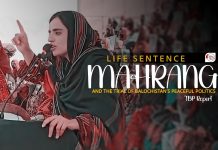

















The life sentences handed to prominent Baloch rights activist and Baloch Yakjehti Committee (BYC) chief organiser Dr Mahrang and central leader Sibghatullah Shahji have drawn widespread condemnation from political leaders, journalists and human rights activists.
An anti-terrorism court in Quetta convicted the two BYC leaders on murder and terrorism charges in connection with the death of Frontier Corps (FC) official during a 2024 protest in Gwadar.
Prosecutors accused them of inciting protesters who allegedly attacked the FC personnel after stones and sticks were thrown at a forces vehicle. Dr Mahrang, Sibghatullah and their legal team denied the allegations and boycotted the proceedings, describing the jail-based process as a “faceless trial.”
‘Peaceful struggle criminalised’
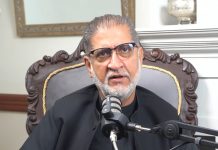
Balochistan National Party (BNP) President Sardar Akhtar Mengal questioned the legitimacy of the proceedings and said the ruling had further undermined confidence in the legal system.
“When decisions are made behind closed doors, without judges, the accused, or their lawyers present, what remains of law, justice and the Constitution?” he said.
Mengal said such protections appeared to be “reserved for a select few,” adding that the treatment of Balochistan amounted to “mocking democracy and the judiciary.”
In another post, he questioned why decades of alleged extrajudicial killings, enforced disappearances, mutilated bodies and homes being set on fire had not resulted in similar accountability.
“How many people involved in these crimes have been brought before a court?” he asked.
Former senator Afrasiab Khattak said the convictions had “shut the doors for a peaceful political solution.”
“It is a colonial and myopic policy that prefers violence over peace,” he said, adding that those who had advocated negotiations with the Taliban in Afghanistan were refusing dialogue with the Baloch.
National Democratic Movement (NDM) Chairman Mohsin Dawar described the proceedings as a “faceless, sham trial.”
“The life sentences given to Dr Mahrang Baloch and other BYC leaders are a grave injustice and an attack on peaceful political struggle,” he said.
“Attempts to silence dissent through repression will not resolve grievances, nor will they silence dissent,” he added.
Journalist and human rights advocate Munizae Jahangir said Dr Mahrang had not received a fair trial or due process, warning that punishing those committed to peaceful and constitutional politics could strengthen support for violent alternatives.
“What a shame that we are punishing those standing for enforced disappearances,” she said, describing the verdict as “another grave mistake” that would weaken democracy and the state.
Security analyst Muhammad Amir Rana said the convictions might “satisfy the ego of a few individuals” but would do little to address the underlying crisis in Balochistan.
Former Dawn editor Abbas Nasir described Dr Mahrang’s sentence as a “travesty.”
“There can be no greater travesty,” he said.
Norway-based Journalist Kiyya Baloch said sentencing a peaceful activist to life imprisonment for campaigning against enforced disappearances sent “a chilling message” that peaceful activism would not be tolerated.
“If peaceful dissent is criminalized, what alternatives are people left with?” he asked.
In another post on X, Kiyya said the verdict appeared intended to tell young people that there was no space for peaceful political struggle.
Journalist Mubashir Zaidi also condemned what he described as a harsh sentence.
“Their only crime was to protest peacefully. Our state will never learn,” he said.
Senator Mushtaq Ahmed condemned the sentences against the BYC leaders, saying democratic voices could not be silenced by describing peaceful struggle and demands for rights as terrorism.
He accused the state of indiscriminately applying labels of treason and terrorism under what he called its “hard state” policy.
BNM Chairman Dr Naseem Baloch described the verdict as part of an ongoing crackdown on Baloch political leaders and human rights defenders.
“This verdict is an attempt to silence dissent, intimidate activists and force Baloch leaders to abandon their principled stance,” he said in a video statement.
He said the prosecution reflected a broader effort to criminalise political activism and discourage advocacy against enforced disappearances, extrajudicial killings and other alleged rights violations.
Baloch Women Forum (BWF) Chief Organiser Shalee Baloch criticised what she described as a “non-transparent and controversial judicial process.”
She said the sentences violated the principles of justice and fair trial and formed part of an attempt to suppress political voices and treat dissent in Balochistan as a crime.
She appealed to lawyers and human rights defenders in Pakistan and abroad to raise their voices against the ruling.
‘Selective justice’
BYC leader Dr Sabiha Baloch said the verdict was “not about justice” but about “making a peaceful struggle criminal.”
She contrasted the convictions with the absence of accountability over the deaths and injuries of participants during the “Baloch Raaji Muchi” , alleging that attempts to register cases against Pakistani forces personnel had been rejected.
“Instead of providing justice to the victims, the victims of state brutality are being held accountable through staged trials,” she said.
Academic Nida Kirmani said the widespread support for Dr Mahrang showed that people did not believe what she described as the state’s “fabricated narrative.”
“Those claiming victory should remember that a regime built on a foundation of lies stands on shaky ground,” she said.
Alifya Sohail questioned the prosecution case, claiming that the principal accused named in the FIR had already been acquitted while Dr Mahrang and Sibghatullah Shahji were convicted.
“At least improve the quality of your lies,” she said.
Journalist Veengas said the ruling had vindicated Dr Mahrang’s criticism of discrimination and injustice in Balochistan.
“Yesterday’s decision against her and Sibghatullah exposed the unjust system in Balochistan and proved her point: there is no justice, no democracy and no free speech,” she said.