















By: Saba Jameel
For decades, Balochistan has remained at the centre of one of the region’s most contested conflicts, shaped by insurgency, counterinsurgency operations, enforced disappearance allegations and competing narratives that have deeply affected public discourse.
In recent years, however, the information battle surrounding the conflict has become almost as significant as the fighting itself. Pakistan’s military regularly releases statements through its media wing, the Inter-Services Public Relations (ISPR), announcing operations against those it describes as “terrorists” or members of banned armed groups.
Baloch armed organisations, meanwhile, issue their own claims through affiliated media channels, often presenting sharply different accounts of casualties and battlefield developments.
Amid these competing narratives, one question remains central: who verifies the dead?
Access to conflict zones remains restricted, independent observers are largely absent, and casualty figures are often left to official statements, armed group claims, local accounts, hospital records and family testimonies that cannot always be independently assessed.
The result is a widening trust deficit in which casualty figures are not merely statistics. They have become part of a broader struggle over truth, accountability and public memory.
Operation Shaban and the Latest Military Campaign
In July 2026, Pakistan’s military announced a major operation in Shaban Valley and surrounding areas, roughly 35 to 45 kilometres from Quetta, the capital of Balochistan.
The operation, named “Operation Shaban”, followed a series of security incidents in the region and came after a high-level visit to Quetta by Pakistan’s Chief of Army Staff and the Prime Minister.
The immediate trigger was an incident in the Hanna Urak area of Shaban Valley, where armed men reportedly killed four people and abducted nine others. The abducted individuals were later released after several days of negotiations between suspected Pakistani Taliban fighters and local intermediaries.
A day later, another major attack targeted a police station in Ziarat district. According to officials, nine policemen, including two station house officers, were killed, while 27 policemen were reportedly taken hostage.
Eight policemen were later released, while the bodies of 19 personnel were recovered on July 7 from an area approximately 15 to 20 kilometres from Quetta.
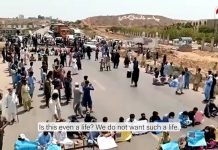
The Pakistani Taliban (TTP) claimed responsibility for both attacks and released video footage through its official media platform, Umar Media. The incidents triggered protests in Quetta, where families and residents staged a sit-in with the bodies of the deceased police personnel. The killings also drew condemnation from political leaders and international observers.
A Surge in Attacks and the State’s Response
The attacks came amid a broader surge in armed activity targeting Pakistani forces, alleged government-backed armed groups and state infrastructure across Balochistan.
Baloch armed groups, including the Baloch Liberation Army (BLA) and the Balochistan Liberation Front (BLF), claimed responsibility for several attacks during the same period, including four major operations.
Following these developments, Pakistan’s military announced the launch of Operation Shaban.
In a statement, ISPR claimed that 114 militants belonging to groups it described as “Fitna-ul-Hindustan”, a term used by Pakistan for Baloch armed groups, and “Fitna al-Khawarij”, its term for the Pakistani Taliban, had been killed during operations in Shaban between July 5 and July 13.
But as with many previous military claims from Balochistan, the central question remains unresolved: how were these figures verified, and by whom?
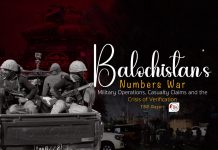
The Numbers War
Casualty figures have long been one of the most contested elements of Balochistan’s conflict.
During a press briefing covering military operations in 2025, ISPR Director General Lieutenant General Ahmed Sharif Chaudhry said Pakistani forces had conducted 58,778 intelligence-based operations (IBOs) in Balochistan during the year.
That figure translates to an average of about 161 operations per day.
The military also claimed that 784 militants were killed during those operations. However, independent verification of such figures remains difficult because of restricted access to affected areas, limited independent monitoring and the absence of transparent post-operation documentation.
In one example, ISPR announced in January 2025 that Pakistani forces had conducted an operation against a militant hideout in Kachhi (Bolan) district, killing 27 insurgents.
Local sources later questioned the claim, saying no bodies were publicly presented at civilian hospitals and no independent visual evidence from the scene was released.
Similar questions have surrounded casualty figures from operations in 2026. Pakistani officials have said that around 24,718 operations were conducted in Balochistan during the first six months of the year, while also claiming that 991 militants were killed nationwide in counterterrorism operations.
In the absence of independent access, such figures remain difficult to assess beyond the official statements in which they are announced.
Operation Herof 2.0 and Conflicting Accounts
The dispute over casualty figures was also visible during the BLA’s six-day offensive in Balochistan from January 31 to February 2026, which the group described as “Operation Herof 2.0”.
The ISPR stated that after a week-long campaign, 216 militants were killed.
The BLA gave a different account, saying 93 of its fighters were killed during six days of coordinated attacks, including 50 members of its suicide unit, the Majeed Brigade.
The group later released photographs, biographies and videos of several fighters, claiming responsibility for the operation and identifying its members.
The conflicting accounts highlighted a recurring challenge in Balochistan: both sides release casualty claims, but independent confirmation remains extremely difficult.
Missing Evidence and Questions of Verification
An examination of casualty reporting in Balochistan raises broader questions about transparency and evidence.
In interviews with multiple health department sources and police officials, who requested anonymity due to the sensitivity of the matter, concerns were raised that bodies of alleged militants killed during major military operations are often not processed through civilian hospitals.
Some officials claimed that, in many cases, Pakistani forces handle bodies independently. This, they said, limits opportunities for medical examination, identification, hospital registration or public verification.
Critics argue that some military casualty claims rely primarily on official statements rather than publicly available evidence, including photographs, videos, hospital records, forensic reports or confirmation from local civil authorities.
Human rights organisations have repeatedly raised concerns about Pakistan’s counterinsurgency operations in Balochistan, including allegations of enforced disappearances and extrajudicial killings.
Families of missing persons have long accused state institutions of detaining individuals who later appear in official accounts as militants killed during encounters.
Rights activists also allege that, in some cases, families are pressured to sign documents stating that missing relatives were killed in security operations. They argue that such practices obscure the long-standing issue of enforced disappearances in the region and blur the line between battlefield deaths, custodial killings and unidentified bodies.
The Pakistani military has repeatedly rejected allegations of systematic human rights violations and maintains that its operations target armed groups it accuses of carrying out attacks.
A Conflict Without Independent Verification
The information war in Balochistan has produced a deep trust deficit.
Military authorities present operations as necessary actions against armed groups threatening Pakistan’s security. Baloch nationalist groups and human rights organisations, however, argue that civilian suffering, enforced disappearances and accountability concerns remain unresolved.
With both sides presenting competing casualty figures, the absence of independent monitoring has made it difficult to establish a complete picture of the conflict.
In many cases, the public is left with official figures, armed groups’ counterclaims, local reports, and family testimonies, none of which can be fully assessed without access to the affected areas.
This lack of verification has consequences beyond individual incidents. It shapes public perception, deepens mistrust and allows each side to accuse the other of manipulating facts.
International Precedents
Around the world, disputed conflicts have often required independent monitoring mechanisms to establish more credible records of casualties and alleged abuses.
During the Kosovo conflict of 1998 and 1999, international organisations, including the Organization for Security and Co-operation in Europe (OSCE) and later the International Criminal Tribunal for the former Yugoslavia (ICTY), investigated alleged war crimes and civilian deaths. Investigators collected witness testimonies, examined forensic evidence and documented mass graves, creating an independent record that was later used in legal proceedings.
During Sri Lanka’s civil war, the United Nations investigated allegations of mass civilian casualties in the final stages of fighting between government forces and the Liberation Tigers of Tamil Eelam (LTTE). Despite disagreement from the Sri Lankan government, the UN panel relied on witness interviews, satellite imagery and available evidence to assess the scale of civilian suffering.
In Syria, where multiple armed actors have operated for more than a decade, the United Nations Independent International Commission of Inquiry has documented casualties and alleged violations by different sides. Because of restricted access, investigators have relied on remote documentation, survivor testimonies, digital evidence and satellite analysis to verify incidents.
Similar efforts have also operated in Afghanistan and Iraq, where international bodies and independent projects attempted to maintain casualty databases by cross-checking media reports, hospital records, official statements and field investigations.
These examples show that even in highly polarised conflicts, transparent methodology and independent verification can help reduce disputes over casualty figures.
The Case for Independent Monitoring in Balochistan
For Balochistan, where both state forces and armed groups regularly release competing casualty claims, analysts and rights observers argue that an independent monitoring mechanism could help establish a more accurate record.
Such a mechanism could involve international observers, human rights organisations, forensic experts, medical professionals and local sources. Its role would not be limited to verifying battlefield deaths, but could also include documenting civilian casualties, unidentified bodies, enforced disappearance allegations and claims made by all sides.
Without such a process, casualty figures in Balochistan will remain trapped between competing narratives. Government statements and militant claims will continue to circulate without independent confirmation, while affected communities will remain uncertain about the fate of those killed, detained or disappeared.
A transparent monitoring system could provide accountability, reduce misinformation and give families a more reliable record of the conflict.
Until then, the numbers emerging from Balochistan’s conflict will remain part of a wider information struggle, where facts are contested, evidence is limited and public trust remains deeply divided.