













By Fareed Baloch
Sohinda is not a town centre, and those who pass through it are rarely strangers to the land. It is a rural stretch of Zehri where a road runs between dry hills, scattered homes, fields and orchards, linking small settlements that depend on one another for work, water and family life.
On ordinary mornings, men travel along these roads to inspect land, water fields, tend orchards or visit family members in nearby villages. The distances are local, the journeys familiar, and the reasons rarely remarkable.
On 16 April 2026, several men from Zehri and surrounding areas were travelling through Sohinda in much the same way.
By the end of the day, eleven of them were dead. One man survived with severe injuries.
What Happened in Sohinda
That morning, the men had not set out together. Their journeys began on different roads across the same rural belt: from fields, orchards, family homes and small settlements around Sohinda, Rasa, Zawah and Lehr.
Families and local sources said they were stopped at different points during the military operation and taken towards Sohinda Rest House, about five kilometres from Noorgama.
It was there, according to those accounts, that the men were held with their hands and feet tied and their eyes covered before being shot dead.
The Balochistan Post was able to collect details about nine of those affected, including the injured survivor, Abdul Salam. Most of the identified men were farmers, agricultural workers or men travelling between nearby villages.
Mohammad Sharif, a resident of Kohing in Kalat who had recently been living in Garrari, Zehri, was returning from the fields that day. He worked as a farmer near Zehri Ghulam Bhat and had gone to water crops when, according to a local source familiar with his family, he was stopped at Sohinda on his way back.
“He had gone to the fields like any other day,” the source said, describing him as a farmer who was returning from routine work when he was taken.
Four others had travelled for a family visit. Mohammad Ramzan, Habib, Saeed Ahmed and Imam Bakhsh worked in the orchards of Zawah and had gone to Lehr to visit their relative, Mohammad Qasim, son of Mohammad Jan Jattak.
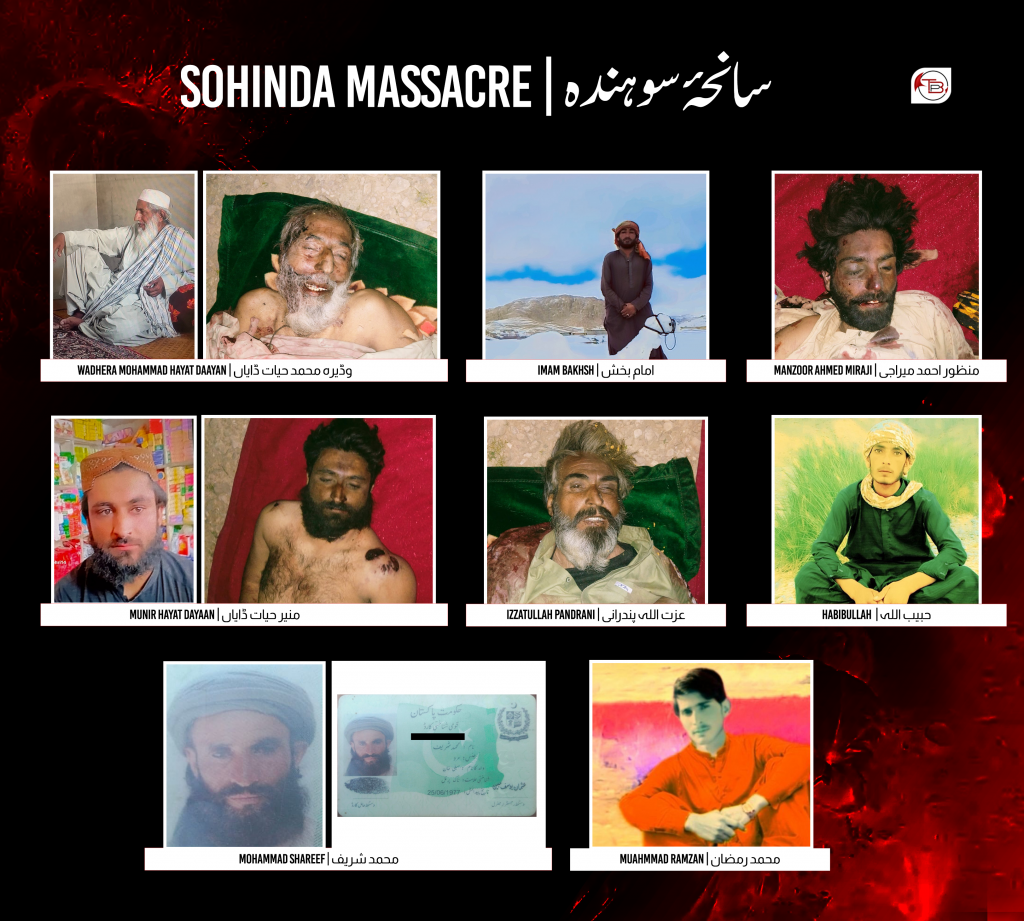
In another account, Munir Hayat, son of Muheem Khan, a resident of Khari Zehri, had left Zehri with Wadera Mohammad Hayat, son of Wadera Khuda Bakhsh. Local sources said they were going to inspect Mohammad Hayat’s land and meet family members when they were stopped in Rasa and later killed.
Manzoor Ahmed, son of Haji Miraji, had been working in agriculture in Aarchaeni, Zehri, where he was using a boring machine for farming work. He was also among the men later identified in the accounts gathered after the killings.
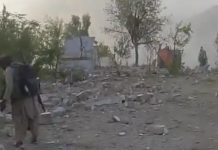
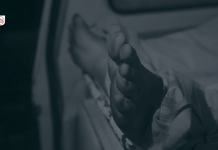
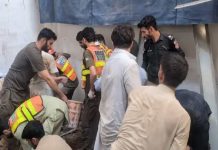
Images and video from the aftermath, documented by The Balochistan Post, showed several victims after their bodies were recovered, with some appearing to have their hands and feet tied and their eyes covered.
The Previous Day
The killings came a day after the Baloch Liberation Army said two of its fighters had been killed in clashes with Pakistani forces in the Sohinda area.
In a statement, the BLA said its fighters had targeted advancing infantry personnel on 15 April with a remote-controlled explosive device, before later ambushing a convoy moving towards the area.
The group claimed 10 Pakistani personnel were killed in the two attacks. It named its own dead as Tanveer Mengal and Sadullah.
The next day, the BLA alleged that Pakistani forces and state-backed armed groups locally referred to as “Death Squads” had detained civilians in the area in the area “out of frustration” and shot 11 of them dead.
Such disputes over the identities of those killed are not uncommon in Balochistan. Rights groups, families and local observers have repeatedly alleged a pattern in which, after armed groups inflict losses on the Pakistani military, state forces detain civilians or present men already in custody as militants killed in armed encounters.
An analyst who monitors Baloch armed groups said the BLA’s own casualty-reporting practice was relevant when assessing competing claims about the identities of those killed in Sohinda.
“When the BLA loses fighters, it names them, gives their aliases and describes their operational role,” the analyst said.
The analyst cited the group’s statement on “Operation Herof 2”, in which it publicly named 93 fighters it said had been killed, as an example of that practice.
A Pattern of Alleged Retaliation
The Sohinda killings came after months of tension in Zehri, where residents say armed attacks on Pakistani forces were repeatedly followed by military operations that reached civilian areas, leaving homes damaged, fields disrupted and daily life restricted.
The cycle intensified on 11 August 2025, when fighters of the Baloch Raaji Aajoi Sangar (BRAS), an alliance of Baloch armed groups, took control of parts of Zehri after clashes with Pakistani forces. BRAS said its fighters ambushed a convoy of 13 military vehicles, killed 37 soldiers and seized military equipment.
Images of dead Pakistani personnel, destroyed vehicles and hanging uniforms later circulated on social media.
Residents said the military response that followed extended beyond positions held by armed fighters. Homes were hit, crops, water sources and solar systems were damaged or destroyed, and families reported arbitrary detentions and enforced disappearances.
In September, three members of the Pandarani tribe were killed when an airstrike hit their home. Two days later, a drone strike near Tarasani hit people returning from a condolence visit, killing Bibi Amna, Lal Bibi and Muhammad Hassan. Five others were injured, including a four-year-old child and a 65-year-old man.
Even after the initial BRAS offensive ended, the Baloch Liberation Army, one of the groups in the alliance, said it maintained control of parts of Zehri and foiled several attempts by Pakistani forces to advance. On 26 September, the BLA said its fighters ambushed a convoy of 10 military vehicles in Anjeera, directly hitting four vehicles and destroying two, and claimed that more than 15 Pakistani soldiers were killed.
The next day, Pakistani ground troops entered Zehri with gunship helicopters, battle tanks and a large number of troops, residents said. On 1 October, a drone strike in Noorgama killed four civilians sitting near cotton fields.
By 4 and 5 October, residents said, the operation had tightened into curfew. Zehri’s only civil hospital was taken over and converted into a military camp, while movement was restricted indefinitely.
Life Under Curfew
In the months that followed, residents said, curfew became part of daily life in Zehri.
Large parts of the area, including Anjeera, Nichari, Pandran, Noorgama and Kambi, remained under military restrictions. Movement between villages was limited, markets operated under pressure, and families struggled to obtain food, water, fuel and medicine, residents said.
The area’s only civil hospital had also been taken over and converted into a military camp, residents said, leaving the wounded and sick with few options for treatment.
The restrictions also cut Zehri off from the outside world. Internet and mobile services remained suspended in several areas, making it difficult to verify the full scale of arrests, casualties and disappearances.
It was under these conditions that The Balochistan Post documented the killings in Sohinda. Residents and local sources said the scale of military operations, raids and communication restrictions in Zehri meant other accounts may still have yet to emerge.
Several families have since left the area for Khuzdar, Hub Chowki and other towns after weeks of surveillance, raids and fear, The Balochistan Post has learned.
The situation in Zehri has also been raised by human rights organisations, including Amnesty International and the Human Rights Commission of Pakistan, which have called for essential services to be restored, detainees to be released and allegations of abuses to be investigated.
Pakistani authorities have not issued a detailed public account addressing the allegations of civilian killings, the alleged denial of medical care or the reported conversion of Zehri’s civil hospital into a military camp.
Sohinda still lies between the same dry hills, fields, orchards and settlements. But for the families of the dead, the road no longer carries only the routines of rural life.
It carries the memory of men who left home for ordinary reasons and did not return.