
























By Nouk Aap
On 22 June 2026, Pakistan sentenced Dr. Mahrang Baloch to life imprisonment. There was a judge. There were charges. There were penal code citations. On paper, it looked like justice. In reality, it wasn’t.
The trial moved from an open courtroom to a jail. Then it moved again. Her own lawyers called it a faceless trial. The state appointed her defence lawyer. That lawyer never once spoke to her. Mahrang and her co-accused could only attend through a video screen. Their real lawyers were kept out.
Pakistan presented this as justice. Balochistan’s so-called Chief Minister, Sarfraz Bugti, celebrated the verdict in public. He said the blood of the slain Frontier Corps soldier would not go in vain. He said the state would always remember the soldier’s sacrifice. Former caretaker Prime Minister Anwar-ul-Haq Kakar called the verdict a victory of accountability over impunity.
Mahrang Baloch, who is a trainee surgeon and a nominee for the Nobel Peace Prize, is the central leader of BYC. TIMEmagazine named her among the world’s 100 most influential people. She was arrested in March 2025 while leading a sit-in in Quetta. She has been given a life sentence for allegedly delivering a speech at Raji Muchi in Gwadar in July 2024 that the court decided made her responsible for the death of a Frontier Corps soldier somewhere in the crowd.
She said from prison that conflating peaceful political movements with armed separatist groups was deliberate propaganda. The court was not interested. Additionally, BYC also rejected the claim, pointing out that the same FIR under which Mahrang and other accused were charged appears to have been issued twice: once against Mahrang, and again, with a different date, against another individual who was later released after the case against him could not be proven. This raises the question of how the same FIR could be issued twice, on different dates, against different accused.
This is the pattern being used in Balochistan. It has run for more than two decades. This is not a failure of law. This is colonial law, repurposed to crush dissent.
As Mahrang mentioned in a letter published in The Guardian: “State violence means no home in Balochistan is safe. Enforced disappearances are widespread; victims are killed in staged encounters; relatives are targeted, and now even women, including a disabled student and a pregnant mother, are forcibly disappeared.”
BYC documented over 1,250 enforced disappearances in 2025 alone. Bodies found by roadsides with bullet wounds. People taken from hostels, from homes in front of their family members, from hospital corridors at midnight. Pakistan’s own Commission of Inquiry acknowledged approximately 3,000 missing persons in Balochistan since 2011.
These numbers should have broken through. They have not. To understand why, you have to look honestly at what Pakistan has become.
To call Pakistan a democracy requires a particular kind of wilful blindness. Field Marshal Asim Munir, the army chief, now holds, by constitutional amendment, a power that no Pakistani military officer has ever formally held before. In November 2025, the 27th Constitutional Amendment was pushed through parliament in under three hours, with the opposition boycotting and being removed from the debate. It created the post of Chief of Defence Forces, held by the army chief, placing the navy and air force formally under his command. It granted him lifetime legal immunity. It stripped the Supreme Court of jurisdiction over constitutional cases and created a new Federal Constitutional Court whose judges are appointed by the government.
Israr Jattak, a constitutional lawyer, called it “the death knell of an independent judiciary.” PTI spokesman Zulfikar Bukhari said, “You cannot force a constitution through bullets.” The opposition walked out. The amendment passed.
The man who built this has also, in the same period, positioned Pakistan carefully on the global stage, leveraging the May 2025 conflict with India, building closer ties with Arab states, and gaining the trust of Washington. Trump called Munir his favourite Field Marshal. The Prime Minister hailed the constitutional changes as institutional harmony. The machinery of Pakistani democracy continues to exist as a surface; there are ministers, sessions, and press releases, while actual decisions flow from a different address entirely. Imran Khan sits in jail. Mahrang Baloch sits in jail. The constitution that was supposed to protect both of them was rewritten, hastily, in November 2025, to protect the man responsible for their imprisonment.
This is the context in which Mahrang’s trial occurred. The judiciary that might have checked it had already been defanged. The constitutional protections she might have invoked had already been amended around her. The state-appointed lawyer who supposedly defended her had never spoken to her. She was convicted on the basis that she had called state officials “occupiers” in a speech which, in any functioning democracy, would be called political expression. Here it was called incitement to murder.
There is a concept that helps explain how this becomes possible without the world registering it as the outrage it is. In 1991, the French philosopher Jean Baudrillard published a set of essays, later collected as The Gulf War Did Not Happen, in which he argued that the first Gulf War was the first conflict to be conducted primarily as a media event. The bombs were real. The deaths were real. But what reached the public was something else: clean graphics, briefing-room confidence, precision-strike footage that looked more like a video game than a war. The managed image replaced the reality so completely that the real war, the one with burning bodies and terrified civilians, essentially did not happen in any space where it might generate political consequence.
Baudrillard was a provocateur, and not everyone agreed with him, but the observation at the core of his argument was serious: when a state controls the frame through which an event is seen, it can determine what the event is understood to be, regardless of what is actually occurring.
What is happening to Balochistan follows exactly that logic. The crisis is documented. It is reported. Amnesty International has condemned the verdict against Mahrang. The UN has expressed concern. And yet it is, in the space of global political consequence, not happening at all. Pakistan produces a presentable image — counter-terrorism operations, legal procedure, a verdict with a penal code citation — and that image travels the world while the reality it conceals stays in Balochistan.
The silence around it is not ignorance. It is chosen. Pakistan has made itself useful enough to enough powerful actors that it is always, for someone important, the wrong time to push too hard. The names of the disappeared do not appear in those calculations. Mahrang, watching her own life sentence delivered through a prison video screen, does not appear in those calculations.
Judith Butler, an American philosopher whose 2009 book Frames of War asked a question that sounds simple and cuts very deep: when is a life grievable?
Butler was writing in the aftermath of the wars in Iraq and Afghanistan, trying to understand why certain deaths produced public mourning and political pressure while others — the deaths of Iraqi civilians, of Afghan villagers — were barely registered. Her argument was that grievability is not automatic. It is produced. The frame, the media image, the political language, the cultural assumption determine whose suffering registers as real and whose is rendered invisible or justified.
A dead soldier from a Western country is grievable. A disappeared student from Balochistan is, in the dominant frame, a security problem. The frame is not neutral. It is a political choice made by those with the power to make it, and it has consequences that are entirely material: when a life is not made grievable, its destruction requires no accounting.
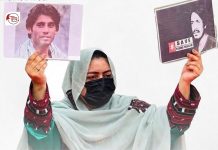
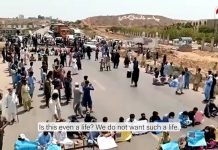
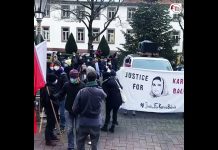
Mahrang Baloch understood this better than most. The entire strategy of BYC was a war against that frame. Make the suffering visible. Hold the photographs of the missing in public squares. March in numbers too large to ignore. Insist that these are people, with names, with families who are still waiting.
The state’s answer was to absorb that strategy and turn it inside out. Instead of disappearing Mahrang the way it disappears others, into unmarked detention and silence, it ran her through a process that looked like law. Instead of a body by a roadside, it produced a verdict. The procedure of justice replaced justice itself, and the result was more internationally presentable than a bullet would have been. Pakistan could point to it. The frame had done its work.
Nadia Baloch, Mahrang’s sister, announced that they would appeal. BYC members asked how many voices could be silenced before silence became impossible to maintain. These are not rhetorical questions. They are the sound of people who are still here, still speaking, still refusing to disappear on schedule.
No frame holds forever against what it is trying to hide. The bodies accumulate. The names accumulate. The life sentences handed to Nobel nominees accumulate. At some point, the weight of what is being suppressed becomes greater than what any legal amendment or diplomatic calculation can contain.
The only question is how many people get buried in the interval and who, in the end, is held responsible for deciding that their lives were not worth the trouble of seeing.
Disclaimer: The views and opinions expressed in this article are those of the author and do not necessarily reflect the official policy or position of The Balochistan Post or any of its editors.