







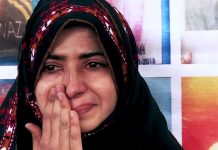


















Dr Mahrang Baloch, central organiser of the Baloch Yakjehti Committee (BYC), has filed an appeal in Pakistan’s Supreme Court challenging the rejection of her bail application following her arrest.
The petition was submitted through lawyer Jibran Nasir, who is representing Dr Baloch in the case. The appeal follows a decision by the Balochistan High Court on 23 February rejecting her request for bail.
Case
The matter relates to a First Information Report (FIR) registered at the Counter Terrorism Department (CTD) police station in Quetta on 6 January, 2026. The complaint was filed by Sub-Inspector Asghar Ali.
According to the FIR, Dr Baloch had been placed on the Fourth Schedule under Pakistan’s Anti-Terrorism Act (ATA) 1997, a list used to monitor individuals considered security risks. Authorities allege that she failed to comply with required attendance obligations and continued to participate in public gatherings and protest sit-ins.
The FIR also alleges that she provided support to the banned armed group Baloch Liberation Army (BLA). Those allegations have not been independently verified, and Dr Baloch and her supporters have previously rejected similar accusations.
The case was registered under Sections 11-EE and 11-F(1)(2) of the Anti-Terrorism Act, which concern membership of or support for proscribed organisations.
Detentions
Dr Baloch was first arrested on 22 March 2025 and detained for 30 days under the Maintenance of Public Order (MPO) law. Her detention was later extended twice for further 30-day periods.
She was subsequently formally arrested on 21 August 2025 in another case while still in state custody.
Earlier, on 12 June last year, she had also challenged her detention under MPO provisions. The Balochistan High Court later upheld that detention in a ruling issued on 22 May.
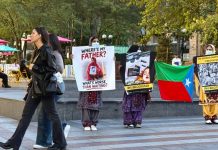
Dr Mahrang Baloch is one of the most prominent rights campaigners in Balochistan and has led demonstrations concerning enforced disappearances, detentions and broader civil rights issues in the region.
Her legal case has drawn significant attention and criticism from activists and observers, who view the proceedings as an important test of civic freedoms and the treatment of dissent in Pakistan.