


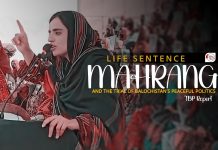













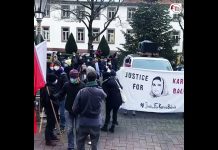




Swedish climate activist Greta Thunberg, the foundation of Iranian Nobel Peace Prize laureate Narges Mohammadi and PEN Norway have condemned life sentences handed to prominent Baloch rights activist Dr Mahrang Baloch and BYC leader Sibghatullah Shahji.
An anti-terrorism court (ATC) in Quetta sentenced the two activists on Monday in a case linked to the death of a Frontier Corps (FC) official during a 2024 protest in Gwadar.
The two leaders, other detained BYC members and their lawyers boycotted the proceedings over what they described as a “faceless trial” held inside Quetta jail.
In a statement following the ruling, Thunberg called the proceedings a “mockery of justice” and a “blatant attempt to silence the legitimate voices of the Baloch people.”
She described Dr Mahrang as a medical doctor and human rights defender who had transformed the grief caused by the enforced disappearance and extrajudicial killing of her father into a movement representing thousands of Baloch families.
“She is not a criminal; she is a medical doctor and a fiercely dedicated human rights defender,” Thunberg said, describing her as “the courageous voice for thousands of traumatised, voiceless Baloch families.”
Thunberg said Dr Mahrang’s only “crime” had been demanding basic human rights, adding that her struggle had remained centred on peaceful protests, long marches and demands for accountability over enforced disappearances.
“Dr Mahrang never carried a weapon. Her weapons were peaceful protests, long marches, and the undeniable truth,” she said.
Thunberg accused the Pakistani state of criminalising dissent and using anti-terrorism laws to imprison peaceful activists and portray them as enemies of the state.
“When bullets, threats, and enforced disappearances fail to break the resolve of human rights defenders, the state resorts to ‘judicial terrorism’,” she said.
Thunberg said the closed prison proceedings had removed transparency and denied the accused the right to a fair and open defence, describing the trial as “a predetermined setup, designed not to serve justice, but to execute political vengeance.”
She said the sentences were intended to “instil fear and paralyse a generation” that had spoken out against what she described as decades of exploitation and brutality, adding that the ruling was “an assault on the very soul of Balochistan and its struggle for dignity.”
In a separate joint statement, PEN Norway and the Narges Foundation expressed “deep concern” over the convictions, saying the use of closed prison proceedings and video-link hearings raised serious questions over judicial transparency, due process and compliance with domestic and international fair-trial standards.
The statement said such proceedings “undermine confidence in judicial independence, accountability, and the right to a fair and public hearing.”
They said they had followed Dr Mahrang’s case since her arrest in March 2025, adding that PEN Norway had previously raised concerns with Pakistan’s ambassador to Norway over her detention and the broader restrictions faced by Baloch human rights defenders.
The organisations called on Pakistani authorities to immediately and unconditionally release Dr Mahrang and other detained BYC activists and quash the convictions against her and Sibghatullah Shahji.
They also urged the authorities to end what they described as a crackdown on civil society, the arbitrary detention of human rights defenders and the criminalisation of peaceful activism.
Thunberg similarly urged the international community to demand an end to secret trials, the withdrawal of what she called fabricated charges and the release of the detained activists.
“Stand with Dr Mahrang Baloch. Stand with the BYC,” she said. “Silence is complicity.”