














Investigative Report by Saba Jameel
The recent presentation of Rahima Bibi at a press conference in Quetta by senior Pakistani officials has renewed attention on the complex realities of conflict, counter-terrorism, and human rights in Balochistan. Authorities described her as a key link in the facilitation network behind the November 2025 Nokundi attack, presenting the case as evidence of an evolving militant strategy involving the participation of women and alleged cross-border networks.
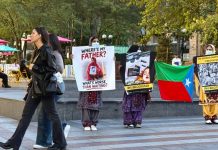
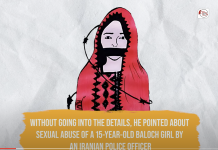
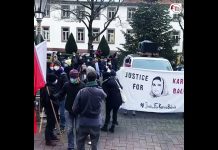
At the same time, parallel accounts from local sources, rights groups, and political activists challenge this narrative. They allege that Rahima was subjected to enforced disappearance for months before being brought forward under tightly controlled conditions. Reports and statements shared by groups such as Baloch Women Forum, PAANK and Baloch Yakjehti Committee have raised similar concerns about patterns of disappearance and later public presentation.
During the Quetta press conference, officials including Additional Chief Secretary (Home) Hamza Shafqaat and Counter-Terrorism Department representatives outlined a detailed account linking Rahima Bibi and her husband, Manzoor Ahmed, to the Nokundi attack. They claimed militant groups in Balochistan are increasingly relying on the participation of women and even children, describing this as both alarming and at odds with local social norms.
According to the official version, Manzoor Ahmed played a central role in facilitating a female suicide bomber who targeted the Frontier Corps headquarters in Nokundi. Authorities alleged that he provided shelter, arranged movement, and helped transport the attacker across the border into Afghanistan for training. After the attack, he reportedly fled to Afghanistan, reinforcing the state’s position that cross-border sanctuaries enable militant activity.
A video statement attributed to Rahima Bibi was also presented. In it, she said her husband brought an unidentified woman and her children to their home in Dalbandin in early November 2025 and took them away the next day. She claimed he later told her that the same woman carried out the suicide bombing. Officials further alleged that her identity and mobile phone were used to maintain contact with militant networks, framing her as part of the facilitation chain.
The Nokundi attack itself marked a significant escalation. It targeted a high-security compound linked to the Frontier Corps and major mining projects such as Reko Diq and Saindak, both of which are strategically important and involve foreign investment. According to official accounts, the attack began with a suicide blast at the main gate, followed by a prolonged siege lasting up to two days before all attackers were killed.
However, the Balochistan Liberation Front presented a very different version. The group claimed responsibility through its Sado Operational Battalion(SOB) and reported higher casualties among Pakistani forces. It framed the attack as a political message aimed at discouraging foreign investment in Balochistan.
The participation of a female suicide bomber marked a notable shift in militant tactics, which the Pakistani state has since emphasised in its narrative, linking it to “broader regional” militant networks and “external support” structures.
In the aftermath of the attack, security operations intensified in Dalbandin and nearby areas. Local accounts and independent investigations suggest that multiple raids were carried out in early December 2025. It was during these operations that Rahima Bibi and her younger brother, 18-year-old Zubair Ahmed, were allegedly taken into custody.
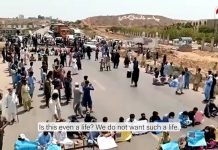
According to these accounts, their detention was based on a suspected phone call rather than concrete evidence. Families say they were not informed of their whereabouts, and authorities initially denied holding them. For nearly six months, both remained unaccounted for. Rights groups, including the Human Rights Council of Balochistan, have documented similar patterns of enforced disappearance across Balochistan.
Rahima’s sudden appearance at a press conference, without prior judicial proceedings or access to legal counsel, has raised serious concerns about due process and the conditions under which her statement has been obtained. Her case has also been highlighted in media reporting, including coverage by The Balochistan Post and earlier reporting on similar incidents involving missing women later presented as suspects.
Central to the case is the role of her husband, Manzoor Ahmed. While officials describe him as a key “facilitator”, alternative accounts portray him as a local driver with no known prior links to militant groups. According to these accounts, he fled Chaghi after the raids, fearing arrest, and crossed into the border region of Baramcha.
There, he reportedly sought shelter through local tribal intermediaries, including individuals such as Sardar Baqi and later Sardar Ismail Mengal. These figures are said to operate within overlapping spheres of tribal authority and state influence. Various sources have alleged Sardar Baqi of maintaining serious ties with Pakistan’s secret intelligence services. Some reports suggest that Baqi initially sheltered Manzoor while concealing his presence, possibly intending to hand him over later to Pakistani authorities in exchange for financial gain.
Subsequently, Ismail Mengal is believed to have facilitated negotiations that led to Manzoor’s surrender or handover to Pakistani authorities in February 2026. He has reportedly been in custody in Quetta since then. Critics argue that his profile was later elevated to fit a broader counter-terror narrative, transforming an ordinary individual into a central figure in a major security case.
The role of such tribal intermediaries adds another layer of complexity. They often act as negotiators, facilitators, and conduits between individuals in hiding and state institutions. In some cases, financial incentives may influence outcomes, raising questions about how individuals are labeled and presented in official narratives. In this context, the case of Manzoor Ahmed illustrates how local power structures can intersect with state objectives, potentially shaping narratives in ways that serve multiple interests. The possibility that arrests and surrenders may involve negotiated terms complicates the credibility of official accounts and highlights the need for independent verification.
Rahima Bibi’s case reflects a broader pattern that has been repeatedly highlighted by human rights organisations. In several instances, individuals previously reported missing have later been presented in press conferences and described as militants or facilitators. These presentations typically occur without court proceedings, independent verification, or legal representation. Statements are broadcast through official channels, shaping public perception before any judicial process begins.
Observers and activists, including voices on social media have repeatedly pointed to this pattern. In some past cases, courts have later dismissed such claims due to lack of evidence, raising further concerns about credibility.
The emphasis on the participation of women in insurgent narratives reflects both a real shift in tactics and a strategic framing by the state. While such participation is not unprecedented, rights groups argue that cases involving women often receive heightened attention and are used to strengthen state’s messaging.
At the same time, reports indicate a rise in enforced disappearances involving women. According to rights organisations, at least 14 women and girls have reportedly been disappeared since 2025, with several still missing. Additional cases have been highlighted by groups such as PAANK, reinforcing concerns about a growing trend.
This creates a complex reality in which women may appear in narratives as both participants in militant activity and victims of state practices. It underscores the need for careful, evidence-based investigation rather than reliance on unverified claims or media presentations.
The manner in which Rahima Bibi was presented raises fundamental questions about due process and the rule of law. International legal standards require that individuals accused of serious crimes be formally charged, granted access to legal representation, and presented before an independent court. The absence of these steps in this case undermines the credibility of the allegations and raises concerns about potential coercion.
Prolonged incommunicado detention, as alleged in this case, further compounds these concerns, as it creates conditions under which individuals may be pressured into making statements. The continued disappearance of her brother Zubair adds an additional layer of urgency, highlighting the broader issue of accountability in cases of enforced disappearance.
Without transparent legal proceedings, it becomes difficult to distinguish between legitimate counter-terrorism efforts and actions that may violate fundamental rights.
The case of Rahima Bibi captures the deep tensions that define Balochistan’s conflict landscape. On one side is the state’s effort to combat insurgency and demonstrate operational success. On the other are persistent allegations of enforced disappearance, coercion, and narrative manipulation.
The lack of independent verification, absence of judicial oversight, and reliance on media presentations over legal processes weaken the credibility of official claims and contribute to public mistrust. At the same time, evolving militant tactics of insurgent groups, including the participation of women in attacks, present real challenges for the state.
Ultimately, the truth of Rahima Bibi’s case can only emerge through a transparent and impartial investigation carried out within a proper legal framework. Until then, her case remains part of a broader pattern in Balochistan, where individuals disappear, reappear under controlled circumstances, and become central to competing narratives shaped by both security concerns and human rights questions.