










By Fareed Baloch
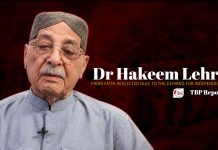
The Balochistan flag covered Dr Hakeem Lehri’s coffin as political leaders, activists and relatives gathered for his funeral on October 8, marking the end of a political career that spanned more than five decades.
Lehri, who died in Karachi on October 7 after a prolonged illness, had once believed that political change could be achieved through elected government. He was involved with the National Awami Party (NAP), which led Balochistan’s first elected nationalist government under Sardar Ataullah Mengal in 1972.
“I used to believe in our ability to change the situation through elected rule,” he recalled years later.
But by the end of his life, Lehri had abandoned that belief and become an outspoken advocate of Balochistan’s independence. His political transformation unfolded over decades of confrontation between Baloch nationalist movements and the Pakistani state, beginning with the dismissal of Mengal’s government in 1973 and the conflict that followed.
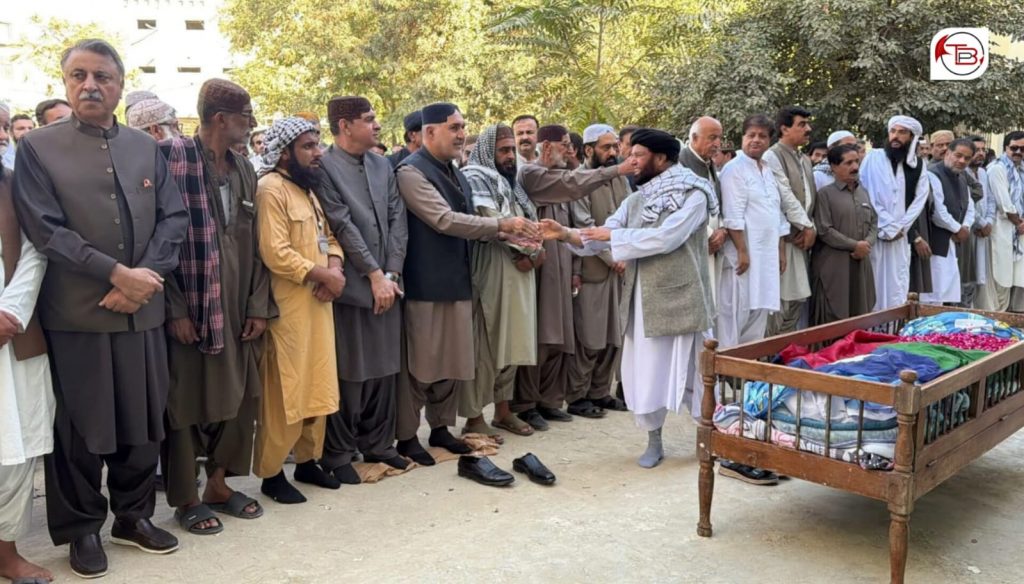
Baloch and Pashtun political figures, activists and relatives gather beside Dr Hakeem Lehri’s coffin, draped in the Balochistan flag, during his funeral. [TBP]
The Making of a Political Worker
Lehri’s political involvement began during the 1960s, when student activists were organising against military ruler Ayub Khan and the One Unit system, which had merged Pakistan’s western regions into a single administrative unit.
He was among the founding members of the Baloch Students Organisation (BSO) and developed a close association with Dr Abdul Hayee Baloch, whom he had known since 1966.
The student movement brought him into confrontation with the authorities. In a 2022 interview with Independent Urdu, Lehri recalled that Abdul Hayee was arrested in Karachi during protests against Ayub Khan and subsequently transferred to Mach jail in Balochistan.
Lehri said he would take supplies to the prison for his friend, although the authorities did not allow them to meet.
Political education was also an important part of his generation’s training. He later recalled regular lectures on politics, history and culture.
Lehri subsequently became involved with the National Awami Party (NAP), which brought together Baloch and Pashtun nationalist leaders and advocated provincial autonomy and greater recognition of national rights.
Recalling his NAP years in a later interview, he described sharing a dormitory with a Pashtun friend. They read leftist thinkers and translated material into their respective languages.
“He would translate it into Pashto; I into Balochi. They were fantastic times,” he recalled.
Following the abolition of One Unit in 1970, the NAP emerged as a major political force in Balochistan. Lehri became closely associated with Mengal and participated in political activities during his government.
A Government, Then the Mountains
In February 1973, less than a year after the National Awami Party took office in Balochistan, Zulfikar Ali Bhutto’s administration dismissed the government under Sardar Ataullah Mengal.
Lehri, then a member of the NAP, was among those who responded by joining the armed resistance against Pakistani forces. Recalling the events in a 2021 interview with BBC Urdu, he said he and his companions went into the mountains following the government’s dismissal and joined Baloch fighters.
He later took part in the fighting at Chamalang, one of the major battles of the 1973–1977 conflict, where Pakistani forces conducted extensive military operations against Baloch fighters.
“I was in Chamalang when a Pakistan Army division began bombing the area,” Lehri recalled.
The helicopters he recalled were American-made Cobra gunships, with guns mounted on either side.
“When we were in Chamalang, American helicopters hovered over our heads all day,” he said.
Lehri estimated that approximately 17,000 Pakistani soldiers were deployed against several thousand Baloch fighters.
“It was a one-sided war,” he said.
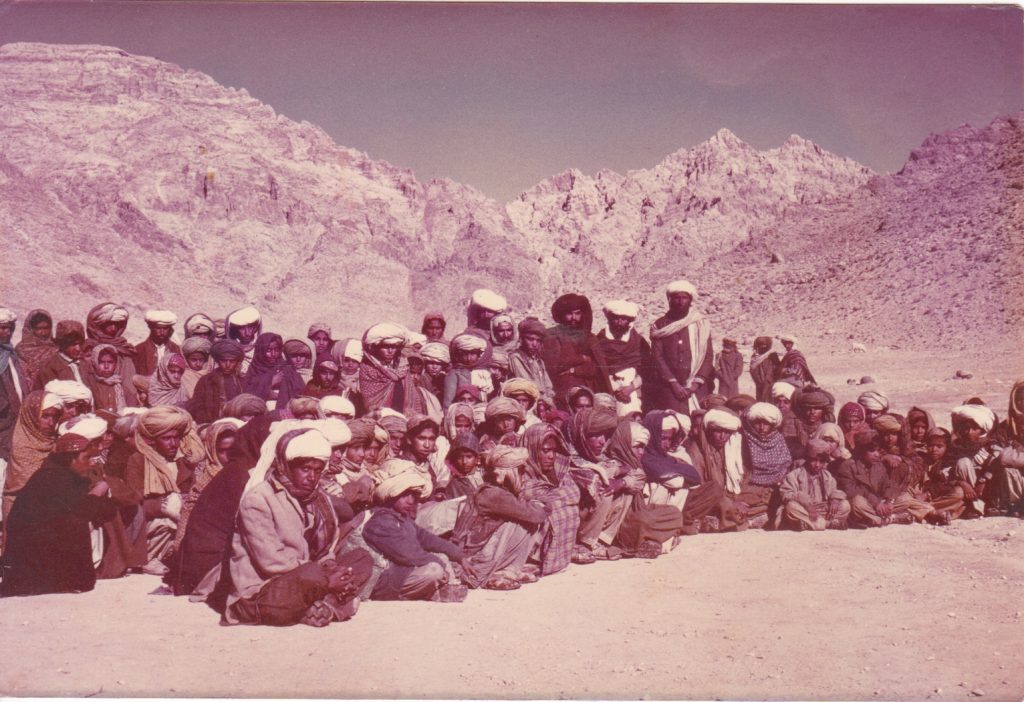
Baloch families in Afghanistan in 1978, after military operations displaced communities during the conflict in which Dr Hakeem Lehri joined the armed resistance. [Mir Mohammad Ali Talpur private photo archive]
Back to Organised Politics
Lehri returned to organised politics after the 1970s conflict and joined the Pakistan National Party (PNP), formed by veteran nationalist leader Mir Ghaus Bakhsh Bizenjo. He was among the former NAP activists who became part of the party’s leadership.
His involvement continued through subsequent divisions and mergers within nationalist politics. In 1996, a faction known as the Pakistan National Party (Lehri Group) joined two other nationalist groups in a merger that formed the Balochistan National Party (BNP).
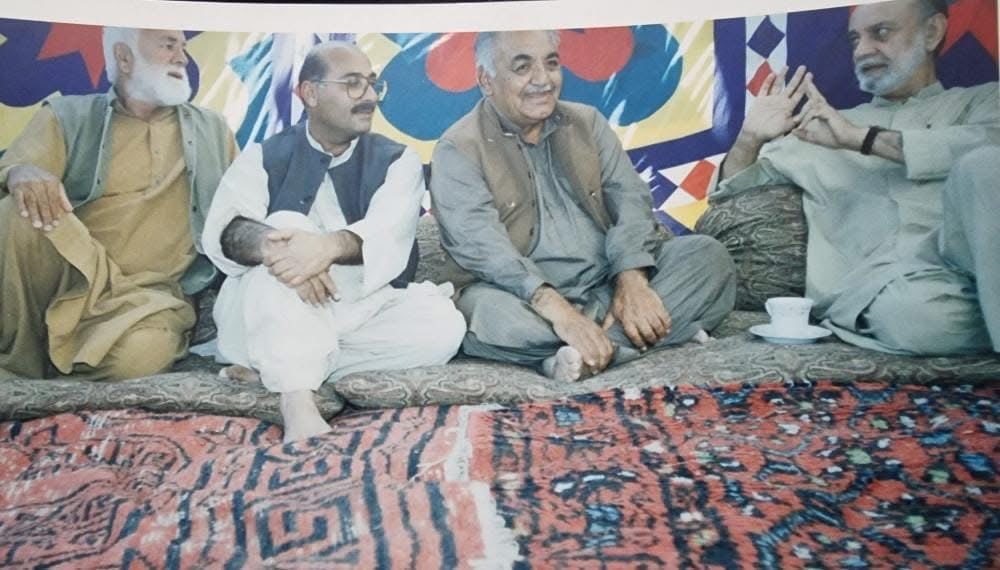
From left, Nawab Khair Bakhsh Marri, Dr Hakeem Lehri, Babu Abdul Rehman Kurd and Sardar Ataullah Mengal in Quetta in 1992. [Archive]
Lehri later contested National Assembly and Balochistan Assembly seats in the 2002 general elections on the platform of the Balochistan National Congress (BNC).
He subsequently served as president of the BNC and represented the party at a roundtable conference in Quetta in January 2005. Nationalist and other political leaders at the gathering urged the Pakistani state to address Balochistan’s political grievances through negotiations and opposed the use of military force.
Imagining a Country of Their Own
Lehri attended funeral prayers in absentia for Nawab Akbar Bugti in Quetta after the veteran nationalist leader was killed in a Pakistani military operation in August 2006.
The following month, he addressed a grand Baloch jirga in Kalat, convened by Khan of Kalat Mir Suleman Daud Ahmedzai. The gathering announced plans to approach the International Court of Justice (ICJ) over what it described as violations of historical agreements concerning the former State of Kalat, and demanded an end to military operations and greater control over Balochistan’s resources.
Lehri also spoke at a public meeting in Quetta’s New Kahan camp in November 2008 to mark the first anniversary of Nawabzada Balach Marri’s death. The speakers said Pakistan’s assemblies could not resolve the problems faced by the Baloch people and called for support for the resistance movement.
“Armed resistance is the only way to achieve our goal,” they said.
By 2009, Lehri had become a senior leader of the Baloch Republican Party (BRP), which advocated Balochistan’s independence.
When Pakistan’s government announced the Aghaz-e-Huqooq-e-Balochistan package that year, proposing political and economic measures to address grievances in Balochistan, Lehri rejected the initiative.
“We’re not interested in living with the corrupt Pakistani elite any more. We want freedom,” he told openDemocracy.
In a 2011 interview with the Swiss newspaper Le Temps, Lehri pointed to the breakup of the Soviet Union and Yugoslavia when discussing the possibility of an independent Balochistan.
“The Soviet Union disintegrated, Yugoslavia too. So why couldn’t we one day have our own country?” he asked.
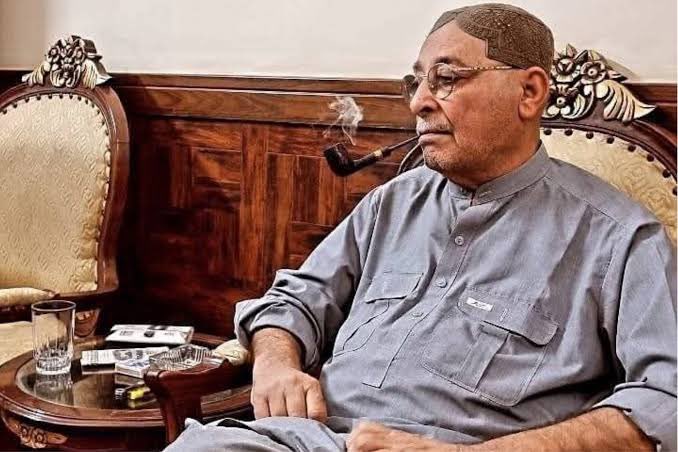
Dr Hakeem Lehri during an interview with Le Temps in Quetta in 2011. [Paul Menesson/Le Temps]
His rejection of parliamentary politics became more explicit ahead of Pakistan’s 2013 general elections, when some nationalist parties returned to electoral participation after boycotting the previous polls.
Lehri, then a senior BRP leader, urged nationalist parties not to participate, arguing that elections would not resolve the Baloch national question.
“Our party believes in the independence of Balochistan. The Baloch people want to be independent and want an independent country. Because we are slaves here,” he told Al Jazeera.
“Elections are not our problem. That is Pakistan’s problem. Our problem is that Pakistan must leave from here and give the power and independence to the Baloch.”
The Generations That Followed
Lehri remained committed to the demand for independence in his later years, even as the generation of nationalist leaders with whom he had begun his political career gradually passed away.
In September 2022, a year after the death of Sardar Ataullah Mengal and months after Dr Abdul Hayee Baloch’s passing, Lehri addressed the question of whether the loss of veteran nationalist figures had left a leadership vacuum.
“Living nations produce leaders,” he said in an interview with Independent Urdu.
He acknowledged that nationalist politics had become deeply divided, but expressed confidence that changing circumstances would eventually bring its different political forces together.
In April 2024, Lehri traced successive generations of Baloch resistance in a speech to mark the second anniversary of the Karachi University suicide bombing.
He recalled Khan Mehrab Khan’s confrontation with British forces in 1839, the struggles of Agha Abdul Karim Khan and Nawab Nauroz Khan, and the political campaigns and imprisonment of Mir Ghaus Bakhsh Bizenjo and Mir Gul Khan Naseer.
He also recalled military operations during General Pervez Musharraf’s rule and the killings of Nawab Akbar Khan Bugti, Balach Marri and other Baloch activists.
Turning to the contemporary armed movement, Lehri paid tribute to Shari Baloch, who carried out the April 2022 suicide bombing at Karachi University that killed three Chinese nationals and a Pakistani driver. He also praised Baloch Liberation Army (BLA) fighters involved in three major operations in early 2024.
Lehri had once recalled how Pakistani helicopters hovered over outnumbered Baloch fighters at Chamalang in the 1970s and described the fighting as “a one-sided war.”
Nearly five decades later, he was praising a younger generation that, within eight weeks, had launched Operation Dara-e-Bolan in Mach and Kolpur, attacked the heavily guarded Gwadar Port Authority complex and targeted the PNS Siddique in Turbat, Pakistan’s second-largest naval air base.
“The tree planted by our elders is now providing shade and bearing fruit,” he said.
“Today, Balochistan has become a volcano,” he added. “You said you would deal with the Baloch with an iron hand. But even iron hands will melt in a volcano.”