
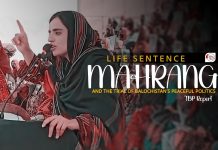



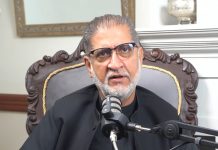






A discussion on governance and institutional challenges held in Islamabad saw an exchange of remarks between senior Supreme Court lawyer Latif Khosa and former caretaker Prime Minister Anwaar-ul-Haq Kakar over the case of jailed Baloch Yakjehti Committee (BYC) leader Dr Mahrang Baloch.
Speaking during the event, Khosa criticised the treatment of political activists and said that women were previously not subjected to such measures. Referring to Dr Mahrang Baloch, he said she had been linked to the Jaffar Express incident but was ultimately sentenced in connection with a separate case from Gwadar.
Responding to Khosa’s remarks, Kakar claimed that the assertions were based on hearsay. Khosa rejected the claim, saying, “This is not hearsay; I am Baloch.”
Kakar then replied, “You are Baloch, but not from Balochistan. I am not Baloch, but I am from Balochistan.”
During the discussion, Kakar referred to the Jaffar Express incident and claimed that several militants were killed during the operation. He alleged that the bodies were transported to Civil Hospital Quetta and claimed that Dr Mahrang Baloch had opposed efforts by security forces to take custody of the bodies.
Kakar further alleged that videos existed showing Dr Mahrang Baloch receiving the bodies of slain Baloch Liberation Army (BLA) members and that the deceased were later buried wrapped in BLA flags.
He argued that participation in an armed movement was not limited to carrying weapons, drawing a comparison between Ireland’s Sinn Féin and the Irish Republican Army (IRA), which he said shared political objectives while employing different methods.
The allegations made by Kakar against Dr Mahrang Baloch and the Baloch Yakjehti Committee are not new. He has raised similar accusations on previous occasions. However, no court ruling or publicly available evidence has established the allegations against Dr Mahrang Baloch or the organisation.
The remarks come amid continuing controversy surrounding the arrests, convictions and legal proceedings involving several BYC leaders and activists. Rights groups, legal observers and political organisations have raised concerns over the handling of such cases, while authorities have maintained that legal action is being taken in accordance with the law.