











By Yaran Diyar
From Dera Ghazi Khan to the mountains of Bolan, the story of a psychology student turned BLA commander reflects on the historical division of Baloch territories, a new generation’s political connections with the Baloch nationalist movement, and the implications for Pakistan’s control over the region.
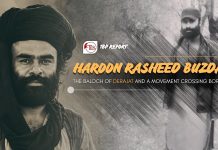
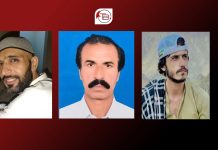
Haroon Rasheed Buzdar, alias Mubarak and also known by his pen name Wahag, was born in Chinala, in the Koh-e-Sulaiman mountains of Dera Ghazi Khan, a region administered as part of Pakistan’s Punjab province but historically associated with Baloch rule and identity. A psychology student, political activist, social worker and writer, he eventually joined the Baloch Liberation Army (BLA), becoming one of the organisation’s fighters from a region that many Baloch nationalists regard as part of their historical homeland.
The BLA announced that Haroon was killed on 20 September 2026 during an operation on the Lehri front in Balochistan’s Sibi district. His life, as described by his friends and the organisation, raises a question that extends beyond one man: are Baloch communities separated by provincial boundaries beginning to reconnect politically, and what might that mean for Pakistan?
Haroon studied psychology at the International Islamic University Islamabad and spent several years associated with the Baloch Students Organization Azad and the Baloch National Movement before joining the BLA in 2022.
His associates describe him as an avid reader interested in colonialism, identity and resistance. They say he helped organise nationalist political activity among young people in Dera Ghazi Khan and Taunsa, and participated in relief work following the devastating floods in Koh-e-Sulaiman in 2022, helping communities in tribal areas deal with the consequences of the disaster.
A historical homeland divided
Derajat region includes the areas of Dera Ghazi Khan, Dera Fateh Khan (Taunsa), Dera Ismail Khan and bordering areas of today’s Balochistan, and Sindh province. Its history is closely associated with the Baloch tribes. The region was founded by the Baloch chieftain Haji Khan Mirani in the fifteenth century and the three main districts named after his sons, Ghazi Khan, Fateh Khan and Ismail Khan.
Related: The Dissection of Balochistan
During the eighteenth century, Mir Naseer Khan I expanded the political influence of the Khanate of Kalat across parts of the wider Baloch region. Baloch historical accounts place Derajat within this broader history of Baloch political unity. Research drawing on the work of Baloch historians, including Inayatullah Baloch, maps Dera Ghazi Khan among the territories associated with the Khanate during Naseer Khan’s reign. Encyclopaedia Iranica also records the incorporation of Dera Ghazi Khan into the territorial reach of the Brahui confederacy under Mir Abdullah Khan, before Naseer Khan I came to power.
That political geography changed under British rule. Following the British annexation of Punjab in 1849, Dera Ghazi Khan came under the colonial administrative system. Historical research documents how British officials subsequently sought to consolidate control over Baloch tribal areas through administrative arrangements, alliances with tribal chiefs, land policies and coercive measures.
A study published in the Pakistan Journal of History and Culture, titled Settling the Frontiers: British Administrative Policy towards the Baloch Tribes of Dera Ghazi Khan (1849–1875), by Muhammad Fiaz Anwar and Irfan Hasnain Qaisrani, examines these policies. The authors describe how the British used financial and administrative support for tribal chiefs, settlement schemes, jirgas and military force to extend their authority. They argue that these measures changed the political organisation of Baloch tribes and strengthened the authority of selected chiefs.
Baloch nationalist historians interpret such policies as part of a wider imperial strategy that fragmented historically connected Baloch territories and weakened their collective political authority. From this perspective, the separation of Derajat from the political centres of Balochistan was not simply an administrative reorganisation but part of a process that divided communities with shared historical, cultural and tribal ties.
They argue that colonial rule institutionalised divisions between Baloch communities, some of which were subsequently maintained within Pakistan’s provincial boundaries. For Baloch nationalists, these changes represented the fragmentation of a wider homeland and the gradual separation of communities whose histories, kinship ties and political experiences had long overlapped.
This is the history that runs through Wahag Buzdar’s writing. In his essay in Urdu, which translates in English as Divide and Exploit, he argued that colonial rule had weakened Baloch unity by dividing territory, encouraging tribal rivalries and deepening differences in language and identity. He was particularly concerned about the distance that had grown between Baloch communities in Derajat and those in Balochistan.
Dera Ghazi Khan was also described as “Yaghistan”, meaning the land of rebels, in the study by Anwar and Qaisrani. Their research traces the term to the difficulty successive powers, including the Sikhs and the British, faced in establishing authority over Baloch tribes in the district. The authors particularly note the resistance of tribes living in the hills, including the Gurchanis, whose resistance to outside rule contributed to the region’s reputation.
However, according to various Baloch nationalist accounts from today’s Balochistan, the participation of the Baloch of Derajat in the wider Baloch nationalist political or armed movement had remained limited in the recent past. They often cite the historical and administrative division of these territories as one reason for this distance.
Dera Ghazi Khan’s involvement
Haroon Buzdar was not the only person from Dera Ghazi Khan associated with the BLA’s recent campaigns. The group also identified Maryam Buzdar, known as Sammi, and her husband, Rasheed Buzdar, known as Meeral, in statements concerning their participation in its armed activities. The BLA said Maryam joined its Majeed Brigade in March 2023 and that Rasheed, who was already a part of the brigade had been killed earlier.
Their cases raise questions about whether the movement is attracting a wider cohort of young people from Derajat.
Activists associated with BSO-Azad, BNM and other student and political circles, interviewed for this report, described a growing involvement of younger people from Dera Ghazi Khan and surrounding Baloch-populated areas in the wider Baloch movement during the current, often-described fifth phase of the insurgency.
According to these sources, participation has expanded through student organisations and political activity, while some young people have also joined armed groups. They described this as part of a wider reconnection between Derajat and the political struggle unfolding across Balochistan.
Alongside this reported growth in political activity, activists and analysts have raised concerns about the treatment of Baloch students and political workers in Dera Ghazi Khan and other Baloch-populated areas outside Balochistan.
Some activists interviewed for this report argued that the reported targeting of students and activists should be understood in the context of a movement extending beyond familiar geographical boundaries. They said Pakistani authorities appeared concerned about the spread of Baloch political mobilisation into areas administered as part of Punjab. This is their interpretation of the pattern, rather than an officially established explanation for individual cases.
Enforced disappearances and killings
In the past few years, increasing cases of alleged enforced disappearances from Dera Ghazi Khan have been reported by families, students and human rights organisations. In December 2023, according to the Baloch Students Action Committee (BSAC), four Baloch students at Ghazi University, Sakim Baloch, Amir Baloch, Salman Baloch and Zubair Baloch, had allegedly been taken from student accommodation during a raid involving the Counter-Terrorism Department and Punjab Police.
In April 2026, the alleged disappearance of Zubair Baloch, a former chairman of the Baloch Students Council Bahawalpur was also reported, who was studying for an MPhil in political science. According to reports, he was taken from his home in Dera Ghazi Khan.
Paank, a Baloch human rights organisation, recorded three cases of enforced disappearance in Dera Ghazi Khan in its July 2025 report. In a separate report covering March 2025, the organisation documented 13 cases from Dera Ghazi Khan. In 2024, a report by the Baloch Advocacy and Studies Center (BASC) stated that thirteen Baloch individuals were forcibly disappeared from the district. These figures come from separate reports and reporting periods.
In May 2026, two brothers, Sajjad Lashari and Sajid Lashari, were reportedly killed in an alleged fake police encounter in Lahore. According to local sources, the brothers, residents of Basti Lashari in Dera Ghazi Khan’s Fazil Pur area, had been detained by unidentified personnel in Islamabad around four days earlier. Their family described the incident as a staged encounter.
For political organisations, such cases have become a central concern in their accounts of the relationship between the state and Baloch political activity.
The reports document allegations and individual cases; the wider explanation offered by activists and analysts concerns the political context in which they occur.
Restrictions on student and political activity
Enforced Disappearances are not the only concern raised by Baloch students and activists in Dera Ghazi Khan and surrounding areas. Reports have also documented restrictions on educational activities, political gatherings and protests.
In April 2022, Ghazi University Professor Rafiq Qaisarani not only participated in a student protest against the alleged harassment and racial profiling of Baloch students in Punjab but also resigned from his post.
In January 2025, the Border Military Police shut down a book fair organised by the Baloch Students Action Committee in Fazla Kach, Taunsa. Students said they had been harassed and threatened. Similar incidents were reported in Rajanpur in January 2025, where police halted a book fair and raided a student book stall. BSAC also reported that their book fair initiative faced administrative challenges at Ghazi University in DG Khan.
In August 2024, Punjab University suspended Sadia Baloch, a law student and activist from DG Khan, following her participation in Baloch political activities, including the Baloch Raaji Muchi (Baloch National Gathering).
In March 2025, the Baloch Women Forum condemned what it described as the disruption of an International Women’s Day gathering in Dera Ghazi Khan, alleging that authorities had threatened women participating in the event.
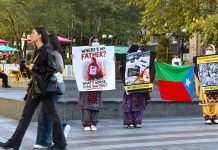
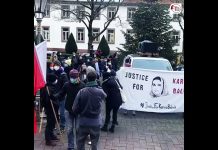
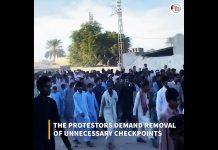
The Baloch Yakjehti Committee’s long march against enforced disappearances and extrajudicial killings also passed through Derajat in December 2023. The committee said local people came out to welcome the march, but alleged that Punjab Police obstructed supporters and arrested more than 20 people, including women and young people. Amnesty International also condemned the arrest of the long march participants in DG Khan.
Meanwhile, armed activities by Baloch armed groups have also been reported in neighbouring Derajat including DG Khan and its neighbouring areas such as Barkhan, Rarasham, Naseerabad and several others.
These incidents do not, on their own, establish the extent of support for Baloch nationalist armed groups in Derajat. They do, however, form part of the wider context in which activists describe growing political connections between Baloch communities across the region. Restrictions on student activities and political gatherings, reports of disappearances, public support for the long march and armed activity in nearby districts all contribute to the debate over the relationship between Baloch identity, political mobilisation and state authority.
What does this mean for Pakistan?
The implications extend beyond the biographies of individual fighters. If political networks linking Baloch communities across Punjab and Balochistan grow, the Pakistani state could face a challenge that is not confined to the existing conflict within Balochistan: the spread of nationalist mobilisation into territories it administers as part of Punjab.
There is no independently established evidence here showing how Pakistani authorities assess the specific involvement of people from Derajat. Nevertheless, the broader question is significant. Would the state view such developments primarily through a security lens, or recognise that historical identity, political representation and grievances over the status of Baloch territories also shape the conflict? A response focused solely on security measures risks deepening alienation if communities perceive it as collective punishment for their identity or political beliefs. A political response would need to distinguish peaceful advocacy from armed activity and allow space for residents to express differing views about their future.
Haroon’s story cannot establish the political preferences of an entire region, nor does his decision to join the BLA demonstrate that all Baloch in Derajat support the same path. But his life illustrates how historical narratives and political connections can cross boundaries that have endured for generations. For Haroon and those who shared his political outlook, reconnecting Derajat with Balochistan was a question of recovering a historical relationship they believed had been broken.
The question now is whether such connections will remain the convictions of a limited number of activists or become part of a broader political development among younger Baloch in the region. If they do, Pakistan will face a question that cannot be answered by security policy alone: can the state secure lasting political allegiance across territories whose inhabitants continue to contest the history and legitimacy of the boundaries governing them?
The boundaries remain on the map. The questions of history, identity and belonging continue to travel across them.
Refrences:
Book: The Problem of “Greater Baluchistan”: A Study of Baluch Nationalism (1987) by Dr. Inayatullah Baloch
Book: Baloch Nationalism: Its Origin and Development by Dr. Taj Mohammad Breseeg
Research: Settling the Frontiers: British Administrative Policy towards the Baloch Tribes of Dera Ghazi Khan