





























By Sangat Shay
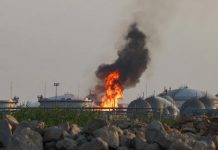
The people of Pakistan commemorate May 28 as the “day of greatness.” Baloch people considered every day after the annexation to be a bad day, but May 28 is seen as the day when Pakistan transcended the bounds of humanity. Pakistan carried out five underground nuclear tests on May 28, 1998, at 3:15 PM PST. Four were of 1–2 kilotons of trinitrotoluene (TNT), and the Raskoh mountain test was of 40 kilotons of trinitrotoluene (TNT). The experiments were carried out covertly in the area of Chaghai, in the province of Balochistan. This day serves as a reminder that, despite Pakistan’s lengthy desert regions, such as Cholistan in Punjab, the country detonated its atomic bombs among the Baloch population. As a result, no more plants or vegetables can be grown there; the only thing visible is soil, and anything further away is invisible. Rich rain-fed terrain and natural springs made Chagai renowned, but after that, nothing remained visible in the area.
If one were to look at it from a global perspective, the creation of atomic bombs would only be for peace; nevertheless, in actuality, every empire that has persisted in oppressing its people has utilized atomic bombs as weapons. This proves that a country may be destroyed but not defeated. Atomic bombs cannot overthrow an ideology. When India detonated five atomic bombs on May 11 and 13, Pakistan took that as a challenge to detonate her own bombs in retaliation. Pakistan also detonated its nuclear bombs 20 kilometers away from a population of Baloch people. However, in accordance with international regulations, explosions must be 200 kilometers away from populated areas. It is also said that the number of nuclear weapons must be reduced, and efforts are being made in this regard globally, but despite this, Pakistan was thought to be using the Baloch homeland as a test site for Pakistan’s nuclear weapons.
On May 28, Pakistan conducted nuclear weapons testing close to the Baloch people in Chagai, removing them from all amenities and preventing them from breathing in a healthy manner by slaughtering human beings. In the name of harshness, this helps us remember Pakistan’s cruelty toward the Baloch; on this day, Pakistan showed her honor of cruelty by demolishing Chagai. Actually, everything has two perspectives: the good and the negative. Therefore, Pakistan’s nuclear explosion had two purposes: first, to demonstrate to India that it is also a nuclear nation; and second, to make the Baloch aware that they are Pakistan’s slaves and that they may be attacked anytime whenever she wants.
In light of the statement made by the military institution a few years ago that, should the necessity arise, “we will bombard Balochistan with an atomic explosion,” it may be concluded that the Baloch people are worthless in comparison to their riches. Pakistan is commemorating this day as “the day of greatness,” which is seen as the devaluation of human capacities in violation of international norms, without realizing it and wasting human life. The story of how Pakistan beat on the chest of Raskoh/Chagai in order to demonstrate herself as the bearer of the baton has become a tale for all to hear.
The residents of Baloch remain affected by the nuclear explosions, which have had a lasting effect on the climate due to radioactive and non-radioactive plutonium, as well as hundreds of other forms. Thousands of civilians were swallowed in the process, which is still ongoing 26 years later and getting worse every day. The entire world community is concerned about nuclear testing because it has so many negative effects. In Chagai, nuclear explosions have killed countless people, and this begs the question of whether Balochistan, which was already facing sociopolitical difficulties, should also be burdened with nuclear testing that is spreading beyond its borders and affecting neighboring nations, as well as the entire ecosystem, which is dangerous for human health and the delicate balance of nature. Even now, the people of Chagai are confronting numerous diseases like:
- Skin diseases
- Allergy
- Dermatitis
- Thalassemia
- Cancer
- Asthma
Instead, people die from hepatitis, malaria, and tuberculosis, but despite these serious illnesses, Pakistan has not sent a research team to Chagai. There is also a dearth of hospitals in the area. After the explosions, victims were left to deal with their circumstances alone, and they continued to suffer from the pain inflicted by Pakistan. From that point on, every generation affected by the explosion will curse Pakistan. Since Pakistan has committed the crime of mortifying the motherland, the Chagai region has been turned into a fiery hell for the Baloch residents. The region has seen radical change, frequent droughts, severe effects on livestock, which is considered to be Balochistan’s lifeline, and total destruction of agriculture. Thousands of animals are dying, and humans are suffering and having birth defects. Prior to this, people had plenty of means of subsistence, but nuclear explosions robbed them of everything. The area is now barren, the water is poisonous from the explosions, and the entire generation is destroyed.
People are also deprived of employment opportunities, clean water, pure air, and health. Pakistan only wants to benefit itself, and anyone who disagrees is put in a detention facility. This is demonstrable, and the country says, “Not Baloch but the resources.” Additionally, uranium is extracted from Balochistan and used there as well. As we can see, in 1998 Balochistan was turned into hell for the Baloch people because of the missiles they endure there. Although many cases of cancer and skin disorders have been reported in the districts of Chagai and Noshki after Pakistan conducted atomic experiments there, although this may have been advantageous for Pakistan, Balochistan views it as having resulted in the birth of boys who are disabled.
When the experiment took place, BNP Mengal was in power. They claim not to have known about it, but if this is true, then they should have known about the implications and would have come up with a remedy; otherwise, they would have been held equally responsible for the crime. Regarding nuclear weapons, two international accords were created to halt nuclear tests, just as in the rest of the world. This is a global issue that requires immediate attention. We call on the International Atomic Energy Agency and world powers to send an independent team to assess the severity of the aftereffects. The Comprehensive Nuclear-Test-Ban Treaty, established in 1996, and the Non-Proliferation Treaty of 1968, which forehold the need to separate nuclear weapons from the country, were not signed by Pakistan, and for that reason, it is against international peace.
Disclaimer: The views and opinions expressed in this article are those of the author and do not necessarily reflect the official policy or position of The Balochistan Post or any of its editors.