



















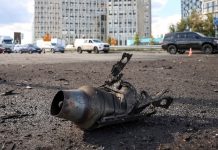











Russia used its new high-speed, jet-powered drones against Ukraine every day throughout August, according to a BBC Verify analysis of Ukrainian Air Force data, marking a sharp increase in the deployment of a weapon Kyiv is struggling to intercept.
The Ukrainian military told the BBC that the number of jet-powered drones used in Russian attacks rose from about 350 in June to 1,600 in July and 2,800 in August. On five days during August, the jet-powered models reportedly outnumbered the older and comparatively slower drones used by Moscow.
The figures marked the first time that attacks involving the upgraded Geran drones had been recorded on every day of a month in Ukrainian Air Force data.
Ukrainian President Volodymyr Zelensky condemned Russia’s increasing use of jet-powered and other drones, describing the attacks as a spreading “horror” over Kyiv’s skies.
Unlike older models driven by propeller engines, the upgraded Geran drones use turbojet engines and can travel at speeds exceeding 300mph. Some of the engines were sourced from China, according to Ukrainian military intelligence.
Dr Marina Miron, a military technology expert at King’s College London, said Russia’s shift towards jet-powered drones was largely driven by their speed.
“The reason for the shift towards jet-powered drones is that they are much faster than the previous model, making it considerably more difficult for Ukraine to intercept them,” she said.
Their speed places them beyond the maximum capability of many interceptor drones currently used by Ukraine, reducing the time available for air-defence units to detect, track and destroy them.
The growing threat was demonstrated during a wave of Russian attacks on Sept. 1 that killed at least 12 people and injured 20 others, according to Zelensky. Six of those killed were railway workers who died when a depot in Kyiv was attacked.
Moldova’s government also said the arrival of an aircraft carrying Zelensky at Chisinau airport was delayed on Tuesday after a Russian drone, reportedly a jet-powered model, entered Moldovan airspace.
Earlier this year, Ukraine reported destroying as many as 94 percent of the long-range drones launched by Russia. However, the growing use of faster models has opened a new phase in the technological contest between the two countries.
Major General Vadym Skibitskyi, deputy head of Ukraine’s military intelligence, said on Aug. 10 that Ukrainian forces needed new interceptor missiles capable of “matching the speed of jet drones”.
Jet Drones: Low-Cost Cruise Missiles?
Four Ukrainian companies have begun testing missiles designed to intercept the new Geran models, according to Ukrainian officials, while Defence Minister Yevhenii Khmara has instructed specialists to produce “thousands of units” as quickly as possible.
Russia also has an economic incentive to expand its use of jet-powered drones. John Hardie of the Foundation for Defense of Democracies said their increased speed and manoeuvrability had narrowed the gap between one-way attack drones and more expensive cruise missiles.
“The more capabilities you add to a drone, the less meaningful the distinction between the drone and a relatively low-end cruise missile becomes,” Hardie said.
Conflict Armament Research, however, said jet-powered drones remained less capable than cruise missiles. They have a shorter range, carry considerably smaller warheads and may be more vulnerable to electronic jamming systems.
Satellite images reviewed by BBC Verify indicated that Moscow was adapting facilities used in the war against Ukraine to accommodate the new weapons. Equipment associated with jet-powered drones was visible at a newly constructed base in Tsymbulova in Russia’s Oryol region, where several launch sites appeared to have been built.
The facility is about 109 miles, or 175km, from the Ukrainian border and appears to have developed into a major hub for Russian drone operations.
Oryol was not identified as a drone-launch location in Ukrainian Air Force reports before September 2024. By August 2026, however, the region was named in reports of almost every Russian drone attack.
A New Challenge for Ukraine
The spread of jet-powered drones comes as Russia increasingly launches complex attacks involving hundreds of drones and missiles, which BBC Verify said were now occurring roughly once a week.
Michael Bohnert, an analyst at the RAND think tank, said Moscow was combining a more diverse range of weapons, including jet-powered and decoy drones, with expensive ballistic missiles that are particularly difficult to intercept.
Ukrainian data indicates that Russia now uses more than 15 times as many drones in each attack as it did four years ago. The scale and complexity of the attacks are intended to overwhelm Ukrainian air defences by forcing them to respond to several types of threats simultaneously.
Bohnert said these tactics, together with a global shortage of air-defence systems capable of intercepting ballistic missiles, had reduced the proportion of Russian drones and missiles destroyed by Ukraine. He attributed part of that shortage to increased demand resulting from the US and Israeli war against Iran.
Ukrainian Air Force data showed that the interception rate for ballistic missiles had declined by the end of July. Kyiv stopped publishing most of the figures required to calculate its interception rate in August, making it more difficult to assess how effectively its air defences are responding to Russia’s changing tactics.