








London Escorts sunderland escorts 1v1.lol unblocked yohoho 76 https://www.symbaloo.com/mix/yohoho?lang=EN yohoho https://www.symbaloo.com/mix/agariounblockedpvp https://yohoho-io.app/ https://www.symbaloo.com/mix/agariounblockedschool1?lang=EN

Turbat: FIR Against Attendees of Sumaiya Qalandarani’s Funeral

Must Read

Genocide is the only option in Balochistan – Pakistani Minister declares

A Pakistani minister in Balochistan, who is de-jure head of security apparatus in the region, has declared that genocide...

Aslam Baloch — The Baloch General – TBP Special report

For seventy years, through ups and downs, successes and failures, with rapid and slow pace, the Balochistan’s...

State’s deadly weapon, Shafiq Mengal – The Balochistan Post report

Strings of suicide bombing in Sindh's Shikarpur city and firing incident on BSO azad's rally in Khuzdar got connected...

Pakistan’s Counter-Terrorism Department (CTD) has lodged an FIR against several attendees at the funeral of Sumaiya Qalandarani. The FIR accuses attendees of promoting separatist ideologies and encouraging the younger generation of Balochistan to adopt these viewpoints.

The FIR specifically refers to a widely circulated photograph from the funeral that includes thirteen notable political and social figures from Turbat in attendance, such as Gulzar Dost and Maulana Khalid Waleed Saifi. The CTD contends that an unidentified individual displayed a victory sign during the funeral, interpreting it as a potential violation under the ATA’s Sections 11-F and 11-W, although this interpretation has yet to be verified through legal channels.

Back in June, Sumaiya Qalandarani executed an attack on a convoy of Pakistani secret agencies at Chakar-e-Azum Chowk, Turbat. The Baloch Liberation Army (BLA), a group seeking Balochistan’s independence from Pakistan, claimed responsibility for the attack. The group’s spokesperson, Jeeyand Baloch, stated that “BLA’s female fidayee (self-sacrificer) Sumaiya Qalandarani Baloch was behind the attack on Pakistani security forces.”

The funeral rites for Ms. Qalandarani took place in the cemetery of Dashti Bazaar and was attended by a significant number of people. Notable attendees included Khalid Waleed Saifi, the vice president of Jamiat Ulema-e-Islam Balochistan; Ghulam Yasin Baloch, the convener of All Parties Kech; Haji Qadir Ahmad of the Peoples Party; and Gulzar Dost, the convener of the Turbat Civil Society, among others.

The accusations levelled in the FIR have yet to be legally assessed, and the implications for those named remain uncertain. However, this incident brings to light the escalating tensions in the region, emphasizing the intricate dynamics of the situation in Balochistan. Instances such as this, where individuals attending a funeral might face legal repercussions, underline the growing discord between the local Baloch population and the Pakistani security apparatus.

SourceTBP

Latest News

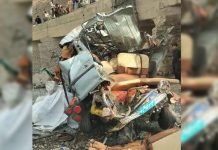
Seven Killed, 18 Injured as Trucks and Passenger Van Collide in Machh

Seven people were killed and 18 injured when two Mazda trucks and a passenger van collided on...

BLF Claims Three Pakistani Soldiers Killed in 10 Operations, Pays Tribute to 14 Fighters

The Balochistan Liberation Front (BLF) on Sunday claimed responsibility for 10 operations across Balochistan, saying three Pakistani military personnel were killed, while...

Two Pakistan Army Pilots Killed in Training Aircraft Crash Near Quetta: ISPR

Two Pakistan Army Aviation pilots were killed when a Mushshak training aircraft crashed near Nawan Killi in Quetta district on Monday, the...

Five People Allegedly Forcibly Disappeared in Nushki and Turbat; Women Protest Outside FC Camp

Five people, including a 17-year-old truck conductor, have allegedly been forcibly disappeared in separate incidents in Balochistan’s Nushki and Kech districts, while...

Dr Hakeem Lehri: An Era Comes to an End – TBP Editorial

Prominent Baloch nationalist leader Dr Hakeem Lehri passed away in Karachi on 7 October. His death is not merely the loss of a political leader, but marks the end of an era in Baloch nationalist politics, one built on ideological commitment, political perseverance, the struggle for national rights, and the determination to remain steadfast in one’s position under the most difficult circumstances. Dr Hakeem Lehri was among those political figures who maintained their association with Baloch nationalist politics from their youth until their final breath and dedicated their entire lives to the struggle for Baloch national rights. Dr Hakeem Lehri belonged to the generation of Baloch nationalist politicians who did not regard politics merely as a means of attaining power or pursuing temporary political interests. Rather, they linked it to national identity, political consciousness, collective rights and the future struggle of the nation. For him, Baloch politics was not a temporary pursuit, but a lifelong commitment. This was why, despite changes in political circumstances, the difficulties faced by the movement in different periods, the rise and decline of political forces, and the numerous obstacles placed in the path of the struggle, Dr Hakeem Lehri never abandoned his political commitment. He was a representative political activist and leader of the generation that witnessed Baloch nationalist politics pass through various historical phases. He witnessed state repression, military operations, the arrests and imprisonment of political activists, enforced disappearances, and the killings of political figures. He saw his comrades face hardships for their political struggle, witnessed his contemporaries endure various ordeals, and closely experienced the ups and downs that emerged within Baloch politics throughout this period. These events were not merely part of his personal memories, but living experiences of the political history through which his generation passed and which profoundly shaped the direction, character and nature of Baloch nationalist politics. The significance of his personality lay not only in the fact that he was a recognised name in Baloch nationalist politics, but also in that he was a witness to a long political era. He carried memories, experiences and observations of a political struggle that influenced generations. Such individuals serve as the historical memory of any political movement, because their lives bring together its different periods, achievements, failures, disagreements and sacrifices. When such figures pass away, it is not merely the loss of an individual; the movement is also deprived of a witness who observed its history at close quarters and played a role in its various stages. Dr Hakeem Lehri is no longer among us, but his life and political commitment will remain part of the history of Baloch nationalism. He will be remembered as a member of the generation that maintained its political identity even under difficult circumstances and remained committed to the struggle for national rights until the end, rather than abandoning it. His death marks the end of an era, but the political memory and historical significance of that era will continue to form part of the study of Baloch politics in the years to come.