







By Fareed Baloch
By around seven in the morning, some residents of Goandhan had already taken tea. In other homes, children were still asleep.
The small settlement in Surab’s Gidar area lies scattered across a dry, open landscape, with low rocky hills rising behind clusters of mud-built homes. Many of the houses have no boundary walls; their roofs are supported by wooden poles and reeds. In the summer heat, residents often sit or sleep outside through the night.
That was the scene witnesses later described to a correspondent for The Balochistan Post when the first bombardment struck.
Homes collapsed. Those who had been outside ran towards the wreckage, trying to reach relatives and neighbours trapped beneath it. As more people gathered around the damaged houses, witnesses said, the area was struck again.
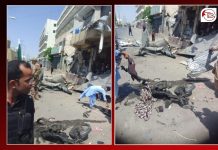
Around the ruined houses, the low, barren hills of Goandhan looked much as they had before. Beneath them, the modest lives families had built within those mud walls had been torn open to the landscape, their rooms collapsed and the belongings of everyday life scattered among the debris.
It was the beginning of a morning that left residents dead and wounded and homes in ruins. But the account that emerged from Goandhan differed sharply from the explanation later issued by Pakistan’s military, which attributed the deaths to militants accidentally detonating explosives while preparing a vehicle bomb.
The Pakistani Military’s Account
According to the Inter-Services Public Relations (ISPR), Pakistan’s military media wing, an “under-preparation vehicle-borne improvised explosive device” detonated prematurely as militants were preparing it in Surab. Eight alleged militants were killed and several others injured, it said.
The military said other explosives stored at the location were caught in the initial blast and detonated, killing three nearby civilians.
Pakistani forces and police subsequently “launched a comprehensive joint clearance operation to track down the perpetrators and facilitators”, according to the statement.
The military said troops then detected militants fleeing the area and killed another 10, bringing its claimed militant death toll to 18. Two soldiers were wounded, it added.
The statement made no mention of an aerial operation.
It did not identify the eight alleged militants it said were killed in the initial explosion or the 10 others it said were killed during the subsequent operation. Nor did it say how those killed in the initial blast had been identified as militants or provide details of the vehicle bomb it said they had been preparing.
A Different Account From Goandhan
But witnesses and residents interviewed by The Balochistan Post said homes in Goandhan were struck from the air.
Several described the same sequence: an initial bombardment struck homes while people were still inside, bringing parts of the structures down. Those who had been outside ran towards the damaged houses, trying to reach relatives and others trapped beneath the wreckage. Another bombardment followed after people had gathered around the site.
“We had taken tea. Some of the children were still sleeping,” one resident recalled. After the first bombardment, he said, people rushed towards the houses to pull out those trapped inside.
“When people gathered there, they bombarded again,” he said.
A TBP correspondent was able to speak to residents and gather details from the area in the immediate aftermath. In the days that followed, however, access was restricted by Pakistani forces, making it difficult for journalists to reach the affected homes and independently document the aftermath.
The sequence described by witnesses differs from the one presented by ISPR, in which a vehicle bomb detonated prematurely and set off other explosives stored nearby.
Residents and local sources reported a total of 27 people killed or wounded, including women and children.
Among those identified as dead were Raj Bano, 50; Shabir Ahmed; Noor Jan; Kareem Dad; two-year-old Bilal Ahmed; and Safia.
Residents who spoke to TBP said some bodies had been taken into the custody of Pakistani forces after the bombardment, leaving the identities of some of the dead unconfirmed.
Children made up most of those identified among the wounded. They included one-year-old Ameer; two-year-old Asim; three-year-old Zia-ur-Rehman; four-year-olds Saeeda and Hassina; five-year-old Rabia; seven-year-old Nadeem; 11-year-old Saira; 12-year-old Fatima; 13-year-olds Umera and Shoaib Ahmed; and 14-year-old Meer Ullah.
Saira, 25; Hajira, 30; Abdul Kareem, 40; and Rasool Bakhsh, 40, were also identified among the wounded.
Images from local sources reviewed by TBP show injured children and adults receiving treatment, bodies being transported from the area, and some of those reported killed.
Related: In Pictures: Aftermath of Pakistani Airstrikes in Balochistan’s Surab
Bodies on the Highway
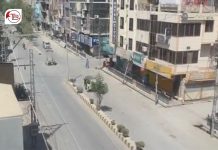
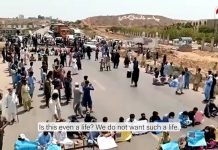
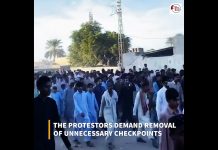
Later that day, relatives brought bodies from Goandhan to Main Chowk in Surab and placed them on the N-25 highway, where they began a sit-in protest.
Videos and photographs shared by local residents and activists show bodies laid on the road as people gathered around them. The demonstration blocked traffic on the highway, leaving long queues of vehicles on both sides. Protesters said the sit-in would continue until their demands were addressed.
In one video from the protest, a speaker called on senior military officials to come to Surab and explain the deaths.
“What terrorism had these children committed that you bombed them?” he said. “We want an answer. We want justice.”
Another speaker at the sit-in accused the military of bombing the area from the air and then issuing an account blaming the deaths on explosives detonating at a bomb-making site.
A separate video sent directly to TBP by residents of Goandhan shows bodies amid the remains of a collapsed mud-brick structure, with blood visible on their clothing.
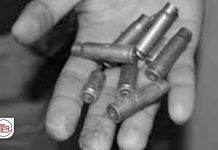
Residents also sent TBP footage of pieces of torn and deformed metal they said had been recovered from the affected area after the bombardment. One larger fragment bears visible markings including “SERIAL NO” and “DATE OF MFR”, along with partially legible numbers and letters.
A Balochistan-based security analyst who reviewed the footage for TBP, speaking on condition of anonymity, said the markings could be significant. If sufficiently preserved, he said, serial numbers, manufacturing dates and production codes can help trace a component to a manufacturer or production series and potentially narrow down the type and origin of the munition it formed part of.
The markings visible in the footage were not complete enough for a definitive identification, the analyst said. But an examination of the recovered fragments themselves, including their full markings and physical characteristics, could provide evidence capable of determining what they were and whether they were consistent with an air-delivered munition.
“An independent forensic examination could establish what the debris is and how it reached the site,” the analyst said.
A Wider Pattern
The events in Goandhan are the latest in a series of reported aerial attacks in Balochistan in which civilians were reported killed, with local accounts in some cases differing sharply from those issued by Pakistan’s military.
Just a week earlier, on Aug. 5, local sources said a drone strike in the Sasol Goru area of Khuzdar killed a young child, Muhammad Aiman, son of Yar Muhammad, while he was at a local hotel.
On July 30, the military said four alleged militants were killed and two explosives-laden vehicles destroyed during an intelligence-based operation in Khuzdar district. ISPR did not identify those killed or disclose where in the district the operation took place.
Sources in Moola Manjhalo, however, said a Pakistani drone struck the area at around 5 a.m., killing four civilians and critically injuring another person. Three of those killed were identified as Irfan, son of Abdul Hameed; Mir Gul, son of Mohammad Hussain; and Ali Gul, son of Mohammad Hussain.
Earlier that month, residents in Mastung’s Khadkucha area reported civilian casualties during a military operation in which a mosque and madrassa at Kund Umrani were damaged. Residents said Pakistani gunship helicopters shelled the area for nearly an hour.
Reports of civilian casualties in aerial operations also emerged repeatedly during 2025.
A drone strike near Tarasani on Sept. 17 was reported to have killed four people, including two women, and wounded five others, among them a four-year-old child.
On Oct. 1, four civilians were reported killed in another strike near cotton fields in Noorgama. Four days later, airstrikes in Moola Pass were reported to have killed six members of one family, including four children, as relatives returned from a funeral.
In some of the incidents, Pakistan’s military said its operations had targeted Baloch armed fighters and described those killed as militants, while residents and families in the affected areas identified civilians among the dead.
Read More: Zehri Under Military Siege: Civilians Killed in Airstrikes, Families Trapped Under Curfew
Calls for an Independent Inquiry
After a succession of aerial operations in Balochistan in which civilians were reported among the dead, the deaths in Surab have become the latest focus of demands for an independent investigation.
The Balochistan Bar Council called for an “impartial and transparent” investigation into the Surab bombing and announced a boycott of court proceedings.
It said the inquiry should establish the “actual facts” of the bombing and that anyone found responsible for an unlawful act or misuse of force should be held accountable under the law.
The Balochistan National Party (BNP) called for a fact-finding commission headed by a retired Supreme Court judge to investigate the Surab deaths and other issues in Balochistan.
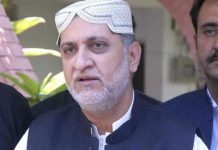
Its chief, Akhtar Mengal, referring to children among the casualties, asked: “Do these children look like militants?”
“What was their crime?” he said. “Can killing children ever bring peace?”
Senior BNP leader Sana Baloch also called for a high-level investigation, saying the Surab incident should not be concealed “behind a narrative” and that the facts should be placed before the public.
He questioned why Islamabad had reached the point of using fighter jets and helicopters against its own citizens and said political problems could not be resolved through military force.
The National Party described the reported bombing of populated areas as a “serious violation of human rights”.
It said the use of force against civilians would deepen mistrust and violence and argued that Balochistan’s problems required “political dialogue”, respect for constitutional rights and the rule of law.
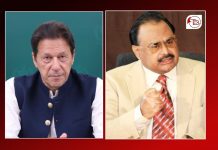
Former Pakistani prime minister Imran Khan criticised the reliance on drone strikes and military operations, saying such actions had failed to provide a lasting answer to militancy.
He warned that “collateral damage” from military operations was resulting in civilian deaths and displacement and called for a broader political strategy based on public participation rather than military force alone.
MQM founder Altaf Hussain described the reported bombing in Surab as “brutality, sheer oppression and barbarity” and questioned the military’s explanation of the deaths.
He said accounts from residents describing repeated explosions at homes were at odds with the claim that militants had accidentally detonated explosives while preparing a bomb. Hussain called for an end to military action against civilians and urged people across Pakistan to observe a peaceful two-hour blackout by switching off televisions or household lights in solidarity with those killed in Surab.
Hafiz Hamdullah, a senior religious politician, described the reported deaths of women and children as “extremely painful and tragic”.
“The government must understand that bombs do not bring peace,” he said.
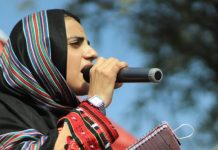
Dr Mahrang Baloch, the jailed Baloch rights activist, described the Surab bombing as a continuation of what she called the “Baloch genocide”.
She said civilian deaths should not be disregarded as “collateral damage” and argued that curfews, military operations, enforced disappearances and killings had increasingly become routine in Balochistan in the name of security.
Dr Sabiha Baloch of the Baloch Yakjehti Committee (BYC) called for an “urgent and independent investigation” into the killings.
She urged the United Nations, Amnesty International, Human Rights Watch and other international organisations to investigate the deaths and demand accountability “for every civilian life lost”.
The Baloch Women Forum (BWF) said women, children and elderly people “cannot be treated as targets under any claim of security or military necessity”.
It called for an immediate halt to airstrikes and military operations in civilian areas, accountability for those responsible and justice for the affected families.
The Baloch National Movement (BNM) described the bombing as a “blatant war crime” and called for an independent international investigation.
It urged international bodies to act over the reported civilian deaths and called on the European Union to reconsider Pakistan’s trade privileges over what it described as continuing human rights violations in Balochistan.
BSO-Azad rejected the military’s version of events and questioned why ISPR had not identified the alleged militants it said were killed in the initial explosion.
It also asked why the military had not produced evidence supporting its account and said the circumstances of the deaths should be “independently established rather than dictated solely by a military press statement”.
The Pakistani military’s version of events remains disputed from the accounts of eyewitnesses, residents and victim families, while lawyers, prominent political figures and rights groups have called for the circumstances of the deaths to be independently investigated. An independent investigation by international forensic and human rights experts, with access to the site, witnesses and recovered debris, could establish what caused the deaths and, if unlawful force is found, where responsibility lies.