











By Rokain Zehri
In March 2025, Pakistani security forces descended on Quetta with an iron fist. The Baloch Yakjehti Committee, the most organised and vocal civil rights movement in Balochistan, was dealt a devastating crackdown. On 20th March, Bebarg Baloch, the iconic face and central committee member of the BYC, was arrested during an illegal raid by CTD and state agencies of Pakistan from his home. Later on, BYC’s other leadership, including Dr. Mahrang Baloch (Central Organizer of BYC), Bebow Baloch, Gulzadi Baloch, and Sibghat Ullah Shahji (Central Committee member of BYC), were also arrested and jailed under the illegal law of 3MPO. The Form 47 government and the puppet CM Sarfaraz Bugti believed he had disengaged the head of a movement that had rattled the foundations of the establishment. But the state forgot about the shadow. That shadow has a name: Dr. Sabiha Baloch.
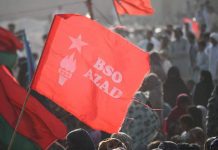
Dr. Sabiha Baloch is a CC member of the Baloch Yakjehti Committee. Born in Zawa, a small village in Zehri, Sabiha grew up with raw academic brilliance but was barred by tribal customs from travelling to Karachi for a national science competition she had rightfully qualified for. That early collision between potential and patriarchy set the tone for everything that followed. She pushed through, enrolled at Bolan Medical College, ranked third in the entrance exam, and it was in those corridors, watching people disappear, campuses militarise, and voices be silenced, that the doctor in training became an activist. She rose to become the Chairperson of the Baloch Students Action Committee (BSAC) in 2021. Her leadership was marked not by slogans, but by substance. She warned against what she called “fashion politics”. She reminded her fellow members that an organisation is built on collective thought, and that without every member realising their responsibility, no movement can survive. When her tenure with BSAC ended in 2023, she transitioned seamlessly into the BYC, where she became one of its most critical central figures, mobilising families of the disappeared and organising protests, marches, and national gatherings across Balochistan.
By October 2025, Amnesty International revealed that Dr. Sabiha Baloch and several other women activists were placed on Pakistan’s terrorist watchlist, a designation that Amnesty called “an affront to human rights” and a clear misuse of anti-terror laws to silence peaceful dissent. The state had thrown every legal, military, and psychological weapon at its disposal. Leaders were jailed. Workers went missing. Family members were disappeared as acts of collective punishment. Terrorist designations were handed to doctors and students. The machinery of repression was running at full capacity. And yet Sabiha kept moving.
This is where the story of Dr. Sabiha Baloch becomes extraordinary and earns her the title that her movement quietly whispers: The Baloch Ninja. While Pakistan’s Frontier Corps, the Counter-Terrorism Department, and intelligence agencies searched every corner for her, she was everywhere and nowhere at once. In the tradition of the greatest resisters in history, she understood that the most dangerous fighter is one the enemy cannot see.
Since the March 2025 crackdown, Dr. Sabiha Baloch has continued to organise and mobilise BYC gatherings and protests, coordinating demonstrations across Balochistan even as the organization’s most prominent leaders remained behind bars. She has continued to speak at public seminars and on digital platforms, addressing webinars on collective punishment, enforced disappearances, and the human cost of state violence. As recently as 27 February 2026, she spoke at a BYC webinar titled “Collective Punishment and Human Cost”, part of a multi-week campaign marking one full year since the detention of BYC’s leadership.
She has led campaigns specifically targeting the state’s practice of disappearing Baloch women, announcing a public mobilisation campaign to shine a light on what she described as a targeted and systematic policy of gendered repression. She has called on writers, artists, filmmakers, activists, and supporters globally to contribute articles, artwork, videos, poetry, and research to the Baloch cause. She does all of this while the state hunts her. She does all of this while listed as a terrorist. She does all of this while being described, in the words of one observer, as a woman. Her power is not derived from being seen. It is derived from never stopping.
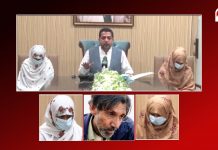
When the state could not catch the ninja, it went after the ones she loved. On 5 April 2025, Pakistani authorities summoned and arrested Dr. Sabiha Baloch’s father, Mir Bashir Ahmed Zehri, from Hub Chowki, Balochistan. He was given no charges. No information was provided about his whereabouts. His family was denied access to him. Police reportedly informed the family directly, and without shame: he would not be released until Sabiha surrendered to the authorities. It was a grotesque act of collective punishment, using a father’s freedom as a hostage to break a daughter’s will. She did not surrender. Then came another blow. In July 2025, Pakistan’s Frontier Corps carried out an unlawful raid on her home, without a warrant, without legal grounds, without any pretence of due process. Her family was harassed.
To understand why Sabiha Baloch cannot be stopped, you must understand how many times she has already survived. Her very first threat came in 2019, when, as a student, she publicly raised concerns about a blackmail scandal at the University of Balochistan. The state took notice. The harassment began. In 2021, during her tenure as BSAC chairperson, her own brother was forcibly disappeared; a warning shot aimed directly at her. He was eventually released, but the psychological scar of watching a loved one vanish into the machinery of enforced disappearance left a mark no release could fully erase.
In 2024, she was arrested and beaten by police during a sit-in protest in Quetta. Officers warned her of continued surveillance. When the Baloch National Gathering (Baloch Raaji Muchi) took place in Gwadar in 2024, her home was raided and family members were falsely charged. State-sponsored campaigns accused her of blasphemy and inciting violence. Through all of it, even when the Frontier Corps fired indiscriminately at protesters, Dr. Sabiha continued to lead demonstrations and gatherings. Each time, the state expected her to retreat. Each time, she advanced. There is something deeply instructive in this pattern. The state, with its guns and jails and courts, operates on the assumption that every human being has a breaking point. Sabiha Baloch has demonstrated, again and again, that this arithmetic does not apply to her. Her activism was never just about herself. It was always about them, the disappeared, the grieving mothers, the nameless bodies, the students who vanished from hostels in the night.
A ninja is not simply someone who operates in secret. A ninja is someone who makes the mission bigger than themselves, someone whose power comes not from visibility, but from purpose. Long before events forced her to live this reality, Sabiha Baloch had already articulated this exact philosophy in her speeches and writings. She trained the movement to run without her at the centre. And so, even in her absence from the visual record, the BYC continues to march, protest, and speak. The state arrested the visible leaders, thinking the movement would collapse. What they did not understand was that Sabiha Baloch had already made herself replaceable by making the movement irreplaceable. That is the true art of the Baloch Ninja.
The Pakistani state can raid homes. It can arrest fathers. It can place names on terrorist watchlists. It can deploy the Frontier Corps in the dead of night. What it cannot do, what no state in history has ever successfully done, is arrest an idea. Dr. Sabiha Baloch is not simply a woman continuing to work under pressure. She is proof of what a movement looks like when it is built right, when its roots run deeper than any one leader, when its workers believe in the cause more than in their own safety, when the silence of hiding becomes more powerful than the loudest press conferences. She is everywhere the state is not looking. She is the voice in every gathering they try to stop. She is the organisation that refuses to dissolve. She is the shadow that keeps moving when all the visible lights have been switched off.
Disclaimer: The views and opinions expressed in this article are those of the author and do not necessarily reflect the official policy or position of The Balochistan Post or any of its editors.