





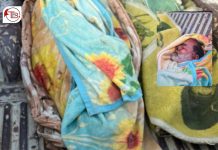
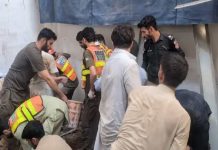

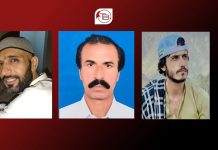




Three young men were killed when unidentified gunmen opened fire in the Parom area of Panjgur district on Friday, local sources said.
The victims were identified as Niaz Baloch, son of Allah Bakhsh; Zakir Baloch, son of Abdeen; and Amar Ali, son of Ali Jan.
Local circles alleged that the attack was carried out by a state-backed armed group commonly referred to as a “death squad”.
The term “death squad” is frequently used by Baloch nationalist groups, human rights activists and advocacy organisations to describe alleged armed groups that they say operate with the support of state institutions in Balochistan.
‘Growing pattern of targeted killings’
Meanwhile, the Baloch Yakjehti Committee (BYC) condemned several recent incidents of violence in Balochistan, including the killing of a university lecturer, a Balochi-language singer and a civilian, saying the cases reflected what it described as a continuing pattern of targeted attacks on civilians.
In a statement, the group said Dilawar Khan, a lecturer at the University of Balochistan’s Kharan sub-campus and a resident of the Nodz area of Turbat, was shot dead on the morning of March 4 outside the campus when armed men opened fire on him and a colleague.
“Dilawar Khan, son of Lal Bakhsh, was attacked by a state-backed death squad in front of the Sub-Campus Kharan,” the statement said, adding that his colleague Bilal Ahmed, son of Ghulam Jan and a resident of Panjgur, was severely injured in the attack.
The statement said that Bilal Ahmed was initially shifted to Sheikh Zayed Hospital in Kharan before being transferred to Quetta due to his critical condition.
The BYC also referred to the killing of Balochi-language singer Talib Nazeer in the Buleda area of Kech district, saying he was shot dead inside his home.
“Talib wasn’t armed. He was a civilian who used his voice to celebrate and preserve Balochi language, culture and identity,” the statement said, adding that the killing reflected what it described as a widening pattern of violence targeting civilians, artists and intellectuals in Balochistan.
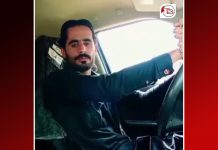
The statement also referred to the case of Fateh Baloch, a driver from the Mashkay area of Awaran district whose family members say he had previously been forcibly disappeared.
According to the BYC, Fateh Baloch was detained near the main military camp in Mashkay on January 13 while transporting passengers in his vehicle, “after which his bullet-riddled body was recovered from the Mashkay River” about one and a half months later.
“These actions constitute grave violations of international human rights law, particularly Article 6 of the International Covenant on Civil and Political Rights,” the statement said, adding that the cumulative impact of enforced disappearances, custodial killings and intimidation of families was creating what it described as an atmosphere of fear in Balochistan.
The group called on the United Nations and international human rights organisations to take notice of the incidents and conduct independent investigations.
Pakistani authorities did not immediately comment on the allegations.