



















A senior Pakistani security official has said that the issues facing Balochistan cannot be resolved through the use of force alone and require sustained political engagement and dialogue with the Baloch population. The remarks were made during a briefing for journalists from Islamabad in Quetta.
According to the official, the state’s objective should be to “win peace, not war” in Balochistan, arguing that the “province’s challenges are serious but not insurmountable”. He said a long-term strategic plan spanning a decade was needed rather than short-term security measures.
The official acknowledged the existence of genuine grievances among the people of Balochistan, including economic and political deprivation. He noted that despite covering nearly half of Pakistan’s land area, Balochistan has only 16 seats in the National Assembly. He also argued that the reduced presence of major political parties in Balochistan had created a political vacuum that had increasingly been filled by social movements and competing narratives on social media.
While stating that armed groups would continue to be dealt with through military operations, the official maintained that a political solution was also necessary, with the aim of bringing people back into the political process.
He attributed the failure of development resources to reach the public to elite capture and corruption and said authorities must address questions about the region’s future development. Describing Balochistan as central to Pakistan’s future because of its mineral wealth and strategic location, he claimed that the region possesses natural resources worth an estimated six trillion dollars, including gold, copper, gas, fisheries and other assets.
The official further alleged that externally supported armed networks were operating against Pakistan and claimed that leaders of Baloch armed groups were based in neighbouring countries. He linked the increase in armed attacks to developments following the United States’ withdrawal from Afghanistan and said the current year had been among the deadliest in recent times. Citing official figures, he claimed that 1,263 militants had been killed during the year.
Despite these assertions, the official acknowledged that the state had not yet found a political solution to the crisis. He argued that Pakistan would succeed only if it won the support of ordinary Baloch people.
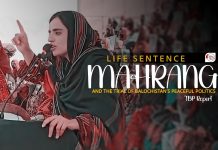
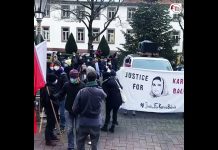
The official also claimed that authorities had made repeated attempts to engage with detained Baloch Yakjehti Committee (BYC) leader Dr Mahrang Baloch, but that she had declined to participate in talks.
The claim was subsequently rejected by Nadia Baloch, sister of Dr Mahrang Baloch, who said her sister had never refused dialogue, negotiations or peaceful engagement.
In a statement, Nadia Baloch said that Dr Mahrang Baloch has consistently advocated peaceful political struggle and has always been willing to participate in serious discussions aimed at achieving peace, justice and harmony.
She said that both before and during her imprisonment, Dr Mahrang Baloch had remained open to dialogue and had repeatedly called for negotiations to address the issue of missing persons and enforced disappearances.
Referring to previous engagements, Nadia Baloch said Dr Mahrang had participated in talks with then Interior Minister of Pakistan, Rana Sanaullah in September 2022, discussions with the federal government in Islamabad in 2023, and negotiations with the Balochistan government during and after the Raji Muchi (National Gathering) in Gwadar in August 2024.
“Dr Mahrang Baloch was ready for dialogue before, is ready today, and will remain ready in the future,” she said.
Commenting on the issue, journalist Kiyya Baloch wrote on X that Dr Mahrang Baloch “strongly believes in dialogue” and wants issues in Balochistan, particularly enforced disappearances, to be addressed through engagement. He further stated that certain elements whom he described as “beneficiaries of war” wanted her to completely submit to their demands and that when she refused to do so, she was portrayed as unwilling to negotiate.
However, Nadia Baloch argued that any meaningful negotiations must include the families of forcibly disappeared persons, those whose relatives were allegedly killed and dumped, and families whose loved ones have remained missing for years.
She said Dr Mahrang Baloch would not participate in any dialogue process solely on her own behalf, but would represent affected families and ensure that their demands formed an integral part of any negotiations.
According to the statement, justice for victims, disclosure of the truth regarding missing persons, and resolution of the issue of enforced disappearances should be central to any dialogue process.
Nadia Baloch added that peace and negotiations should not come at the expense of ignoring the suffering, demands and fundamental rights of affected families, arguing that any lasting and meaningful settlement must include their voices and concerns.