


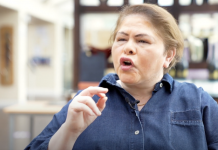

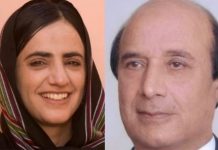



Baloch political and social activist Dr Ayesha Faiz said on Monday that Baloch armed fighters were waging a war of independence rather than engaging in terrorism, adding that women had supported the movement since the 1970s.
Dr Ayesha, the daughter of the late Baloch politician Malik Faiz Mohammad Dehwar, made the remarks during a press conference at the Quetta Press Club.
She said Baloch women had supported fighters during the 1970s by hosting them in their homes and providing food, shelter and medical care when they came from the mountains.
According to Dr Ayesha, fighters who had remained in the mountains for several days were welcomed into homes because proper food and other necessities were unavailable there. If a fighter became ill, she said, a doctor would be called and treatment provided inside the house.
She described this as part of the history of the Baloch people and said it demonstrated the commitment, honour and contribution of Baloch women to the independence struggle.
She also called for the reversal of the State of Kalat’s accession to Pakistan, arguing that it had taken place without the consent of the Baloch people.
“The accession of Kalat that took place without our consent must be reversed,” she said. “We want it back under all circumstances. This is our land.”
Dr Ayesha alleged that people had been displaced from Kalat and that its accession had been secured through deception, saying the struggle to reverse it would continue.
She said her father had remained concerned about Kalat and the establishment of an independent state until his final days, adding that he told her while on his deathbed that people should not worry because “the army being built underground will liberate Balochistan”.
Referring to Baloch Liberation Army (BLA) chief Bashir Zeb and Balochistan Liberation Front (BLF) leader Dr Allah Nazar Baloch, she described them as guerrilla fighters and “soldiers of Balochistan’s war of independence”.
“They are the fighters of Balochistan, soldiers of Balochistan’s war of independence, fearless fighters, and the army and guerrilla fighters of the Republic of Balochistan. They are our brave people and they are fighting their own war,” she said.
She rejected the use of the term “terrorists” for Baloch armed fighters, arguing that the conflict involved two sides fighting one another.
“If one side is a terrorist, then the other side should also be called terrorist,” she said.
Dr Ayesha said armed organisations had repeatedly warned traders, businesspeople, civilians and labourers from Punjab not to enter areas where fighting was taking place.
She also criticised reported plans to remove residents and cut down orchards in Khadkocha following an attack on the convoy of Balochistan Home Minister Ziaullah Langove.
Dr Ayesha warned that such measures would deepen resentment and force local men and women to resist, adding that the state would bear responsibility for the consequences.
She said residents would not leave Khadkocha or allow their orchards to be destroyed.
Dr Ayesha said the conflict was not a recent development and that her family had also opposed the accession of the State of Kalat.
Her father was associated with Balochistan’s early political movement and participated in the Anjuman-e-Ittehad-e-Balochan, which campaigned for political reforms, the unification of Baloch regions and political rights. He later took part in the political activities of the Kalat State National Party.