














The Baloch Liberation Army (BLA) said on Friday it had carried out 65 coordinated attacks across multiple districts of Balochistan between March 29 and April 1, claiming that more than 86 personnel of Pakistani armed forces, “death squads” and intelligence agencies were killed and dozens more injured.
In a media statement, BLA spokesperson Jeeyand Baloch said the operations were conducted in areas including Panjgur, Shapuk, Basima, Sibi, Mastung, Quetta, Nushki, Zamuran, Dasht, Surab, Jhal Magsi, Dalbandin, Kharan, Washuk and Kalat.
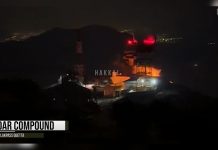
He said the attacks targeted military camps, an airbase, radar systems, communication towers, railway tracks, bridges and gas pipelines, adding that “major highways were brought under control for several hours” during the operations.
He added that six BLA fighters were killed during the clashes.
Details of the operations
According to the statement, the first wave of attacks on March 29 targeted positions of what the group described as “death squads” and Pakistani forces in Panjgur, where clashes took place at multiple locations.
The group said it seized and destroyed several hideouts in the Garmakan area, killing two members of one group and setting fire to vehicles before demolishing the structures with improvised explosive devices.
It said a second hideout was also targeted, with surveillance equipment and vehicles destroyed, adding that Pakistani forces attempting to advance were intercepted, resulting in four personnel killed and several injured.
The statement said a prolonged clash between Garmakan and Washbod resulted in at least six personnel killed, while BLA fighters Zahid, Saeedullah and Jahanzeb were killed during the clashes.
It added that in Khudabadan, fighters seized another “death squad” hideout, killing four operatives and confiscating weapons before destroying the facility, while BLA fighter Aamir was killed during the operation.
Saddam, another BLA fighter, was injured in the clashes and later died of his injuries, the statement said.
The group said it also established temporary control at Football Chowk, where vehicles were stopped and searched, adding that a vehicle belonging to a “death squad” was targeted, killing four people.
It said Pakistani forces attempting to advance were repelled using “thermal and modern weaponry,” while four quadcopters were shot down and weapons were seized.
The statement said attacks were also carried out in Shapuk, where a military camp was targeted with heavy weapons, killing three personnel, and in Basima, where an attack on a military post left two Pakistani soldiers dead.
It added that five electricity transmission towers were destroyed in Sibi and Naseerabad, while a convoy was targeted in Lemji, Sibi, and checkpoints were established for snap-checking in Dhadar and Kat Mundai.
In Mastung’s Kaanak area, fighters seized a Levies checkpost and burned vehicles, while in Quetta, a military camp and a Military Intelligence office were targeted with grenade launchers, killing two personnel and injuring five, the statement said.
Railway bridges and tracks were destroyed at multiple locations in Quetta, while in Nushki, tracks were blown up at five locations, including Battu Landi, Ahmad Wal and Gomazi.
A gas pipeline was also destroyed in Mohammad Colony in Sui, Dera Bugti.
The group said it carried out a “multi-directional attack” on a military camp in Zamuran, killing five personnel, while BLA fighter Abdust Aziz, alias Almaan, was killed during the operation.
In Surab, a military convoy was ambushed, killing four soldiers, it added.
On March 30, the group said it seized a police station in Kotro in Jhal Magsi district, killing one officer and injuring others, including a station house officer, who was later released at the request of local elders.
It said an eight-vehicle military convoy was later ambushed on the Kotro-Noorani Road, with nine personnel killed and over ten injured, while vehicles and equipment were destroyed or seized.
The statement added that a Levies post and a mining site were taken under control in Dalbandin, where machinery was destroyed and 14 weapons were confiscated, while mortar and rocket attacks on a military camp in Kharan caused what it described as “heavy losses.”
In Washuk, it said several BM-12 rockets were fired at the Shamsi airbase, while a gas pipeline was also destroyed on Quetta’s Western Bypass.
On March 31, the group said attacks continued across multiple districts, including the destruction of a communication tower in Sibi.
In Dasht Kudan in Kech district, it said fighters took “full control” of the area, including a Levies station and NADRA office, while attacks on a military camp and an armoured vehicle resulted in seven personnel killed.
In Manguchar, Kalat, the group said simultaneous attacks were carried out at nine locations, including multiple military camps and posts, killing eight personnel.
It added that its drone unit QAHR (Qazi Aero Hive Rangers) carried out “five drone strikes” on the Manguchar College camp, killing three and injuring five.
Additional attacks were carried out in Surab, Mastung and Spilinji, while a radar system was destroyed in Kambela and a section of the Quetta-Taftan highway was held for several hours, the statement said.
It also said a Military Intelligence office was targeted in Turbat and that an intelligence operative was killed in Quetta.
On April 1, the group said it targeted supply vehicles and personnel in Zamuran, while a military post in Nushki used for convoy security was destroyed using explosives.
BLA fighters killed
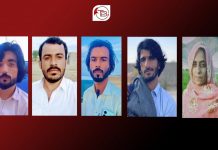
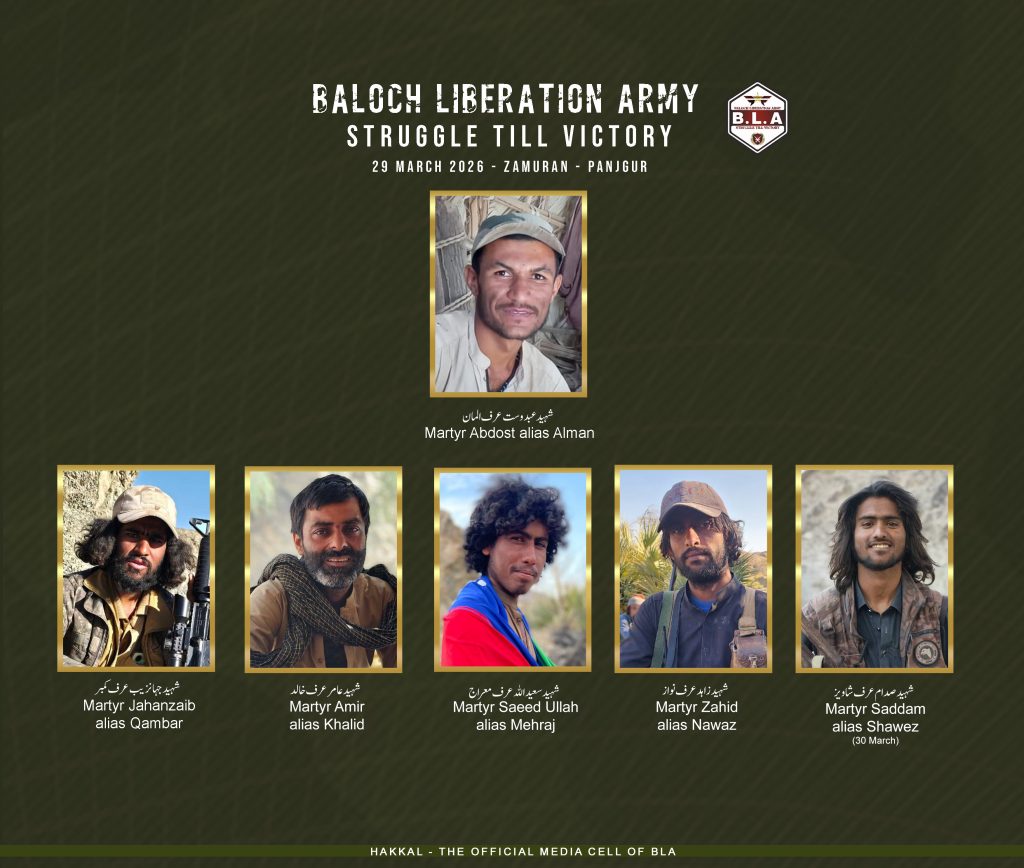
According to the statement, six BLA fighters were killed during the operations, identified as Sangat Zahid, Sangat Saeedullah, Sangat Jahanzeb, Sangat Aamir, Sangat Saddam and Sangat Abdust Aziz.
The group said Zahid, alias Nawaz, a resident of Gichk in Panjgur, had joined the armed struggle in 2016 and became part of the BLA in 2023, describing him as “a fearless warrior and an experienced Sarmachar.”
It said Saeedullah, alias Meraj, originally from Raghay in Washuk, joined in April 2025 and “proved his bravery as a frontline soldier,” while Jahanzeb, alias Qambar, a resident of Nokabad in Tasp, joined in January 2025 and was described as having shown strong “ideological commitment.”
The statement said Aamir, alias Khalid, from Khudabadan in Panjgur, served as an urban guerrilla from 2022 before moving to the mountain front in 2024, adding that he “performed valuable services” across multiple fronts.
It described Saddam, alias Shavez, from Kalag in Kech, as “a hardworking Sarmachar” who had joined the BLA in 2025 and took part in several operations.
Abdust Aziz, alias Almaan, a resident of Kohaad in Tump, joined the armed struggle in 2018 and became part of the BLA in 2019. The group described him as a member of the “elite ‘Fateh Squad’.”
It added that he was “a living example of continuous struggle” and did not waver despite what it described as “collective punishment” against his family.
The BLA warned individuals associated with what it described as “death squads” to “abandon their anti-Baloch activities and surrender,” adding that it would otherwise “use its full force to bring them to their end.”
It also accused Pakistani forces of using civilians as human shields during operations in Jhal Magsi and advised the public to “maintain a safe distance from occupying forces.”
“Our strategic war and coordinated strikes will continue with full strength and intensity until the restoration of a free and sovereign Balochistan,” the statement said.
Pakistani authorities did not immediately respond to the BLA statement.