



















The Sindh High Court has ordered the completion of an inquiry within one month into a case involving the alleged killing of three Baloch youths in a suspected staged police encounter in Karachi.
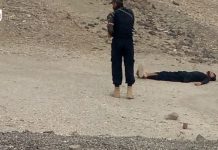
The case relates to an incident reported on 17 February 2026 in the Shah Latif Town area of Malir, where the Counter Terrorism Department (CTD) of Sindh Police said four individuals were killed during an operation. Authorities had claimed that the deceased were affiliated with the Baloch Liberation Army (BLA).
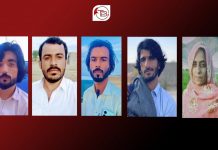
Subsequently, three of the deceased were identified as Jaleel, son of Noor Muhammad, Niaz Qadir, son of Qadir Bakhsh, and Hamdan (alias Hakeem), son of Muhammad Ali, while the identity of a fourth individual remains unknown.
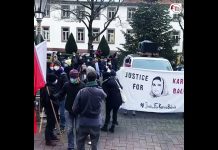
Families of the victims rejected the official account and staged protests, alleging that the individuals had previously been taken into custody by security forces and the CTD and were due to be presented before a court. They described the encounter as staged and unlawful.
Related: From Courtroom to ‘Encounter’: A Pattern in Balochistan — TBP Report
The father of Hamdan, Muhammad Ali, has filed formal complaints with the Federal Investigation Agency (FIA), including its Karachi zone, as well as with the National Commission for Human Rights (NCHR), seeking an investigation under the Torture and Custodial Death (Prevention and Punishment) Act 2022.
According to the petition, Hamdan had been in CTD custody since 5 January 2026 and was on police remand until 18 February, as acknowledged in court records. However, on 17 February, police stated that he had been killed in an encounter, a claim his family disputes.
During the hearing, officials including the Deputy Inspector General of the Special Branch appeared before the court. The bench directed the DIG Special Branch to complete a transparent inquiry within one month and submit a report.
The court also ordered that, until the inquiry is completed, CTD personnel allegedly involved in the incident should not be given new postings.
Additionally, the court directed the Inspector General of Sindh Police to develop standard operating procedures (SOPs) to ensure the safety of individuals in police or judicial custody, particularly in high-profile cases.
The bench expressed concern that if deaths in custody continue, such incidents could increase, and instructed that the inquiry should determine the circumstances of the killings, including whether the individuals may have been shot while already in custody.
The court further directed that copies of the inquiry report be provided to the families upon completion, after which the petition was disposed of.
During proceedings, the petitioner’s counsel, Jibran Nasir, told the court that Hamdan had been missing since 29 December before his arrest was later shown in a separate case. He stated that an anti-terrorism court had granted police physical remand of Hamdan until 19 February.
The lawyer argued that police had acknowledged that the individuals were in custody at the time of the alleged encounter, and added that post-mortem findings contradicted the official version of events.
He further noted that under the Torture and Custodial Death Act, an inquiry into deaths in custody is required within seven days, but no such proceedings had been initiated so far.
Authorities have not publicly issued a detailed response addressing the allegations raised by the families or during the court proceedings.