












“My son was picked up and kept at an unknown location for seven days… He was then produced before a court twice. We were waiting for the third appearance when we heard that my son had been killed in a so-called encounter.”
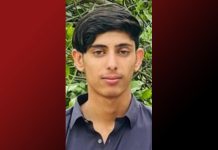
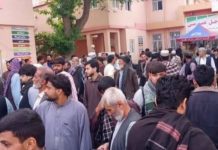
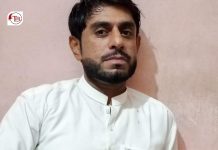
Standing outside the Karachi Press Club, alongside families of Baloch missing persons, Muhammad Ali struggled to steady his voice as he described how his son had been detained, held incommunicado for a week, and twice brought to court under heavy police escort. Now, authorities were claiming he had been killed in an encounter.
Ali said he could not understand how someone in full police custody could end up dead in such circumstances.
The Case: What Happened to Hamdan?
Hamdan Baloch’s family says he was detained without a warrant by Pakistan’s Counter-Terrorism Department (CTD) near Dhobi Ghat Bridge in Karachi on 29 December 2025. His father also filed a petition before the Sindh High Court against his enforced disappearance.
Ali said the CTD later announced in a press conference on 6 January 2026 that it had arrested his son and others from Raees Goth on suspicion of links to, and facilitation of, an armed group.
According to the father, Hamdan was due to be presented before a court on 18 February after the completion of his physical remand. Instead, the family was informed that he had been killed in an alleged encounter.
Officials claimed he was struck by gunfire from his own associates as they fled “taking advantage of the dark.” Ali said the explanation followed a familiar script he had seen in multiple previous cases.
He questioned how a detainee brought to court under heavy police escort could later be reported dead in an armed confrontation.
“When my son was brought to court, ten police vehicles escorted him. If he was in custody, how did he go out for an encounter and where did all those police officers disappear?” he said.
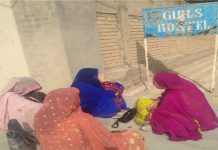
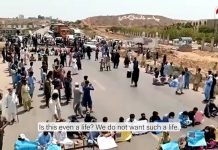
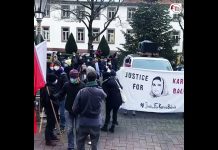
After the announcement, Hamdan’s family, alongside relatives of other missing persons, held a protest outside the Karachi Press Club demanding justice and the release of his body. The family says they identified Hamdan’s body, but Edhi authorities told them it could not be released without CTD authorisation. They alleged CTD officials delayed the process through various pretexts, including asking them to sign a form declaring Hamdan a militant — a form they refused to sign, noting he had been killed before any charge was presented in court.
A hearing was held on 19 February at a local court in Karachi. The CTD submitted a post-mortem report, but the family rejected what they described as a one-sided examination and requested an independent and transparent post-mortem conducted in their presence.
On 25 February, Hamdan’s funeral was held in Karachi after a court ordered authorities to release the body. Residents said police and CTD personnel cordoned off the area and maintained a heavy presence, adding that officers questioned mourners and monitored those attending the prayers. According to attendees, the family also faced last-minute pressure to change the location of the funeral, while plainclothes personnel remained around the site throughout the day.
Hamdan’s father has since submitted applications to the Director FIA Karachi Zone, the Director General of the FIA, and the National Commission for Human Rights, requesting an investigation into the death under the Torture and Custodial Death (Prevention and Punishment) Act 2022.
What CTD Says Happened
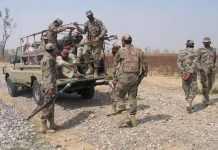
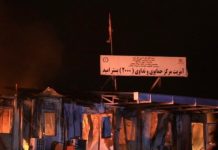
According to the Counter-Terrorism Department, Hamdan was killed during a pre-dawn raid in Karachi’s Shah Latif Town on 17 February. Officials said the operation was carried out on the basis of information provided by suspects already in custody.
The CTD said the men inside the house opened fire on the raiding team, prompting officers to return fire. When the shooting stopped, four suspects were found injured “by firing from their own accomplices”.
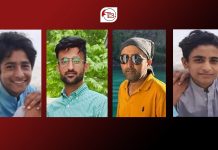
The statement added that all four were taken to hospital, where they were pronounced dead. Three of the deceased were identified as Jaleel alias Farid, Niyaz alias King and Hamdan alias Farid, while the identity of the fourth man remained unknown.
Officials claimed that several accomplices escaped “under the cover of darkness”. They also said a Kalashnikov rifle, grenades and explosive material were recovered from the scene. The CTD described the men as members of an outlawed Baloch armed group.
An intimation later submitted to the court repeated this version, stating that the suspects opened fire “with the intention to kill” and that CTD personnel responded “in self-defence”. The filing added that two police officers were injured during the exchange. However, apart from the CTD statement, the claim of personnel injured was not confirmed by any independent source or evidence.
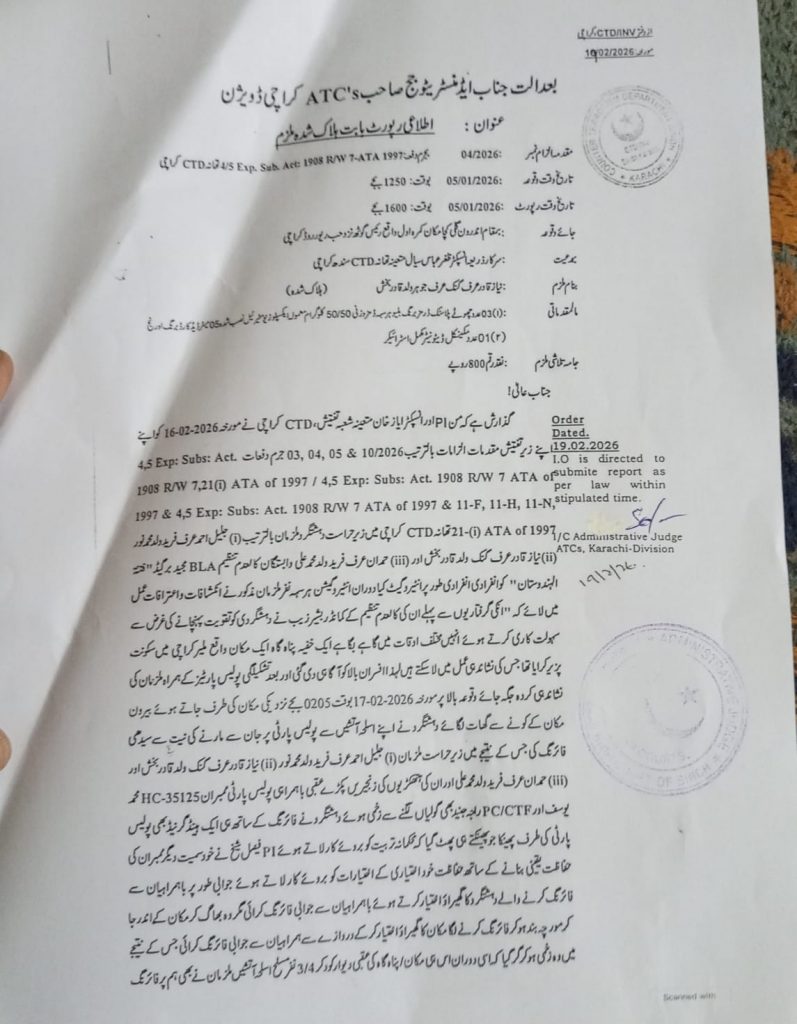
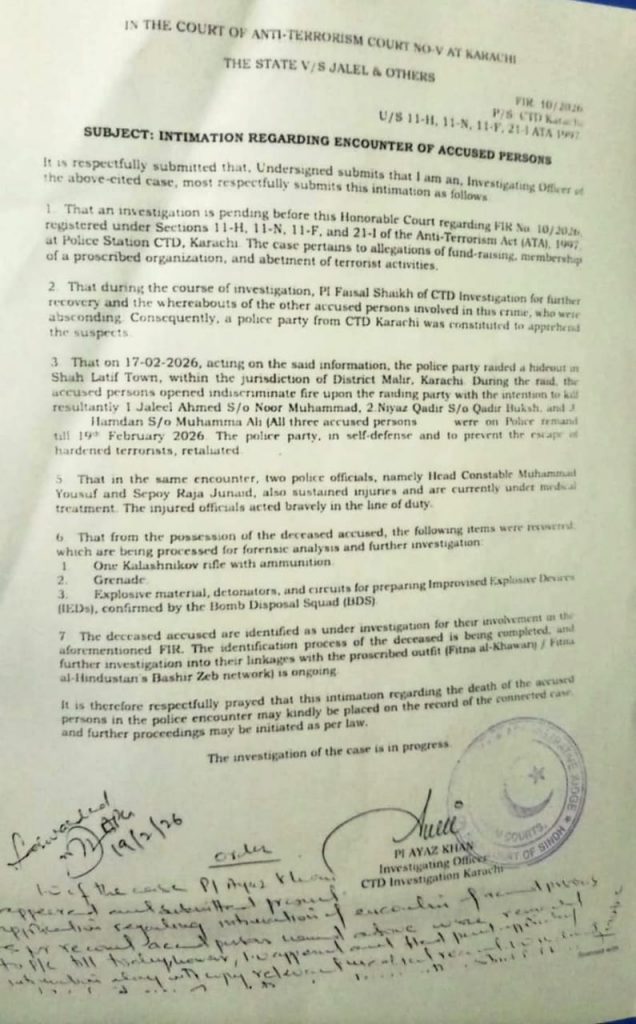
What the Court Papers Show
Court documents show that Hamdan Baloch was reported missing by his family on 29 December, with a written complaint stating that he had been taken by plainclothes officers near Karachi’s Dhobi Ghat Bridge. At the time, police stations and Counter-Terrorism Department (CTD) units denied holding him.
His detention was formally acknowledged on 5 January, when he was produced before an anti-terrorism court in two CTD-registered cases under the Explosive Substances Act and the Anti-Terrorism Act. Remand papers list him as “Hamdan @ Fareed @ Hakeem” and show that the CTD sought physical custody for investigation.
Subsequent remand orders issued throughout January record repeated CTD requests for extensions, citing the need to examine alleged explosive material, trace other suspects and recover additional evidence.
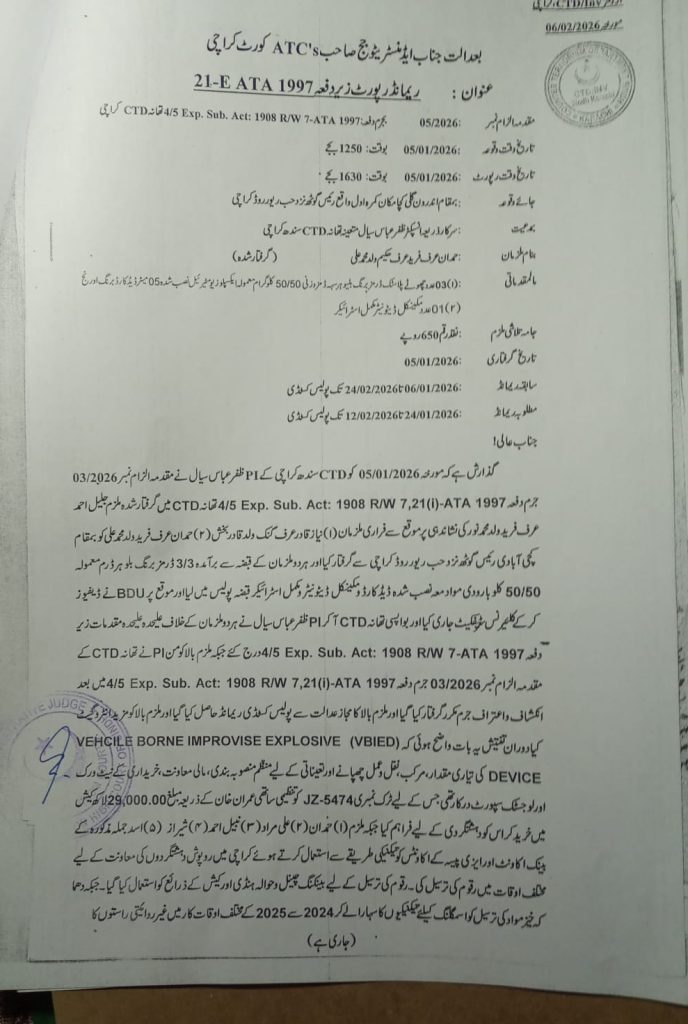
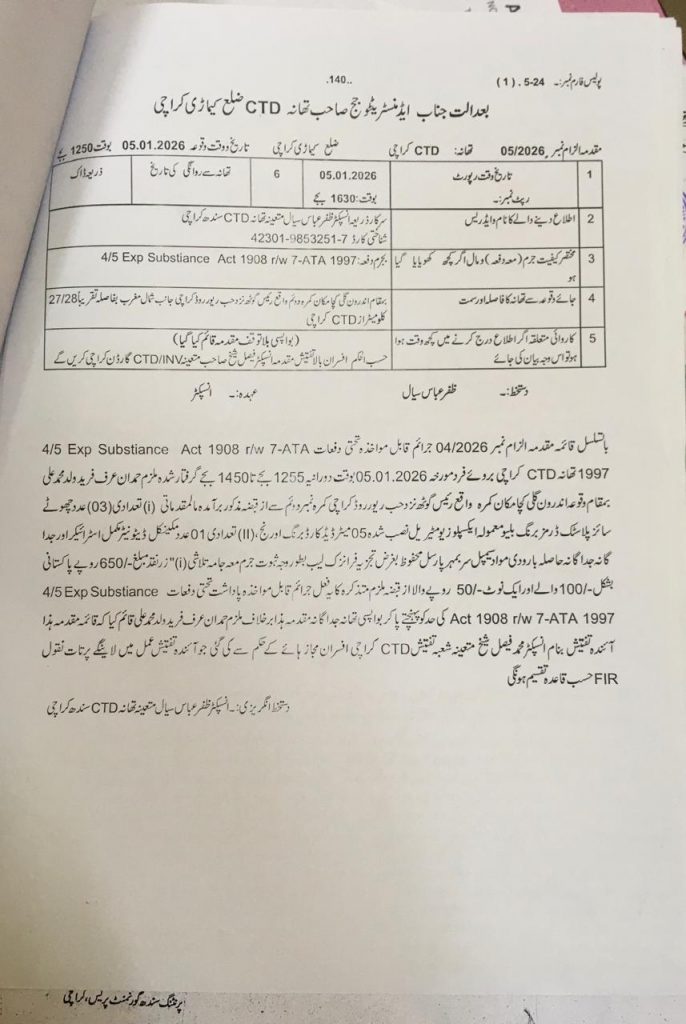
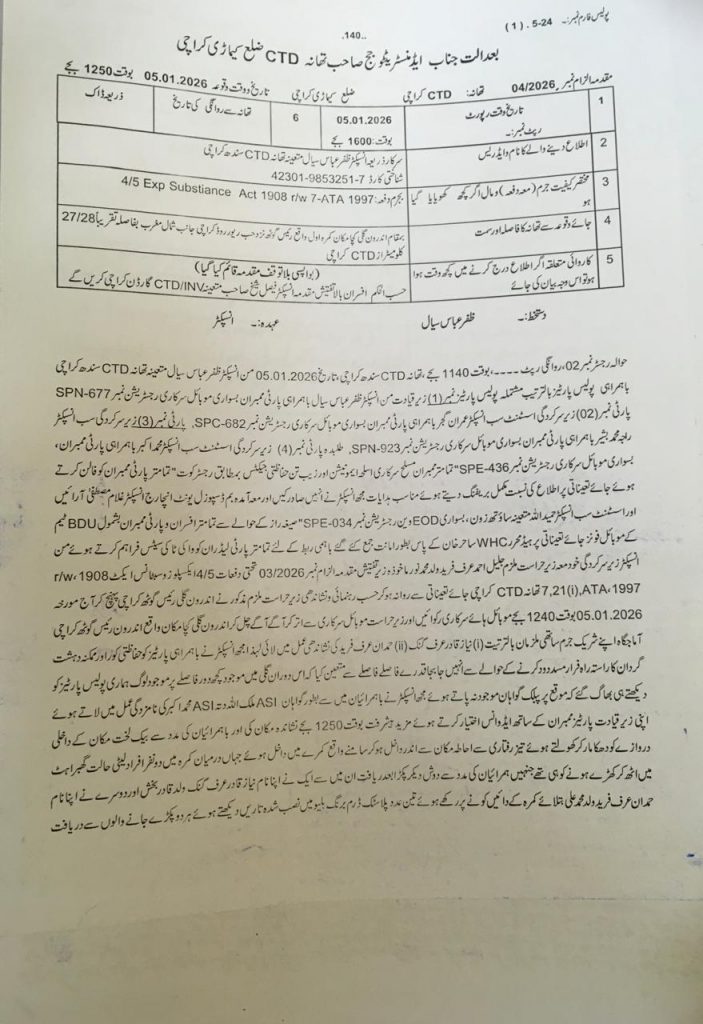
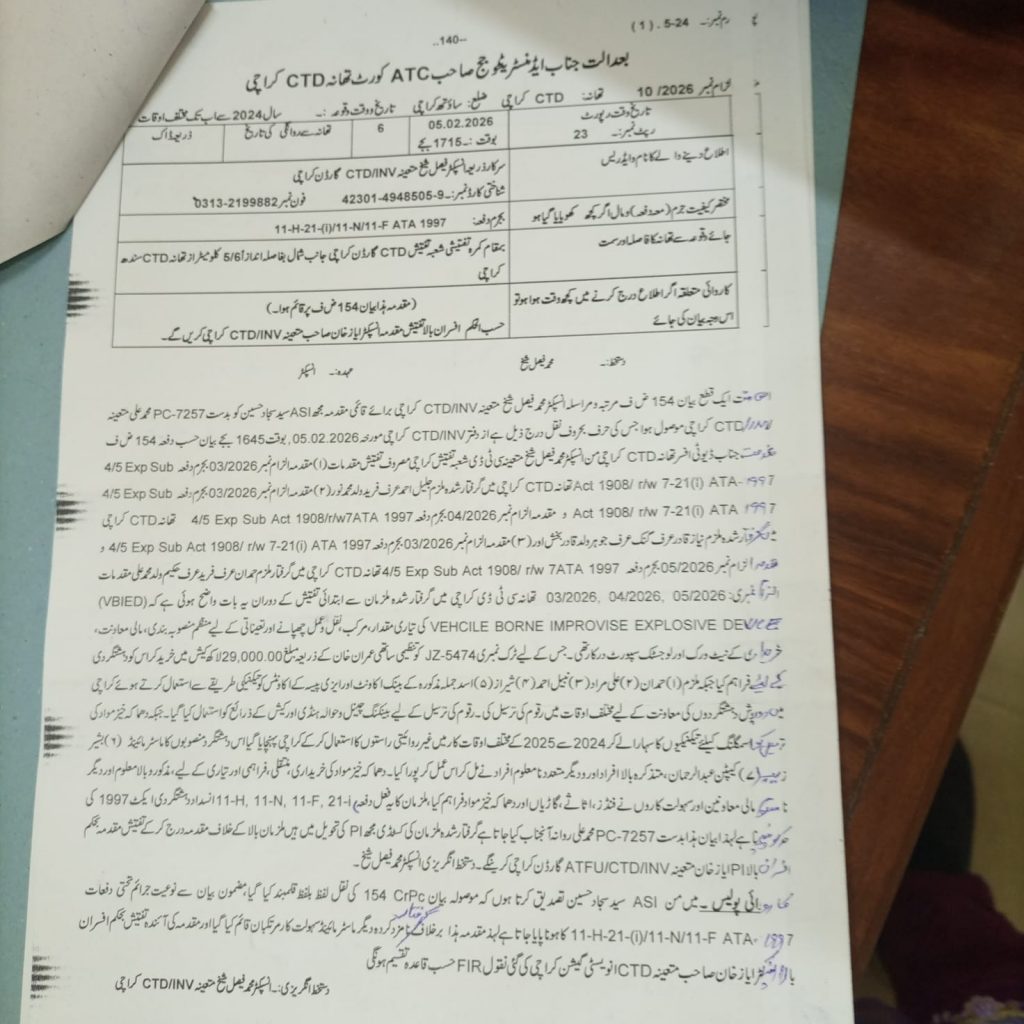

In an order dated 6 February, the court again recorded Hamdan’s presence in CTD custody. The investigating officer, Muhammad Faisal Shaikh of CTD-IV Karachi, requested further police remand under Section 21-E of the Anti-Terrorism Act. The court granted 13 days of police custody, extending remand from 6 February to 18 February, and directed the CTD to submit case diaries on 19 February.
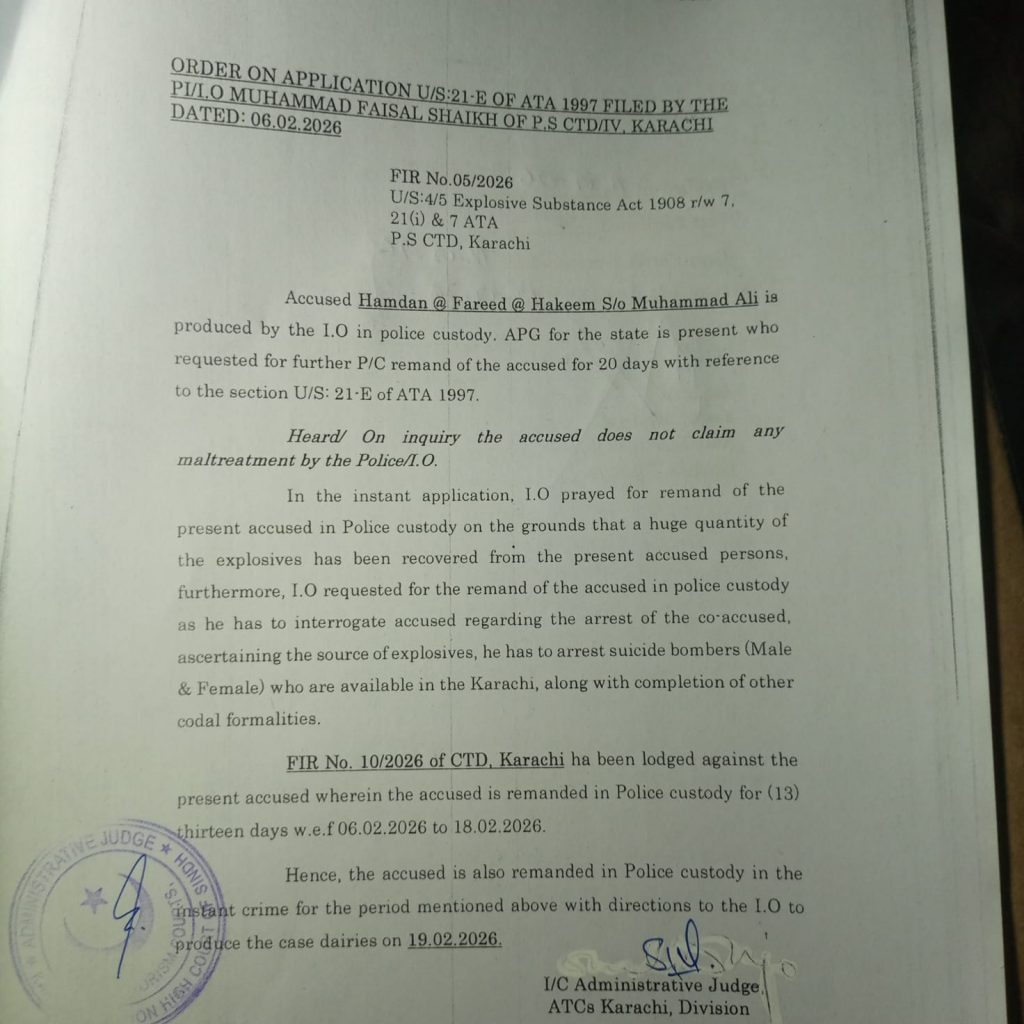
On 17 February, the CTD said Hamdan was killed during an armed encounter in Karachi’s Shah Latif Town, a day before the remand period was due to expire and two days before he was scheduled to appear again before the court.
The timeline of hearings, along with CTD’s claim that Hamdan was taken from custody to a hideout, reflects a pattern frequently seen in Balochistan, in which detainees held for prolonged periods and later declared dead in encounters days before they are due to appear in court.
A Familiar Pattern: The Case of the Pirkani Cousins
The questions raised by Hamdan’s death echo a case from Balochistan nearly five years earlier.
On 18 January 2021, the Eagle Force of the Balochistan Police announced at a press conference that it had arrested two men after they allegedly failed to stop their motorbike during routine checking. Officers said they chased and detained them, recovering two hand grenades. The suspects were labelled “terrorists” and handed over to the Counter-Terrorism Department.
The two young men were cousins, Jameel Pirkani and Sami Pirkani, both around 20 years old.
According to court records and family accounts, both men appeared before a court twice while legal proceedings were underway. Their relatives said the cousins insisted they had been falsely implicated.
Weeks later, on 7 March, the CTD announced it had killed five members of the Baloch Liberation Army in a shootout near Mastung. Officials said the operation was launched after the detained cousins “identified a militant hideout”. According to the CTD, officers came under fire when they approached the location. In the exchange that followed, five men were killed, including Jameel and Sami.
The other three were identified as Arif Marri, Yousuf Marri and Shah Nazar.
But questions quickly emerged about the circumstances of the operation. All five men had been shot at close range in the head, while no CTD personnel were injured or killed during the alleged encounter.
An investigation by The Balochistan Post revealed that not only the Pirkani cousins, but the other three men had also previously been detained by Pakistani forces. Yousuf Marri had been arrested in Sibi on 27 November 2020. Arif Marri was detained from his shop in Hazar Ganji, Quetta on 28 February 2021. Shah Nazar, too, had been forcibly disappeared before the incident.
The Pirkani case was not an isolated incident.
In January 2018, police in Quetta issued a statement claiming they were transporting an arrested militant, Asfand Khan, to identify a hideout when his associates attempted to free him. Officials said a shootout followed, leaving both Asfand and one alleged attacker dead. The family later said both men had already been in police custody before the reported encounter.
Paraded on Television — Then Killed
An earlier incident from 2015 followed the same pattern.
Two political activists, Shafqat Rodeni and Ibrahim Nichari, were arrested by Pakistani security forces and presented before the media as alleged members of the Baloch Liberation Army. Both men appeared on several Pakistani mainstream news channels including ARY and Geo TV during a press conference held in the presence of Balochistan’s then Home Minister, Sarfraz Bugti, confirming that they were in state custody. The news was also published by Dawn, The Express Tribune and PPF but on an interesting note, TV broadcasts of the press conference (Geo, ARY, Dunya) from 2015 appear to have been removed or archived.
Months later, authorities said the two had been killed during an operation in Killi Kandawa near Mastung. Once again, police claimed the detainees had been taken to identify a militant hideout when another suspect opened fire. According to officials, the third man was also killed in the exchange.
No police personnel were reported injured during the incident.
The deaths drew criticism from Baloch political groups and activists, who said the men had already been in state custody and could not have died in the manner described.
The Case of Balach Maulabakhsh
One of the most widely cited examples of this pattern is the case of Balach Maulabakhsh.
According to his family, Balach was taken from his home in Turbat on 29 October 2023. For more than three weeks, his whereabouts remained unknown. On 21 November, he was produced before a court, where the CTD alleged he had been caught with five kilograms of explosives. An FIR was registered against him the same day.
Two days later, during the night of 22–23 November, Balach’s body was brought to Turbat Teaching Hospital. His relatives identified him.
The CTD initially claimed he had been killed during an intelligence-based operation on Pasni Road, stating that four militants had been “neutralised”. A later version said Balach had taken CTD personnel to identify a hideout, and that he was killed in crossfire when militants opened fire.
The family rejected the CTD’s account, saying Balach had been forcibly disappeared weeks earlier and was in state custody at the time of his death.
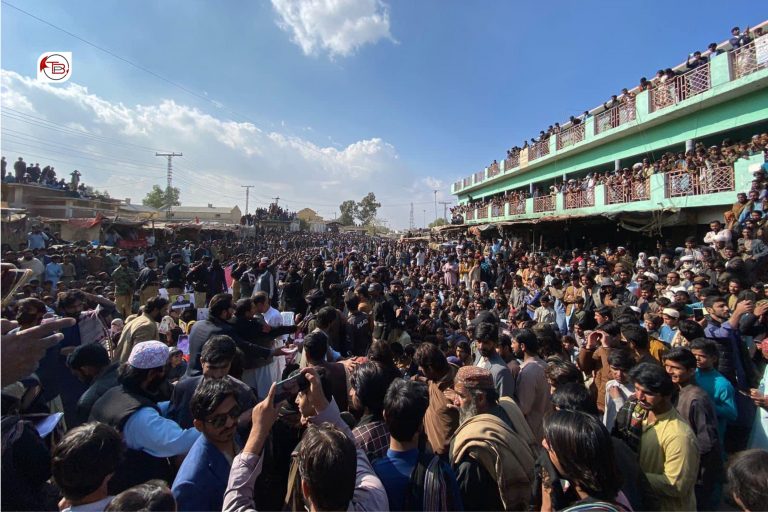
His killing triggered protests in Turbat, where thousands demonstrated with his body. The sit-in later turned into a long march that moved through parts of Balochistan and eventually reached Islamabad, where families of missing persons held a month-long sit-in demanding accountability.
The Recurring Question
The cases of Hamdan Baloch and earlier incidents documented in this report point to a pattern that families, lawyers and rights groups say they have witnessed for years.
In each case, the men were detained, disappeared or already produced before a court, yet were later reported dead in encounters described as hideout raids, exchanges of fire or intelligence-based operations. Despite differing locations and circumstances, the official accounts often appear to follow the same script.
Rights groups note that FIRs and official statements rely on “strikingly similar” language. Suspects are alleged to have opened fire first, detainees are said to have been hit by “firing from their own accomplices,” and others are reported to have escaped by “taking advantage of the dark.”
In a recent fact-finding report, the Human Rights Commission of Pakistan (HRCP) described these narratives as “copy-paste structuring rather than incident-specific reporting.”
These groups say the similarity of such accounts, combined with the absence of police casualties in many incidents and the lack of independent post-mortems, raises serious questions about the nature of these encounters. Without transparent investigations, they argue, allegations of custodial killings remain unresolved.
Critics say what distinguishes these cases is not only the similarity of the official accounts but the point at which the legal process appears to lose relevance. Court records in multiple cases show detainees remaining under judicial remand when they were taken from custody to alleged hideouts and later declared dead in encounters.
For families, the questions have not changed. If their loved ones were already in state custody, how did they end up dead in armed encounters they were never meant to be part of? And why, despite years of complaints, does the pattern continue?