







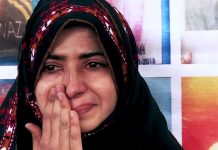
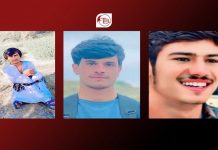
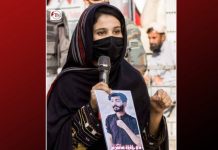





A Baloch woman who had been missing for nearly six months after being taken from her home in Balochistan’s Dalbandin was presented by Pakistani authorities in Quetta as an alleged facilitator linked to a suicide attack, while her brother, detained with her, remains missing.
Rahima Bibi, daughter of Muhammad Rahim, was taken into custody along with her younger brother, Zubair Ahmed, during a raid on December 9, 2025. Since then, their whereabouts had remained unknown.
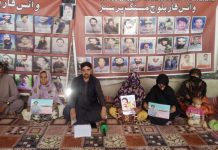
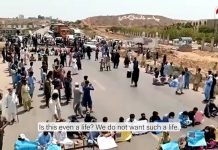
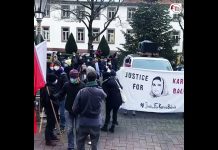
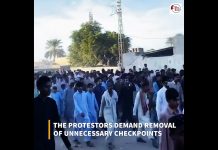
Following their disappearance, family members and residents of Dalbandin staged protests and blocked highways connecting Quetta and the Iranian border, demanding their recovery. Despite official assurances at the time, neither sibling was produced before a court.
On Saturday, Rahima was brought before the media during a press conference in Quetta and presented as a suspect in connection with the November 30 attack on the Frontier Corps headquarters in Nokundi.
Additional Chief Secretary Home Hamza Shafqaat said extremist networks were “increasingly using women and children as tools to carry out attacks,” describing the trend as inhumane and contrary to local traditions.
Officials said the Nokundi bombing involved a female attacker linked to the Balochistan Liberation Front and described Rahima as the wife of an alleged facilitator, claiming her arrest had provided “key leads” in the investigation.
They alleged that her husband assisted the attacker and later fled to Afghanistan.
A video statement attributed to Rahima Bibi was also presented during the press conference. In the recording, she said her husband had brought an unidentified woman and her children to their home in Dalbandin in early November 2025 and took them away the following day. She said he later informed her that the same woman carried out the suicide bombing.
Questions over due process
Baloch rights groups and activists raised concerns over the circumstances of her detention and subsequent presentation.
PAANK, the human rights department of the Baloch National Movement (BNM), said the case reflected what it described as a shift “from enforced disappearance to staged narrative.”
“After nearly six months of enforced disappearance, Rahima has now been brought before the public and presented as a so-called ‘suicide’ case,” the group said.
“This development raises serious concerns about coercion, custodial pressure, and the manipulation of facts,” the group said, adding that Rahima’s prolonged incommunicado detention and subsequent presentation through a controlled press interaction pointed to what it described as a pattern of forced confessions.
Baloch Voice For Justice (BVJ) said similar cases in Balochistan had followed what it described as a repeated sequence involving disappearance, reappearance under serious allegations, and presentation through media channels without transparent legal proceedings.
“When individuals remain missing for extended periods and then suddenly appear in state custody with scripted narratives, it raises legitimate questions about the conditions under which these statements are obtained,” the group said, referring to “so-called confessional statements.”
Dr Sabiha Baloch said Rahima’s case raised “grave legal concerns,” arguing that nearly six months of detention outside what she described as a “recognized judicial framework” undermined the credibility of any statement attributed to her.
“A Baloch woman forcibly disappeared from her home, denied access to legal counsel and family, and held for months before being presented as a ‘suicide bomber’ cannot be presumed to have made a voluntary statement,” she wrote.
She said allegations of this magnitude require “transparent investigation, access to defense, and adjudication through an independent court of law,” rather than presentation through media channels.
“Presenting an individual before cameras without fulfilling minimum legal safeguards undermines the integrity of the justice system itself,” she said.
Dr Sabiha added that similar cases in the past had followed what she described as a broader pattern in Balochistan, in which individuals subjected to enforced disappearance were later reintroduced to the public under serious allegations, often framed as “suicide bombers” or “facilitators.”
She said courts had later dismissed such allegations in previous cases and called for “accountability, adherence to legal procedure, and the immediate recovery of all persons who remain forcibly disappeared, including Zubair.”
Related News:
Sammi Deen Baloch Calls Mahal Baloch’s Acquittal a ‘Slap in the Face’ of State Narrative
HRCP Expresses ‘Grave Concern’ Over Enforced Disappearances, Including Cases Involving Baloch Women
Quetta: Balochistan Govt Accused of Falsely Presenting Woman as Suicide Bomber