
















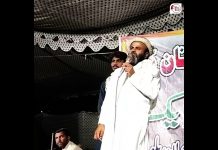



Baloch activists, political leaders and human rights advocates raised concerns over the situation in Balochistan during the ongoing Asma Jahangir Conference in Lahore, where issues ranging from enforced disappearances to political representation were discussed.
According to the Baloch Yakjehti Committee (BYC), its central member Sammi Deen Baloch attended the conference and held meetings with diplomats, politicians, journalists and reporters. The organisation said she used the platform to highlight what it described as serious human rights issues and to present the perspective of the Baloch people.
During the conference, Sammi Deen Baloch met several United Nations officials, including the UN Special Rapporteur on the rights to freedom of peaceful assembly and of association, Gina Romero; the UN Special Rapporteur on violence against women and girls, Reem Alsalem of Jordan; and Ed O’Donovan, senior adviser to Mary Lawlor, the UN Special Rapporteur on the situation of human rights defenders.
In these meetings, Sammi Deen Baloch provided a briefing on the situation in Balochistan, stating that peaceful assembly and freedom of expression were being restricted and that people were being denied the right to protest or speak out against state actions. She also raised concerns about alleged violence against Baloch women, including claims of enforced disappearances of women and minors, and what she described as unlawful arrests. Cases discussed included that of Dr Mahrang Baloch.
She further highlighted what she described as the systematic targeting of human rights defenders, citing allegations of threats, harassment, enforced disappearances, arbitrary arrests and killings. Cases referenced included those of Dr Mahrang Baloch, Beebo Baloch, Gulzadi Baloch and others.
According to the BYC, UN representatives expressed concern over the reported human rights violations and said they would raise these issues at relevant UN forums. There has been no official response from Pakistani authorities to these claims.
Separately, the head of the Balochistan National Party (BNP) and former chief minister of Balochistan, Sardar Akhtar Mengal, addressed the conference, making strong remarks about the security situation in the region. He said that groups labelled as militants by the state were viewed by sections of the local population as protectors.
He stated that when security forces entered towns, residents often confined themselves indoors in fear, whereas, according to him, armed Baloch fighters were received differently by local people. He added that such realities were not visible from outside the region but were experienced firsthand by residents of Balochistan.
Sardar Akhtar Mengal also referred to historical agreements related to Balochistan, including an agreement between the Khan of Kalat and Muhammad Ali Jinnah, arguing that commitments made regarding autonomy were not honoured. He criticised what he described as unequal accountability in the justice system, citing recent convictions of lawyers and activists while alleging impunity for those responsible for major political and economic wrongdoing.
He further referred to remarks previously made by federal minister Rana Sanaullah suggesting negotiations could take place if responsibility for armed groups was assumed. In response, Mengal questioned such expectations and cited past instances involving Baloch leaders, saying they ended in imprisonment or execution.
During his address, former chief minister Dr Abdul Malik Baloch said that complaints regarding missing persons were a daily occurrence when he visited his constituency, calling the situation alarming. He urged the government and political leadership to pursue urgent and sustainable solutions.
Dr Malik said treating Balochistan solely as a security issue would worsen conditions and stressed the need for political dialogue and inclusion of elected representatives. He expressed concern over what he described as shrinking political space for popular political parties in Balochistan and Khyber Pakhtunkhwa, and said that consensus reached during the Pakistan Democratic Movement period on issues such as enforced disappearances had not been implemented.
He called for political reforms in Balochistan, protection of the 1973 Constitution, the 18th Amendment and the NFC Award, and urged security institutions to remain separate from politics. He also criticised electoral processes in the region, alleging irregularities, and highlighted governance challenges, unemployment and resource management issues.
Dr Malik further raised concerns about corruption and the impact of restrictions on cross-border trade, noting that informal trade along the border had long supported livelihoods for large numbers of people. He warned that ignoring these realities could further destabilise the situation.
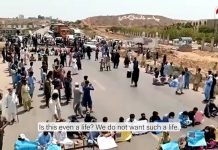
The conference later witnessed protests following remarks by former interior minister and current adviser to the prime minister, Rana Sanaullah, regarding Balochistan and enforced disappearances. During his speech, comments attributed to him were met with strong reactions from the audience, leading to disruptions.
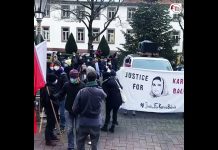
Participants objected to remarks in which Rana Sanaullah appeared to justify enforced disappearances in the context of militancy. Following continued disagreement, a large number of attendees, including social activist Sheema Kermani and Sammi Deen Baloch, staged a walkout. Protesters outside the hall chanted slogans calling for the release of Dr Mahrang Baloch.
A relative of Asma Jahangir criticised Rana Sanaullah’s participation, saying that remarks perceived as justifying rights violations were inappropriate at a conference held in her name. Several participants said that defending enforced disappearances at a human rights conference was unacceptable and contradicted the principles associated with Asma Jahangir.