











In the early hours of 31 January 2026, residents across Balochistan awoke to the sound of explosions. Within minutes, armed fighters appeared on highways, streets and alleyways, outside police stations and around military installations in at least a dozen cities.
The Baloch Liberation Army (BLA) later announced that it had launched the second phase of “Operation Herof”, or Black Storm, which the group describes as a multi-phase campaign to restore Baloch sovereignty across the region.
For Pakistan, which has long portrayed the Baloch armed movement as fragmented, externally backed and militarily contained, the scale and synchronisation of the attacks were unprecedented. For many observers, however, the most significant development was not only the breadth of the operation but the speed at which it overwhelmed the state’s ability to control information. Over the following week, a battle for territory unfolded alongside a parallel battle for narrative, one that proved equally difficult for the state to regain.
Pakistan’s Official Framing
Pakistani officials said the coordinated attacks had been repulsed on the first day, despite clashes continuing for nearly a week. In its initial statement on 1 February, the military’s media wing, the Inter-Services Public Relations (ISPR), said the assaults were launched “at the behest of their foreign masters” and were intended to disrupt life in Balochistan.
ISPR said security forces had “immediately responded” and “successfully thwarted” the attacks, claiming that 92 fighters had been killed. It said 18 civilians and 15 security personnel had also died.
On the same day, Defence Minister Khawaja Asif told reporters that “peace has been established” in Balochistan after attempts to target Frontier Corps headquarters in Nushki and Dalbandin, including a reported suicide attack, had been “foiled”, and that “all targets have been neutralised”.
Throughout 2–3 February, officials rejected reports that Baloch fighters had seized control of parts of the region. Minister of State for Interior Tallal Chaudhry said a “false narrative” was circulating on social media, while Balochistan government spokesperson Shahid Rind said police and Frontier Corps personnel had “foiled attempted terrorist attacks at a few places across Balochistan”.
Chief Minister Sarfraz Bugti acknowledged that it had taken security forces “some time to disengage” BLA fighters in Nushki but insisted the district had been “completely cleared”.
A central feature of the state’s narrative was the immediate externalisation of blame. Interior Minister Mohsin Naqvi said “India is behind these attacks”, alleging joint planning between Indian agencies and armed groups. Mr Asif echoed the accusation, while Mr Bugti said a “narrative of independence” was being promoted “on India’s instructions”. Officials also accused Afghanistan’s Taliban government of failing to prevent its territory from being used for attacks inside Pakistan.
Government officials further insisted there was no public sympathy for the fighters. Mr Bugti claimed residents across Balochistan had “strongly condemned and rejected” Operation Herof, saying the local population did not support Baloch armed groups.
Officials also sought to downplay the scale of the assault. Mr Bugti dismissed BBC reporting that between 1,000 and 1,200 fighters had taken part in the offensive, saying the number was “under 200 or 250 at maximum”. He said he did not know the precise strength of BLA fighters in Balochistan but estimated their numbers at between 4,000 and 5,000.
Mr Bugti also warned that family members of those who had joined armed groups could face consequences. He said families were responsible for informing the state about their relatives’ involvement. “Law will take its course against all the family members of these terrorists who did not alert the government,” he said. A regional spokesperson later said action could follow once deceased fighters were identified, without specifying the legal basis.
On 5 February, ISPR said it had concluded a week-long counter-operation, claiming that 216 fighters had been killed. It said 22 security personnel and 36 civilians had also died, and that the operation had “significantly degraded the leadership, command-and-control structures and operational capabilities” of armed groups.
Some elements of the state’s narrative were contradicted by its own officials. A Home Ministry source told Reuters that 45 security personnel — not 22 — had been killed. Pakistani police also told the agency that drones and helicopters had been used to wrest control of Nushki from insurgents after a three-day battle, contradicting earlier claims that the attacks had been repelled on the first day.
General Public as Narrative Actors
One of the earliest challenges to the state’s assertion that Baloch fighters lacked public support emerged from the conduct of ordinary residents during Operation Herof 2.0.
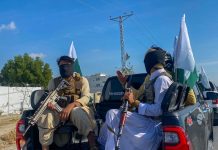
Footage shared on social media showed residents in several towns approaching sarmachars — a term used for Baloch fighters — and offering them water, food and assistance. Young people, women and children were seen taking photographs and walking alongside armed men in areas where Pakistani forces had only recently withdrawn.
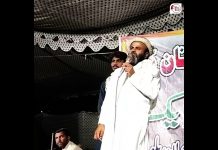
In Nushki, crowds gathered openly around BLA fighters. In one widely circulated video, an armed individual addressed residents in the Brahui language as people stood listening without visible signs of panic. The scenes appeared at odds with official claims that the general Baloch public had rejected the operation.
Throughout Operation Herof 2.0, social media platforms were flooded with videos filmed by residents showing armed fighters moving through streets, damaged buildings, sealed markets and public gatherings. In some clips, women were seen offering prayers for the fighters; in others, locals posed for photographs beside them.
A resident of Quetta told The Balochistan Post that daily movement in the city is usually marked by fear of harassment or disappearance by Pakistani troops. “But that day,” he said, “familiar local faces were guarding the streets, and for the first time, there was no fear in stepping outside.”
To understand the public response, The Balochistan Post approached a Quetta-based political analyst who spoke on condition of anonymity due to security concerns. The analyst said many Baloch fighters come from the same towns and neighbourhoods as the residents seen in the videos. “People recognised them,” he said. “These were not strangers. Many of them were known locally long before they joined the armed struggle.”
The analyst added that armed operations by Baloch groups generally target military installations, convoys and state-linked projects rather than civilians. This distinction, he said, shapes how the local populace perceives such operations and reduces fear during periods of fighting.
He also said sustained restrictions on peaceful political activity in Balochistan had pushed some young people towards armed groups. “Political avenues have narrowed for years,” he said. “When those spaces close, people see no option other than joining the armed movement.”
Civilian Deaths That Did Not Match the Official Story
Pakistan said 36 civilians were killed during the fighting, suggesting many of the deaths occurred during militant attacks. However, a fact sheet released by the Human Rights Council of Balochistan (HRCB) documented incidents of civilian harm that appeared unrelated to clashes with armed groups.
HRCB listed “Targeted & Indiscriminate Killings: 30” and said these deaths occurred during security operations carried out after the launch of Operation Herof. The organisation cited the killing of twelve people, including women and children, when a residential compound housing labourers’ families was struck.
In Turbat, HRCB said a 15-year-old boy was killed after mortar fire hit a civilian neighbourhood. A drone strike in Nushki’s Killi Jamaldini area reportedly killed a minor child, while ten passengers died near Cadet College Nushki after security forces opened fire on a civilian vehicle. Additional deaths were recorded in Turbat, Gwadar and Nushki during raids and firing incidents that followed the initial attacks.
The rights group also challenged Pakistan’s claims about militant casualties, saying the figures “sharply contradict claims from other sources”. It noted that the state had released no names, profiles or circumstances of death.
“Given the long-established pattern of people being killed in custody and later labelled as militants killed in ‘encounters’, these claims cannot be accepted at face value,” HRCB said, adding that without transparent identification of the deceased, official figures remained “unsubstantiated and inconsistent with ground reports”.
How the BLA Seized the Information Space
From the outset of Operation Herof 2.0, the Baloch Liberation Army moved quickly to shape the public narrative around the attacks.
Within minutes of announcing the second phase of the operation, the group began releasing a steady stream of statements, audio messages and video material, including battlefield updates, casualty claims, instructions to civilians and footage filmed by fighters on the ground. During this period, Pakistani state institutions issued no immediate public response.
When official statements did emerge hours later, they focused largely on casualty figures and assertions that the operation had been foiled, even as reports of clashes continued to surface from multiple districts.
Shortly after the initial announcement, the BLA’s commander-in-chief, Bashir Zeb Baloch, appeared in a widely circulated video message released by the group’s media wing, Hakkal. In the recording, purportedly filmed inside Balochistan, he urged the public to come out of their homes and stand with the fighters.
“This struggle does not belong to any single individual but to collective consciousness,” he said. “When a nation stands united, the enemy cannot avoid defeat despite its power.”
As the fighting continued, the BLA released further claims that its fighters had launched coordinated attacks across several cities and carried out suicide-style operations inside military and intelligence installations.
Throughout the first day, video footage, photographs and audio messages circulated widely. Some clips appeared to show fighters inside police stations and government buildings, while others showed damaged military installations and burning vehicles. Audio recordings from several towns included fighters providing real-time updates to field commanders.
One set of images showed armed men inside the Counter-Terrorism Department headquarters in Nushki, with detainees visible on the floor. Another video showed the district’s deputy commissioner and assistant commissioner in BLA custody before the group said they were later released.
In the days that followed, images and videos circulated online showing public gatherings and interactions between fighters and local residents.
Across six days of fighting, this pattern continued. While Pakistani officials repeatedly said the situation was under control, the BLA continued to release footage and claims showing clashes, seized buildings and armed patrols, maintaining a visible and largely uncontested presence in the information space.
The Erosion of Official Credibility
Pakistan’s narrative during Operation Herof followed a familiar pattern: foreign interference, swift retaliation, militants eliminated and control restored. For years, this formula has shaped how the state has sought to manage national and international perception around major security incidents in Balochistan.
Operation Herof 2.0 unfolded in an information environment the state could no longer fully command. As images, audio recordings and battlefield footage released by the BLA, alongside material filmed by local residents, circulated online in real time, official claims came under sustained scrutiny from the public, analysts, journalists and researchers.
Journalist Shahzeb Jillani described Balochistan as an “information black hole”, where armed groups use social media to project battlefield gains while the state releases what he called “random figures” to assert that control has been restored.
Security analyst Abdul Basit said Balochistan had reached a “tipping point”, where propaganda and manufactured narratives could no longer obscure the underlying political crisis.
That credibility gap was compounded by contradictions between official statements and state actions. Baloch political analyst Hakeem Baloch said the continued use of drones, helicopters and aerial surveillance, even after officials said the attacks had been repelled, raised questions about the accuracy of official claims. “These measures do not signal control,” he said. “They expose fear, weakness and the collapse of Pakistan’s narrative on Balochistan.”
Berlin-based researcher Sahar Baloch said it had become “difficult to fully trust” official numbers when different institutions reported conflicting totals. “Whenever a major incident occurs in Balochistan, we are presented with different narratives and different figures,” she said. She added that Pakistan’s mainstream media, heavily dependent on official briefings and restricted by limited access to the region, often amplified state claims without independent verification.
Analysts also said the coordinated assaults exposed vulnerabilities the state appeared reluctant to acknowledge. Afghan journalist Bilal Sarwary said the operations resembled tactics used by the Taliban in the years preceding their takeover of Afghanistan, when temporary control of districts was used to project a parallel authority.
He added that Pakistani authorities appeared to be “downplaying the significance of these attacks through controlled media narratives,” warning that such an approach risked the state losing “large parts of Balochistan” if underlying issues were not addressed.
Some of the sharpest criticism focused on the government’s insistence that the conflict could be resolved through military force alone. After Chief Minister Sarfraz Bugti described military operations as the “solution” to Balochistan’s problems and suggested that family members of suspected fighters could face consequences, Rafiullah Kakar, a political analyst specialising in Balochistan and a doctoral candidate at the University of Cambridge, said decades of coercive approaches had produced neither stability nor trust.
According to Kakar, the same mindset that relies on coercion also shapes how the state constructs its counter-narrative. The crisis, he argued, went deeper than a flawed counterinsurgency strategy. The state’s entire narrative framework, he said, was never designed to win the trust of Baloch people but to reassure audiences in “Pakistan proper.” On mainstream television, he said, officials “bury their heads in the sand,” presenting “lies upon lies” to create an entirely fictional picture of the conflict. “Even from the state’s perspective,” he said, “it is hard to understand what benefit such blatant dishonesty provides.”
Kakar said this narrative architecture was driven less by conditions in Balochistan than by bureaucratic incentives. Civilian and military officials, he argued, are more focused on demonstrating success to superiors in Islamabad and Rawalpindi than on addressing realities on the ground. “Whether the results are fake or based on falsehoods does not matter,” he said. “What matters is that during their tenure, everything appears excellent on paper.”
He contrasted this approach with the BLA’s strategy, which he described as deliberate and calibrated. Despite its use of violence, he said, the group has intentionally avoided targeting the general population, particularly ordinary Baloch and Pashtun civilians, and refrains from attacking the civilian administration. “Because of this, it has been able to maintain its support base,” he said.
Kakar added that the state’s attempt to portray the BLA as indiscriminate did not match how local people experience the conflict. “If the BLA wanted to, it could arrest the entire civilian administration in the Baloch belt in a single night,” he said. “But it does not do so. Even in Nushki, when the deputy commissioner and assistant commissioner were detained, they were later released.”
The result, he said, is a widening disconnect between the state’s narrative and the reality perceived by Baloch residents. “This narrative may succeed in shaping opinion within Pakistan proper,” he said, “but among ordinary Baloch people, there is no visible decline in the BLA’s support base.”
Kakar said any serious attempt to restore stability — and credibility — would require a fundamental recalibration of the state’s approach. The starting point, he argued, must be confidence-building measures that acknowledge the political nature of the conflict rather than relying exclusively on force.
Operation Herof 2.0 underscored that conflicts in Balochistan are no longer defined solely by military engagements. Alongside the fighting, control over information, and the ability to sustain a credible account of events, has emerged as a decisive front. Over the course of the operation, competing narratives shaped public understanding as much as the battles themselves. As this episode showed, maintaining narrative credibility can influence outcomes beyond the physical domain of the conflict.