

















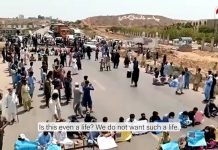
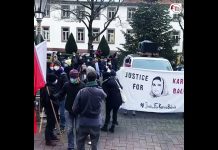




Baloch rights leaders and groups on Sunday condemned the alleged enforced disappearance of 15-year-old Nasreena Baloch in Hub Chowki, saying the case highlights an escalating pattern of targeting Baloch women and girls by Pakistani armed forces.
Nasreena, originally from Awaran and living with her family in Hub, was allegedly forcibly disappeared during a midnight raid on 22 November, according to family members and rights groups. Pakistani authorities have not issued any statement regarding her disappearance.
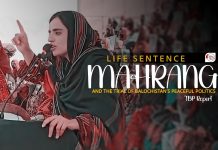
In a message posted on X, Baloch Yakjehti Committee (BYC) chief organizer Dr Mahrang Baloch said the disappearance of a teenage girl underscored “the face of ongoing oppression, brutality and genocide in Balochistan.”
She said Nasreena was taken during a raid marking “yet another example of the daily crimes committed against Baloch civilians,” adding that the incident showed enforced disappearances were continuing “without restraint.”
Dr Mahrang said the case was not an isolated incident, pointing to the enforced disappearance of polio-affected student Mahjabeen Baloch, taken from her hostel in Quetta six months ago and still missing. Such detentions, she said, were “part of the system of repression” and showed that “age, gender and disability offer no protection.”
“Pakistani forces are committing crimes against humanity in Balochistan on a daily basis,” she said.
In a separate statement, Dr Shalee Baloch, organizer of the Baloch Women Forum (BWF), said the incident amounted to a “direct state attack on Baloch societal norms,” describing Nasreena’s disappearance as part of what she called an emerging pattern of enforced disappearances targeting Baloch women.
She called the raid and detention “illegal and unwarranted” and said it violated cultural and social values. “Women have always been a symbol of dignity in our society as a norm, but today, the state agencies are openly challenging the Baloch code, conduct and norm,” she said. Dr Shalee demanded Nasreena’s “immediate and unconditional release.”
Meanwhile, the Baloch Yakjehti Committee (BYC) said Nasreena’s disappearance had left her family in “anguish and helplessness,” adding that no information had been provided regarding her condition or whereabouts.
The group said the case, along with Mahjabeen’s disappearance, demonstrated that “the central basis of enforced disappearances in Balochistan is solely Baloch identity.”
“Age, gender or health conditions are not considered; anyone can become a target of this repression,” the statement said.
The BYC added that the detention of women without legal process violated international law, the Geneva Conventions and fundamental human rights. It said enforced disappearances had pushed families into “trauma, grief and permanent insecurity,” and that the disappearance of minor girls represented “an attack on human dignity and Baloch identity.”
BYC warned that attempts to instil fear would instead deepen political awareness. It urged the Baloch public to present these incidents before the world “with unity, so that this suffering becomes a motive for national struggle rather than a private torment of few families.”