








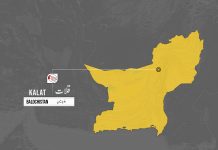






Armed Baloch fighters have held control of the Zehri area of Khuzdar district for the past ten days, with fresh clashes reported on Thursday.
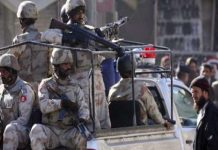
Local sources said heavy assaults targeted Pakistani military forces in the Gazzan, Sohinda and Sunni areas. They said the forces suffered losses, although Pakistani authorities have not released details.
The armed takeover of Zehri began on 11 August, when Baloch fighters addressed a public gathering in Zehri and ambushed convoys attempting to enter the city.
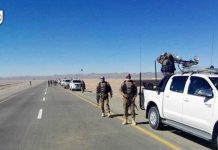
Fighters later blocked entry routes, using heavy machinery to destroy sections of road and prevent military movement. The Sunni–Noorgama road was bulldozed, while convoys advancing through Gazan and Mashk came under attack.
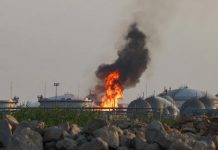
Videos circulating on social media appeared to show destroyed vehicles, uniforms and other belongings allegedly belonging to Pakistani security forces scattered along the highway.
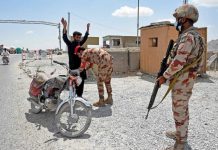
Meanwhile, Pakistani forces closed the Anjeera RCD Cross to all traffic. Local sources said troops attempted to detain two young men travelling to Zehri after allegedly subjecting them to torture, but passengers intervened and prevented the arrests.
Neither Baloch armed groups nor Pakistani authorities have issued official statements on the situation. Internet services in the area remain suspended.
Earlier this year, the Baloch Liberation Army (BLA) claimed control of Zehri city for several hours in a similar attack.
During that operation, BLA fighters seized police and government buildings, ambushed a military convoy with a remote-controlled explosive device, and claimed to have captured weapons and documents.
The BLA has previously described such takeovers as preparations for the second phase of “Operation Herof”, a multiphase resistance campaign launched in August 2024 aimed at “reclaiming Balochistan”.
In its first phase, the group claimed to have killed more than 130 Pakistani soldiers and to have seized control of highways and installations, including a 20-hour occupation of a military base in Bela.
Analysts described it as the largest coordinated armed action in the history of the Baloch insurgency, stretching from Makuran to the Koh-e-Sulaiman range.