

















A senior district official has been killed, and multiple government buildings and vehicles torched, after fighters from the Baloch Liberation Army (BLA) stormed the city of Surab in Balochistan’s Kalat division.
Balochistan government spokesperson Shahid Rind described the assault as “an attempt to challenge the writ of the state.” He said security forces were working to restore control and secure the area.
In a detailed statement released late Friday, the BLA claimed its fighters had “taken complete control” of Surab city, “paralysing all military, administrative, and financial structures of the state.”
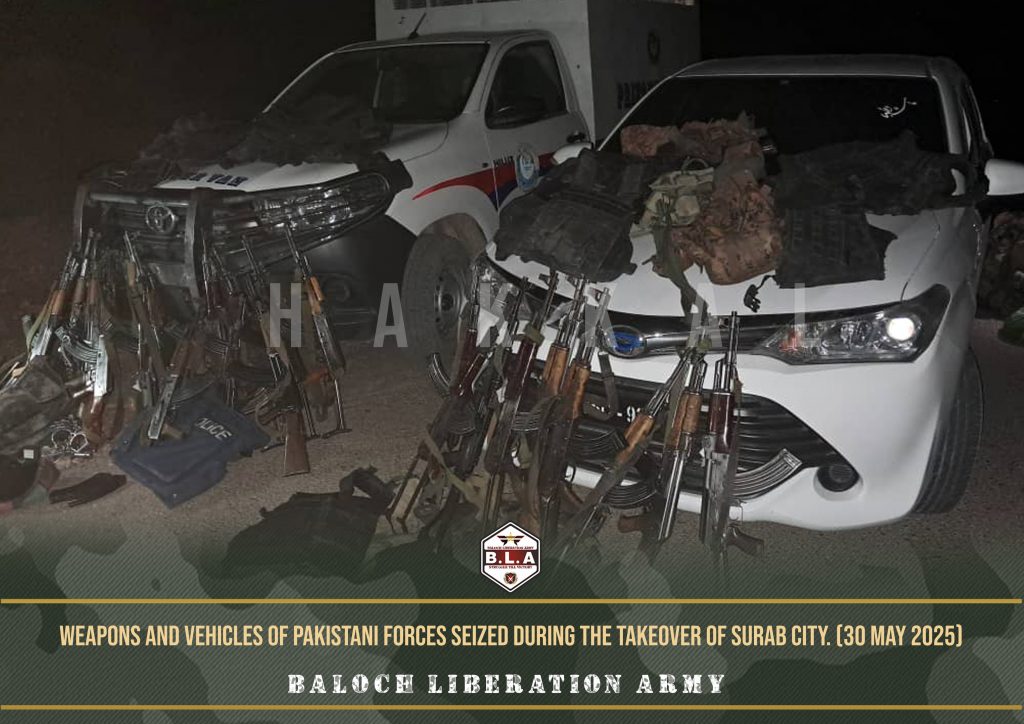
The group said its operation lasted over three hours, during which fighters seized the Levies station, police station, Deputy Commissioner’s office, guest house, and banks.
BLA spokesperson Jeeyand Baloch said fighters detained Levies and police personnel, seizing 30 Kalashnikov rifles and other weapons from security posts. The detained personnel were later released “under conditional amnesty based on their Baloch identity.”
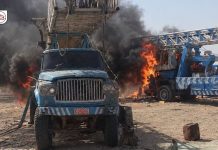
The BLA said it set fire to three vehicles belonging to security forces, state warehouses, the guest house, and three banks. Two vehicles were reportedly seized for use by BLA fighters.
The group confirmed that Assistant Deputy Commissioner (ADC) Hidayatullah Buledi died during the assault. According to the BLA, he was subdued by fighters during an attempt to retake the DC office and locked in a room, where he later died from asphyxiation—an “accidental incident,” the group claimed.
Eyewitnesses and local sources said the attackers also destroyed security forces’ vehicles and established checkpoints on major roads, including the Quetta–Karachi highway and the Surab–Gidar route. Video footage from the scene showed smoke rising from the Levies station, with armed fighters patrolling key locations in the city.
This is not the first time the Baloch Liberation Army has claimed control over towns and strategic locations in Balochistan, having also launched a series of high-profile attacks in recent months.
In January, the group said it had taken over Zehri in Khuzdar district, seizing weapons and ambushing a military convoy. In March, the BLA claimed responsibility for hijacking the Jaffar Express train, allegedly killing 214 security personnel after a failed prisoner exchange.
On May 11, the group said it had captured Manguchar in Kalat district, torched government buildings, and blocked the Karachi–Quetta highway. The BLA also claimed to have carried out more than 71 attacks across 51 locations between May 8 and 10, including strikes on military convoys, intelligence agency offices, and mineral transport routes.
Analysts say the BLA’s evolving strategy—marked by temporary territorial control, coordinated multi-location attacks, and growing local support—poses an increasingly serious challenge to Pakistan’s authority in Balochistan.
In its latest statement, the BLA said its operations aim to “destroy every institution, every symbol, and every force of the occupying Pakistani state,” reiterating that its struggle will continue until the goal of “Baloch national independence is achieved.”