







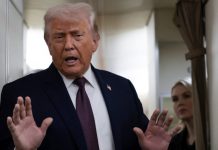



US President Donald Trump on Friday reiterated his earlier threat of military action if Iranian protesters continue to be killed, saying Iran’s leadership appeared to be “in big trouble” as unrest spread to cities previously seen as firmly under government control.
“It looks to me like people are taking over some cities that nobody thought were really possible just a few weeks ago,” Trump said, commenting on the rapidly evolving situation inside Iran.
Protests triggered by soaring inflation have entered their 13th consecutive day across the country, increasingly taking on an explicitly political character, with demonstrators calling for the end of Iran’s clerical system established after the 1979 Islamic Revolution. The current unrest is described as the largest nationwide protest movement in more than three years.
Despite a sweeping security crackdown, Iranians were again seen on the streets on Friday. Authorities have maintained extensive internet shutdowns as part of efforts to contain the protests. Dozens of people have reportedly been killed during security operations, though the full scale of casualties remains unclear due to restrictions on information.
An AFP-verified video showed residents in Tehran’s northern Saadat Abad district banging pots and pans and chanting slogans against Supreme Leader Ayatollah Ali Khamenei, while passing vehicles honked in apparent support. Other images circulating online indicated similar scenes in multiple parts of the capital.
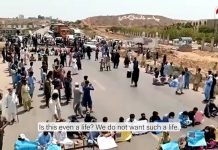
Footage broadcast by Persian-language television channels based outside Iran showed large crowds gathering in eastern Mashhad, the northern city of Tabriz, and the holy city of Qom, suggesting the protests have spread well beyond Tehran.
The demonstrations followed major rallies on Thursday, described as the largest since the 2022–23 protest movement sparked by the death in custody of Mahsa Amini, who had been detained by morality police over alleged violations of dress regulations for women.
Internet monitoring group NetBlocks said Iranian authorities had imposed a “nationwide internet shutdown” over the past 24 hours, describing the move as a violation of citizens’ rights and an attempt to conceal state violence. Amnesty International echoed those concerns, stating that the “total internet blackout” appeared designed to hide the scale of serious human rights violations and crimes under international law being committed during the crackdown.
In his first public comments on the protests since they intensified on January 3, Supreme Leader Khamenei on Friday dismissed demonstrators as “looters” and “saboteurs.” In a speech broadcast on state television, he accused President Trump of having “the blood of more than a thousand Iranians on his hands,” an apparent reference to the June 2025 conflict between Israel and Iran, which the United States supported and participated in.
Khamenei predicted that the “arrogant” US leader would eventually face the same fate as Iran’s former monarchy, overthrown in 1979. “Millions of people shed blood to establish the Islamic Republic,” he said, adding that the state would not retreat in the face of what he described as subversion.
Meanwhile, Iranian Foreign Minister Abbas Araghchi, speaking during a visit to Lebanon, accused Washington and Israel of “direct interference,” claiming they were attempting to turn what he described as peaceful protests into violent unrest. A US State Department spokesperson dismissed the allegation as “delusional.”