







By Zamul Baloch
THE PRESS CONFERENCE
January 6, 2026. Rawalpindi
Lt. Gen. Ahmed Sharif Chaudhry, DG ISPR, stood before the cameras for yet another press briefing.
He opened with numbers. Operations. Statistics. In 2025 alone, he said, 58,778 operations had been carried out in Balochistan. But the briefing did not remain about armed groups for long. The real target soon became those who questioned the state’s version of events.
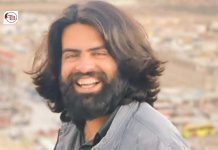
A slide appeared on the screen. Social media posts. Photographs. Faces of activists, journalists, intellectuals. Among them was Jamal Baloch — writer, thinker, and advocate for Baloch rights.
Chaudhry spoke about Dr. Usman Qazi, a professor at BUITEMS who was disappeared in August 2025. The state claimed Qazi had “confessed” to involvement in terrorism. Then came the warning: those who had defended him, who had asked where he was, who had questioned the circumstances of his disappearance or the validity of a confession obtained in custody, were not innocent observers.
“They promote terrorism under the guise of human rights and democracy,” he said.
Names followed. Kiyya Baloch, freelance journalist. The Baloch Yakjehti Committee. Imaan Zainab Mazari-Haazir, human rights lawyer. And Jamal Baloch.
The message was clear. Write about Baloch suffering, and your face can end up projected on a screen at a military press conference, presented to the nation as a security threat.
JAMAL BALOCH’S RESPONSE
Within hours, Jamal Baloch responded on X:
“What an irony that son of UN designated terrorist Ahmed Sharif Chaudhry, spokesperson of Pakistan Army @OfficialDGISPR, displayed my photo on screen during today’s press conference & labeled us as terrorists with 0% proof. You are a terrorist, son of a terrorist & war criminal!”
The statement deserves examination not for its language, but for what it rests upon.
Jamal Baloch is a Baloch intellectual and writer whose work engages questions of identity, historical memory, and systematic political marginalization. His essay “It’s Not Your Mistake” is widely read within Baloch academic and activist circles for its analysis of colonial psychology and internalized subjugation. His writing focuses on enforced disappearances, denial of due process, and the state’s criminalization of dissent. He commands no armed group. His method is documentation, analysis, and public argument.
No charges have been filed against him. No trial has been held. No evidence has been presented in any court.
His inclusion in a military press conference as a “terrorist” therefore raises obvious procedural and evidentiary questions. But his response did not centre those questions. Instead, it pointed to a matter of public record.
Sultan Bashiruddin Mahmood, father of Lt. Gen. Ahmed Sharif Chaudhry, appears on the United Nations Security Council Consolidated Sanctions List for providing support to al-Qaeda. That designation remains active. Mahmood has never been prosecuted. He lives freely in Pakistan.
With that reference, the accusation was turned back on its author.
SULTAN BASHIRUDDIN MAHMOOD
Sultan Bashiruddin Mahmood earned degrees from the University of Manchester — a master’s in control systems in 1965 and another in nuclear engineering in 1969. He joined the Pakistan Atomic Energy Commission in 1968 and became a central figure in Pakistan’s nuclear weapons program. He worked on uranium enrichment and later directed the Khushab Nuclear Complex, which produces weapons-grade plutonium.
This is the résumé Pakistan celebrates.
In August 2001, three weeks before the 9/11 attacks, Mahmood travelled to Kandahar. He met Osama bin Laden and Mullah Omar. According to UN documentation, he provided information on the infrastructure required for a nuclear weapons programme and explained the effects of nuclear weapons. Al-Qaeda operatives told him they possessed nuclear material and wanted to know how to weaponize it. Mahmood provided guidance.
This is not conjecture. This is why, on December 24, 2001, the United Nations Security Council placed him on its al-Qaeda sanctions list for “providing the Taliban and al-Qaeda with information about chemical, biological and nuclear weapons.”
A Pakistani nuclear scientist sat across from the architect of 9/11 and discussed weapons of mass destruction. Weeks later, nearly 3,000 people were killed in New York, Washington, and Pennsylvania. Mahmood’s name entered an international terrorism register alongside al-Qaeda’s inner circle.
He was arrested by Pakistani authorities under FBI pressure. During interrogation, he admitted meeting bin Laden but claimed they discussed food aid and education projects. Pakistani intelligence released him, concluding he “lacked the technical knowledge” to transfer nuclear secrets — a claim difficult to reconcile with his role directing Pakistan’s plutonium production facility. He was never prosecuted.
More than two decades later, Sultan Bashiruddin Mahmood lives freely in Islamabad.
His involvement with extremism was not merely technical. In 1999, he founded Ummah Tameer-e-Nau, presented as a charity for Afghan reconstruction. Its real function was ideological and technical alignment with the Taliban and al-Qaeda. When authorities raided its offices in 2001, they recovered documents relating to anthrax, bubonic plague, and nerve agents. The organisation’s members included senior military and intelligence figures.
Mahmood also believed djinn could be captured and used to generate electricity. He proposed these ideas to General Zia-ul-Haq and wrote books predicting apocalyptic nuclear war. Physicist Pervez Hoodbhoy publicly debated him, describing his ideas as “ludicrous science.” Mahmood responded by accusing critics of being anti-Islamic.
This was the man elevated by Pakistan’s nuclear establishment.
THE SON — AHMED SHARIF CHAUDHRY
Ahmed Sharif Chaudhry did not arrive at the post of DG ISPR by chance. Before assuming control of the military’s public narrative, he headed DESTO, Pakistan’s military research organisation responsible for weapons systems, munitions, and strategic technologies. DESTO was sanctioned by the United States after Pakistan’s nuclear tests, restrictions that were later eased after 9/11.
The contrast is difficult to ignore. His father met Osama bin Laden to discuss nuclear weapons. He himself led a sanctioned military research body. Today, he determines who is branded a terrorist.
As DG ISPR, he has used that authority expansively.
On May 23, 2025, he stood before cameras and targeted Dr. Mahrang Baloch. Her demand was simple: DNA tests for unidentified bodies so families of the disappeared could know whether their loved ones were among the dead. For this, she was labelled a proxy of terrorists. Her motives were questioned. Her right to ask for bodies was challenged. She was later arrested under the Maintenance of Public Order law, detained without trial, tortured, and denied medical care.
Then came January 6, 2026. Another press conference. Another screen. Another set of faces. Jamal Baloch among them.
WHEN “TERRORISM” BECOMES PERMISSION
The label does not end at rhetoric.
On December 23, 2025, Hani Baloch, eight months pregnant, was abducted alongside 17-year-old Hair Nisa Wahid during what authorities described as counter-terrorism operations.
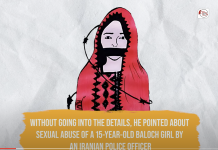
On October 28, 2025, Nazia Shafi and her mother were abducted during a military raid in Panjgur. Nazia was raped in custody and later died. No investigation followed. No arrests were made. The justification was militancy in the area.
These are the operations whose numbers are recited at press briefings.
When activists are called terrorists, the term becomes authorization. It licenses disappearance, torture, sexual violence, and death. It converts crime into duty and brutality into policy.
THE PATTERN — WHO DECIDES WHAT TERRORISM IS
Frantz Fanon warned that the colonizer always defines violence in ways that criminalize resistance and sanitize domination. Pakistan follows this logic precisely.
Osama bin Laden lived in Abbottabad for years. The Haqqani Network operated openly. Hafiz Saeed moved freely for decades. Sultan Bashiruddin Mahmood remains unprosecuted.
Meanwhile, doctors asking for DNA tests are arrested. Writers are projected on screens. Intellectual dissent is rebranded as extremism.
Jamal Baloch’s response exposed the contradiction at the heart of this system. When the son of a man sanctioned for aiding al-Qaeda defines terrorism, the word itself collapses.
One generation met Osama bin Laden. The next generation labels essayists.
The question is no longer whether Jamal Baloch is a terrorist. The question is why a state that protected actual terrorists is permitted to decide who deserves that name.
If writing about Baloch history is extremism, while providing nuclear guidance to al-Qaeda carries no consequence, then terrorism has ceased to be a legal category. It has become a weapon.
And when that weapon is accepted without challenge, the meaning of the word is lost entirely.
Disclaimer: The views and opinions expressed in this article are those of the author and do not necessarily reflect the official policy or position of The Balochistan Post or any of its editors.