

















By Shahab Baloch
Seventeen years, no answers, a daughter, a photograph, and the silence of Balochistan.
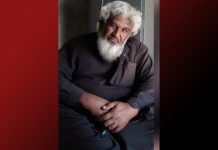
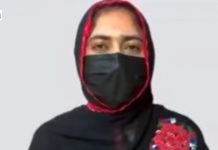
There are photographs that record joy and photographs that record history. Then there are photographs that become a substitute for a living person. In the hands of Sammi Deen Baloch, a single image has carried the weight of seventeen years. It is the image of her father, Dr. Deen Muhammad Baloch, a man taken away on 28 June 2009 and never returned. What remains is a daughter holding his face against her chest, as if memory itself could keep him alive.
Sammi was only ten years old when her father was forcibly disappeared. At that age, children measure time in school terms and birthdays. They believe absence is temporary and that every goodbye ends with a return. She could not have known that the word missing would come to define her childhood, her youth, and the shape of her adulthood. Today she is twenty-seven years old, and seventeen years of her life have been spent waiting for a knock on the door that never comes.
The picture she holds is not just paper. It is a question that has never been answered. It asks where her father is, who took him, and why a family was condemned to live between hope and grief. This uncertainty is not loud. It does not announce itself with funerals or final prayers. It lingers quietly, entering every room, sitting beside every meal, and following every celebration with a shadow.
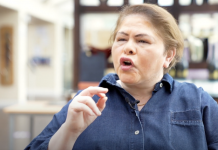
In one interview, Sammi said something that reveals the depth of this wound. She said that those who know their loved ones were martyred at least have certainty. They can grieve, cry, and eventually bury their pain in the soil of acceptance. But those who do not know whether their loved ones are alive or dead suffer a different kind of torment. Waiting, she said, is harder than hard. It is an endless punishment with no conclusion.
This is the psychology of enforced disappearance. It creates what scholars call ambiguous loss, a form of grief without closure. The mind cannot complete the process of mourning because the truth is withheld. The heart continues to hope even when reason is exhausted. For children like Sammi, this uncertainty grows with them. It shapes their understanding of the world and teaches them early that justice is not guaranteed.
Dr. Deen Muhammad Baloch was not just a missing person. He was a father, a professional, and a presence in his community. When he disappeared, a household lost its centre. A child lost her guide. A family lost its sense of safety. These losses are rarely documented in official records, but they are etched deeply into private lives.
Sammi grew up holding her father’s photograph at protests and on long marches for justice. While other children held schoolbooks or toys, she held an image of a man frozen in time. Her childhood did not unfold quietly at home. It unfolded on roads, under the open sky, among slogans and banners. She learned the language of resistance before she learned the language of comfort.
The image of a child holding her father’s picture is powerful because it exposes a contradiction. Childhood is meant to be protected from the weight of political violence. Yet in Balochistan, many children inherit this burden before they understand its meaning. They grow up knowing the names of detention centres, courts, and commissions. They learn patience not as a virtue, but as a survival skill.
What makes Sammi’s story especially painful is its familiarity. Her story is not unique. It is repeated in countless homes across Balochistan. Every house has a name spoken softly. Every family has a chair that remains empty. Every mother knows the sound of footsteps that are not the ones she waits for. These are not isolated tragedies. They form a collective wound carried by an entire region.
When families of the disappeared take to the roads, holding pictures and chanting for justice, they are often seen as symbols. But symbols do not feel hunger, exhaustion, or fear. These families do. They endure heat, cold, and indifference. They endure the accusation that their pain is political, as if pain needs permission to exist. What they are really asking for is simple. They want answers. They want truth.
The disappearance of a parent during childhood creates a fracture that time does not easily repair. Children learn to live in a state of emotional suspension. They become adults who still measure their lives against an absence. Education, career, and personal growth continue, but they are accompanied by a persistent question: What if today is the day he returns? What if today is the day the truth is finally spoken?
From a medical and psychological perspective, prolonged uncertainty can be as damaging as confirmed loss. It increases anxiety, depression, and a constant state of alertness. The nervous system never fully rests. For families of the disappeared, hope and despair coexist in the same breath. This is not resilience by choice. It is endurance forced by circumstance.
Sammi represents a generation that grew up between slogans and silence. Her youth was not defined by rebellion alone, but by responsibility. She became a voice not because she wanted attention, but because silence had already taken too much. In speaking about her father, she speaks for many who can no longer speak for themselves.
There is something profoundly human in holding on to a photograph. It is an act of defiance against erasure. When institutions fail to acknowledge a life, the family becomes the archive. Memory becomes resistance. Love becomes evidence. Sammi’s grip on her father’s image is a refusal to let him vanish completely.
Balochistan’s story is often told in numbers and headlines: how many disappeared, how many years passed. But numbers cannot capture the experience of a child growing into adulthood without knowing whether her father is alive. They cannot capture the weight of birthdays celebrated with an empty space. They cannot capture the sound of a name repeated in prayers for seventeen years.
Justice, in such cases, is not abstract. It begins with acknowledgment. It begins with answers. It begins with recognising that enforced disappearance is not just a political issue, but a deeply human one. It tears families apart and leaves wounds that stretch across generations.
Sammi’s life is marked by waiting, but it is also marked by dignity. She stands not only as a daughter searching for her father, but as a witness to a collective pain. Her story asks a question that remains unanswered: how long can a society ask its children to carry the consequences of silence?
Until that question is answered, photographs like the one Sammi holds will continue to speak. They will speak in rallies, in interviews, and in quiet moments at home. They will speak of fathers who never came back and daughters who grew up too soon. They will remind us that behind every case file is a human life suspended in time.
Seventeen years have passed since Dr. Deen Muhammad Baloch was taken. Seventeen years of uncertainty. Seventeen years of waiting. For Sammi, time has not healed the wound. It has only taught her how to live with it. And as long as she holds her father’s picture, the world is reminded that some absences are not accidents. They are injustices.
Disclaimer: The views and opinions expressed in this article are those of the author and do not necessarily reflect the official policy or position of The Balochistan Post or any of its editors.