





















Author: Hamaad Baloch
Balochistan has long been a region mired in conflict, oppression, and human rights violations. Enforced disappearances, extrajudicial killings, and suppression of dissent have become hallmarks of this troubled region. Historically, Baloch politics has been dominated by men, but a significant shift is taking place—women are now emerging as prominent leaders in the fight against injustice and for their rights.
Balochistan, a region spanning parts of Pakistan, Afghanistan, and Iran, is home to people who identify as Baloch. The demand for an independent Baloch state has been a persistent feature of its history, especially in Pakistan-controlled Balochistan, where the state has met such aspirations with severe crackdowns. While public movements in the region have periodically surged and subsided, leadership has traditionally been male-dominated. Women, though present, were largely confined to supporting roles and rarely given opportunities to lead.
However, the last five years have seen a significant transformation. Women in Balochistan, often marginalized in the sociopolitical sphere, are now challenging traditional norms and asserting themselves as leaders in grassroots movements. This shift represents not just a change in the political landscape but also a redefinition of societal norms in a historically patriarchal society.
Breaking Barriers in a Patriarchal Society
Balochistan has long been a male-dominated society, with few historical accounts of women playing prominent roles, except in folklore or poetry. Traditionally, women were relegated to the periphery of political movements. In recent years, however, they have defied these conventions and established themselves as voices of leadership, organizing protests and speaking out against oppression.
Women like Dr. Mahrang, Sammi, and Sabiha are leading figures in this resistance. Their leadership not only reflects their courage but also stems from personal sacrifices. Dr. Mahrang’s father was killed while held incommunicado. Sammi’s father has been missing since 2009, and Sabiha’s family has faced repeated instances of state violence. Despite these personal losses, these women have become symbols of hope, inspiring thousands to join their cause.
Catalysts for Change
The emergence of women as leaders in Balochistan’s political landscape can be traced to several pivotal moments. One such instance occurred in 2019, when a scandal involving hidden cameras in the restrooms of Balochistan University came to light. With allegations of state involvement, students staged large-scale protests. Women students led these protests, delivering impassioned speeches and galvanizing public outrage. This marked a turning point in the perception of women’s roles in Baloch society and politics.
Another critical moment was the killing of a woman whose young daughter, Bramsh, was injured in the same attack. This incident sparked widespread protests across Balochistan. This time, women not only participated but also led the demonstrations, mobilizing communities against state violence.
The death of Karima Baloch, a prominent activist who passed away under mysterious circumstances in Canada, further galvanized women in Balochistan. Her funeral was a powerful moment, with women breaking traditional norms by carrying her body to the graveyard themselves. This act was both a tribute to her legacy and a statement of defiance against oppressive traditions.
Women Leading the Charge
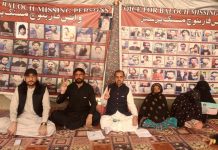
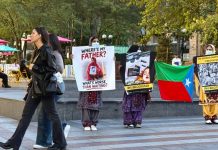
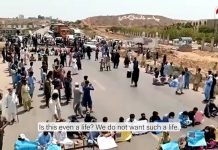
Today, women in Balochistan are organizing grassroots movements, mobilizing thousands of men, women, and children. Their struggle transcends political rights, extending to social justice, education, and human dignity. Organizations like the Baloch Yakjehti Committee, where women hold key leadership positions, are addressing issues such as enforced disappearances and state repression. Their protests and gatherings have drawn large crowds, showcasing the collective power of women-led activism.
It is essential to recognize that this movement did not emerge in isolation. For years, the families of missing persons—often mothers, daughters, and sisters—have been at the forefront of protests, demanding accountability for their loved ones. Their perseverance laid the groundwork for the broader women’s resistance movement that we see today.
Challenging Norms and Inspiring Change
The rise of women leaders in Balochistan challenges deep-rooted patriarchal norms. Men in the region, traditionally seen as the sole decision-makers, are now supporting and participating in these women-led movements. This acceptance marks a significant cultural shift and signals a growing recognition of women’s capabilities and contributions.
Baloch women’s struggle is not an isolated issue; it is part of the global fight for human rights and equality. According to Amnesty International and the United Nations, Balochistan’s population has suffered disproportionately from enforced disappearances in Pakistan. Through their leadership, Baloch women are sending a powerful message to the international community, urging it to pay attention to the crisis in their region.
A Revolutionary Moment in History
The emergence of women leaders in Balochistan is a revolutionary moment in the region’s history. In a society where women have traditionally been given limited opportunities, they are now at the forefront of the fight for justice and human rights. Their courage and determination serve as a beacon of hope, not just for the people of Balochistan but for oppressed communities worldwide.
This movement is not merely about Balochistan; it is about dignity, equality, and freedom. The resilience of Baloch women is a reminder to the world that even in the darkest times, collective struggle and unwavering hope can ignite the flame of change.
Disclaimer: The views and opinions expressed in this article are those of the author and do not necessarily reflect the official policy or position of The Balochistan Post or any of its editors.