













Author: Fareed Baloch
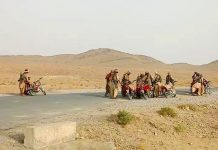
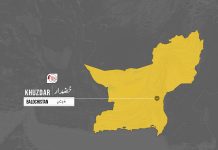
Armed fighters briefly took control of Naal, a town in Balochistan’s Khuzdar district, after dusk on Thursday, seizing a police checkpost and a construction company’s camp and blocking traffic along the China–Pakistan Economic Corridor (CPEC) highway. They withdrew by the early hours of Friday, leaving behind burned police vehicles and heavy machinery on an empty road.
The assault was one of several coordinated attacks reported across Balochistan within a single day — a surge that appears to challenge Chief Minister Sarfraz Bugti’s recent claim that the government’s writ has been “fully restored.”
A Wave of Coordinated Assaults
Over a 24-hour period, Baloch armed groups carried out a series of attacks across Khuzdar, Mastung, Kalat, Kech, and Awaran districts, targeting Pakistani forces, government offices, and construction companies. Officials and local sources said at least 27 people were abducted, more than ten vehicles were torched, and several soldiers were killed or injured.
In Naal, sources said fighters held the town for nearly six hours, detaining 18 police and company employees. They overran a checkpost, seized weapons and vehicles, and set heavy equipment ablaze before retreating into the surrounding terrain. Levies officials said more than two dozen armed men stormed the camp late on Thursday, adding that at least eight vehicles were “completely gutted” and other machinery damaged.
Further south in Awaran’s Jhao Nondrah area, armed men ambushed a military patrol, killing four personnel and injuring one, security officials said. The Balochistan Liberation Front (BLF) claimed responsibility, stating that its fighters first targeted four soldiers patrolling on foot near a camp and then opened heavy fire on an armoured vehicle that arrived to assist, forcing it to withdraw. The group said a quadcopter and surveillance cameras were also damaged before its unit withdrew “safely” to secure locations.
Meanwhile, the Baloch Liberation Army (BLA) said it carried out operations in Kech, Kalat and Mastung districts, including a remote-controlled explosion and several highway blockades. The group claimed it halted traffic for more than an hour on the Quetta–Karachi highway near Manguchar, clashed with Pakistani troops, and killed two soldiers. In Zamuran, Kech district, it said a remote-controlled device struck soldiers on foot, killing one, while another unit intercepted a vehicle near Spilinji, Mastung, allegedly transporting drugs and rations for the military.
Across southern Balochistan, local sources said similar snap checkpoints appeared along stretches of the CPEC route, restricting the movement of military convoys and disrupting access to government installations.
Official Claims and Ground Realities
The latest surge in armed activity comes only days after Balochistan Chief Minister Sarfraz Bugti announced that his government had “restored the writ of the state” across Balochistan.
Speaking at the National Youth Summit in Quetta earlier this month, Bugti praised his administration’s “effective governance and strong security measures,” claiming that peace and order had been “successfully re-established” after years of unrest. He said his government had fulfilled its promise to “reclaim every inch of Balochistan from the grip of fear.”
However, the rapid escalation in armed attacks and the growing presence of militant checkpoints paint a different picture. Political figures, legal experts, and even members of the ruling coalition say Bugti’s assertion of control does not reflect realities on the ground, where much of Balochistan remains outside the reach of state authority.
Advocate Sajid Tareen, a senior lawyer based in Quetta, described the Chief Minister’s statement as “detached from the facts.” “The Chief Minister himself cannot travel by road from Mastung to Khuzdar,” he said, adding that provincial ministers routinely avoid road travel between districts for security reasons.
During a session of the Balochistan Assembly earlier this year, MPA Zafarullah Zehri also warned that the Balochistan’s highways were now “effectively under the control of armed groups.” “The government’s writ does not extend beyond its own offices,” he said, urging the administration to acknowledge the severity of the security crisis.
In October, Senator Kamran Murtaza told lawmakers that the government’s writ had “shrunk to just five kilometres” in Quetta, the capital of Balochistan. He warned that armed groups were setting up checkpoints outside the city, adding: “They can stop vehicles and carry out inspections at their own choosing.”
Former Chief Minister Jan Muhammad Jamali voiced similar concerns in September during the Balochistan Awami Party’s internal elections. “Because of fear, I cannot pass through Bolan,” he said. “Even [Senate Chairman] Sadiq Sanjrani cannot cross Nushki. The situation in Kalat and other areas is alarming.”
Pakistan’s Interior Minister Mohsin Naqvi has also repeatedly downplayed the strength of Baloch armed groups. After the BLA’s Operation Herof last year, he dismissed Baloch fighters as “no more than a match for an SHO,” implying that local police could easily handle them. The comment, widely seen as an attempt to project confidence, has since been used by critics to highlight the disconnect between official rhetoric and the ground situation.
Khyber Pakhtunkhwa Chief Minister Sohail Afridi mocked Naqvi’s remark after bullet-proof vehicles originally allocated to his province were re-routed to Balochistan. “If Balochistan is just one SHO’s job,” he said, referring to Naqvi’s previous claim that local police could manage the insurgency, “then why send them armoured vehicles? Either he was exaggerating then, or he is admitting the truth now.”
Afridi’s remarks echoed a growing recognition within Pakistan’s political circles that years of official claims of “restored peace” have done little to hide the reality that Balochistan’s conflict continues to outpace the state’s ability to contain it.
The Expanding Conflict
The recent surge in attacks marks a continuation of the escalation that began when the Baloch Liberation Army (BLA) launched Operation Herof in August 2024 — a campaign analysts see as a turning point in the decades-long insurgency and a shift from sporadic guerrilla tactics to coordinated and organized warfare.
The BLA described Herof, meaning “Black Storm” in the Balochi and Brahui languages, as the first phase of a multi-stage campaign to “reclaim Balochistan.” It was, by most accounts, the largest and most coordinated armed action in the history of the Baloch insurgency, stretching from the Makuran coast to the Koh-e-Sulaiman range.
During the operation, the group claimed dozens of attacks across fourteen districts, including ambushes on military convoys, control of key highways for up to 48 hours, and a large-scale assault on a Frontier Corps base in Lasbela that lasted two days.
Since Herof, the BLA has carried out successive large-scale offensives across multiple districts, describing them as “military drills” to test coordination, command structure, and battlefield endurance in preparation for the operation’s second phase.
In January 2025, the group claimed to have seized control of Zehri in Khuzdar district, holding the town for several hours. In May, it said fighters captured Manguchar in Kalat district, torching government buildings and blocking a major highway before withdrawing.
On 9 and 10 May, the BLA claimed to have launched more than seventy attacks across fifty-one locations, targeting military convoys, checkpoints, and communications infrastructure. The group said the operation tested “coordination, ground control and defensive positions,” describing it as part of a series of “organised military exercises” leading to the next phase of Herof.
Marking the first anniversary of the campaign in August 2025, the BLA released a documentary in which its chief, Bashir Zaib Baloch, formally declared that the next stage — Operation Herof II — would mark “the enemy’s downfall and the beginning of Baloch sovereignty.”
“Operation Herof II will be the chapter in our history that writes the downfall of the enemy and the beginning of our sovereignty,” Bashir Zaib said in the video. “We are more prepared, more organised, and more resilient. This war is not only of explosives and bullets; it is a war of determination and willpower, a war of discipline and sacrifice.”
Around the same time, the Balochistan Liberation Front (BLF) launched its own Balochistan-wide offensive, Operation Baam, on 9 July. The group said it carried out more than eighty coordinated attacks across several districts, striking military targets, seizing weapons, destroying communication towers, and blocking major highways. The BLF described Baam as the first Balochistan-wide offensive of its kind, aimed at demonstrating the group’s ability to launch simultaneous operations across the region.
In August 2025, both organizations, operating under the Baloch Raaji Aajoi Sangar (BRAS) alliance, mounted what observers described as the most extended armed takeover in the history of the insurgency. Fighters captured the town of Zehri in Khuzdar district for nearly two months, establishing checkpoints, targeting convoys, and maintaining control of parts of the region until Pakistani forces launched a large-scale aerial and ground operation to reclaim the area.
Analysts say operations such as Herof and Baam, and their coordination under BRAS, signal a fundamental transformation in the Baloch insurgency. The fighters now demonstrate not only the capacity to carry out Balochistan-wide offensives but also a growing level of organization, communication, and tactical sophistication.
A More Capable Insurgency
Two decades after the latest phase of armed struggle erupted in Balochistan, the conflict has entered a more sophisticated and sustained stage — one defined by stronger organization, the ability to strike across multiple districts, disrupt state control, and sustain operations for extended periods.
According to a recent report by the Jamestown Foundation, a Washington-based think tank, the Baloch Liberation Army (BLA), which spearheads the current insurgency, has emerged as “South Asia’s most capable active insurgent group,” driven by expanding manpower, improved coordination, and growing legitimacy among alienated Baloch youth.
The report attributes this transformation to a new generation of educated, middle-class leaders and former student organizers who have replaced tribal elites, decentralized command, and expanded recruitment beyond traditional loyalties.
This leadership transition has reshaped the insurgency’s character, making it more ideologically driven, socially embedded, and capable of mobilizing across tribal and regional divides.
The study also highlights the group’s evolving tactics, including its increasing use of social media to project its narrative and challenge state-controlled information flows, the inclusion of women not only as caregivers and recruiters but also as front-line participants, and a strategic focus on Chinese interests under the China–Pakistan Economic Corridor (CPEC).
The Jamestown report notes that such operations have turned what was once a domestic insurgency into a geopolitical flashpoint involving Pakistan, China, and, increasingly, Western policymakers.
At the same time, the report argues that Islamabad’s military-centred approach has deepened alienation and indirectly strengthened insurgent narratives.
The Pakistani state continues to frame Balochistan’s crisis through a narrow security lens, avoiding meaningful political dialogue.
The installation of hand-picked provincial governments through allegedly rigged elections, censorship of peaceful protests against enforced disappearances, and the branding of social movements as “foreign-sponsored” have all contributed to disillusionment — driving more youth toward the insurgency’s fold.
Despite repeated declarations of “restored authority,” the government’s control remains contested and fragile. Its writ, once confined largely to urban centres, now appears to be diminishing even there.
The surge in coordinated attacks, the capacity of armed groups to seize and hold territory, and the widening gap between official rhetoric and conditions on the ground all point to a shifting balance of power in Balochistan — one that is quietly, but unmistakably, moving away from the state.