























Dr Allah Nazar Baloch, chief of the Balochistan Liberation Front (BLF), said a new generation of Baloch fighters was bringing modern political and military strategies to the independence movement and warned foreign companies against investing in Balochistan’s mineral resources.
In an exclusive interview with the Indian newspaper The Sunday Guardian, Dr Allah Nazar said the Baloch armed movement had been under way for nearly three decades and that its recent intensification was a continuation of the same conflict.
Speaking from an undisclosed location, the BLF leader said Baloch fighters had gained extensive experience during the prolonged conflict with the Pakistani military, while Balochistan’s geography and support from the local Baloch population provided what he described as natural advantages to the movement.
“Every war is fought for political objectives. The Baloch freedom movement is ongoing, and its main and sole objective is our freedom.”
Referring to the Baloch Liberation Army’s “Operation Herof 2.0” and recent BLF operations, Dr Allah Nazar said the developments were not extraordinary but reflected the continuity of the conflict and the growing participation of a new generation in the movement.
He said young people were not joining the movement merely by taking up arms but were also embracing modern political and military strategies alongside the ideology of Baloch nationalism.
“They are not only armed with guns, but they are also armed with the ideology of Baloch nationalism and modern political and military tactics,” he said.
Asked about cooperation between the BLA and BLF, Dr Allah Nazar said the two organisations were closely coordinated at ideological, strategic and tactical levels.
Responding to repeated claims by Pakistani authorities that he had been killed or incapacitated, he said the state wanted to eliminate him and other members of the organisation but that such claims had proved unsuccessful.
Dr Allah Nazar said the BLF operated through a formal chain of command designed to allow its struggle to continue. The organisation had a long-term political strategy, he added, while its military tactics were periodically adjusted according to the movements of Pakistani forces.
Speaking about Balochistan’s mineral resources and projects including Reko Diq and Saindak, Dr Allah Nazar said the region possessed rare-earth minerals, oil, gold and natural gas, as well as a coastline stretching for hundreds of kilometres.
He said the BLF opposed Reko Diq, Saindak and other projects that it regarded as mechanisms for exploiting Balochistan’s resources and called on multinational companies and foreign powers to refrain from investing in mineral exploration and extraction in the region.
“We oppose not only the Pakistani coloniser but also all other multinational companies and world powers that have joined or intend to join Pakistan in plundering our resources, and I call on them to abstain from investing in Balochistan.”
Dr Allah Nazar said investments made in cooperation with Pakistan for mineral exploration and extraction were viewed by the BLF as contributing to the exploitation of Balochistan’s resources and strengthening the Pakistani state.
“Therefore, such companies and their investments are legitimate targets for us,” he said.
He added that following the establishment of an independent Balochistan, its resources would be used for the welfare of the Baloch people and the region would be developed as a welfare state.
Asked about allegations that India supports the Baloch armed movement, Dr Allah Nazar rejected what he described as “fake propaganda” by the Pakistani establishment and said he hoped India would provide political, diplomatic and moral support to the movement.
He said India should also support the Baloch cause at international forums, including the United Nations, describing the movement as “not merely an armed insurgency, but an indigenous national liberation struggle”.
Asked about a May 24 attack on a train carrying Pakistani military personnel and their families, Dr Allah Nazar said the operation had been carried out by BLA fighters and that military personnel were its intended target.
He claimed civilians had been allowed to leave the train and reach safety during the operation.
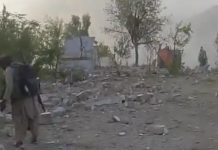
Dr Allah Nazar accused the Pakistani military of using warplanes against civilian populations in Balochistan, citing the recent bombing in Gidar, Surab, and earlier incidents in Mehi, Mashkay and Wahli in Awaran.
He claimed women, children and other civilians had been killed in aerial bombardments in those areas and said restrictions on independent media access had prevented many such incidents from receiving international attention.
Dr Allah Nazar said the BLF respected international laws of war and called on the international community and the United Nations Security Council to hold those responsible for alleged war crimes in Balochistan accountable.
Regarding the United States’ designation of the BLA and its Majeed Brigade as foreign terrorist organisations, he said international powers made decisions according to their strategic interests and predicted that Washington would eventually reconsider its decision.
He also referred to a reported attempt by China and Pakistan to secure United Nations sanctions against the BLA, saying the United States, Britain and France had opposed the move.
According to Dr Allah Nazar, the BLF retained access to legal and political forums around the world that supported freedom, human rights and the right to self-determination.
Responding to Pakistani military claims that its operations had weakened the command and control of Baloch armed groups, Dr Allah Nazar described the assertion as “baseless and irrational”.
He cited a recent briefing by the director general of Inter-Services Public Relations (ISPR) referring to more than 31,000 military operations in Balochistan over the course of a year, arguing that the figure instead demonstrated the difficulties faced by the Pakistani military.
He said the military had failed to distinguish between a national liberation movement and a law-and-order situation and claimed that the Baloch movement retained widespread support among the Baloch population, while Balochistan’s mountains, forests and geography remained unfamiliar terrain for Pakistani forces.
Speaking about enforced disappearances, detention and extrajudicial killings, Dr Allah Nazar said the targeting of Baloch youths, particularly educated people, was driving a new generation towards the independence movement.
He called on the United Nations to intervene in Balochistan and declare it an international conflict zone, saying Pakistan had failed to comply with international law.
According to Dr Allah Nazar, every nation had the right to resist what it regarded as occupation and colonial rule, while the Baloch movement enjoyed the moral support of the Baloch population, intellectuals and others who believed in the right to self-determination.
Asked whether negotiations would be possible if Islamabad offered political autonomy, a greater share of resource revenues, an end to enforced disappearances and internationally supervised guarantees, the BLF leader said talks could take place on only one condition:
“In the presence of international powers, we will provide a safe way for the Pakistani Army to withdraw from Balochistan.”
Dr Allah Nazar criticised the Pakistani constitution, describing it as a “dead horse” that had failed to protect itself from the military, judiciary, parliament and executive.
“The Baloch do not accept any concessions,” he said. “The objective of the Baloch nation is a sovereign and independent Balochistan. Now independence is the only acceptable solution.”