






A side event focusing on the human rights situation in Pakistan and its trade status under the European Union’s GSP+ scheme was held on the sidelines of the 61st session of the United Nations Human Rights Council in Geneva.
Titled “Pakistan’s GSP+ Status: Human Rights Conditionality, Treaty Obligations and Accountability”, the event brought together international participants, including policymakers and human rights experts. It was organised by Action for Education, Social and Family Empowerment, with participation from CAP Liberté de Conscience and Global Human Rights Defence.
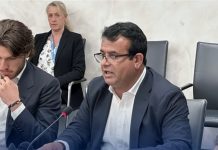
Among the speakers were European Parliament member Barbara Bonte, Baloch National Movement (BNM) chairman Naseem Baloch, and UK-based Pakistani political figure Zulfi Bukhari, who addressed various aspects of Pakistan’s human rights situation, including enforced disappearances and compliance with international obligations.
Speakers emphasised that Pakistan’s preferential trade access under the European Union’s GSP+ framework is linked to adherence to international conventions on human rights, labour protections, and governance standards. They stressed the need for effective implementation of these commitments alongside continued trade benefits.
During the event, legal analyses and testimonies were presented to highlight what participants described as a gap between Pakistan’s international commitments and the situation on the ground. Calls were made for greater international scrutiny and accountability mechanisms.
Remarks by BNM Chairman
In his address, Naseem Baloch called on the European Union to review Pakistan’s GSP+ status in light of human rights violations in Balochistan. He argued that, for many families in Balochistan, human rights concerns are not abstract but relate directly to the fate of missing relatives.
He cited figures claiming that in 2025 there were 1,355 reported cases of enforced disappearances and 229 alleged extrajudicial killings in Balochistan. According to his statement, by 20 March 2026, a further 228 cases of enforced disappearances and 81 alleged extrajudicial killings had been recorded, including incidents involving women.
Baloch also referred to allegations of arbitrary arrests, torture, and restrictions on political expression, stating that thousands of activists, students, journalists, and civilians have been subjected to enforced disappearance over the years. He claimed that some individuals were later found dead under what he described as a “kill and dump” policy.
He further stated that these actions would constitute violations of international agreements, including the International Covenant on Civil and Political Rights and the Convention Against Torture, both of which Pakistan has ratified.
Broader Context
The discussion also touched on the broader political climate in Pakistan, with speakers expressing concern over shrinking space for political dissent and civil liberties. Reference was made to the arrest of former Prime Minister Imran Khan as part of wider concerns about rule of law and democratic governance.
Participants argued that rights violations in Balochistan reflect longer-term structural issues, while also noting that similar concerns have increasingly been raised in other parts of the country.
Calls for Review and Oversight
Speakers at the event urged European Union policymakers and members of the European Parliament to conduct a transparent review of Pakistan’s compliance with GSP+ conditions. They called for the inclusion of independent human rights organisations, civil society groups, and affected communities, particularly from regions such as Balochistan, in any such assessment.
The GSP+ scheme grants developing countries preferential access to EU markets on the condition that they implement a set of international conventions related to human rights, labour rights, environmental protection, and governance.
Pakistani authorities have not issued an immediate response to the remarks made during the event.