



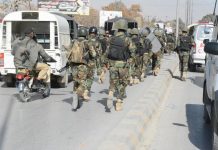

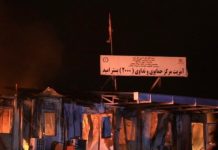

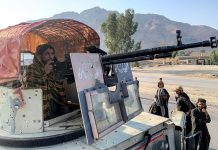



Armed groups, political figures and sections of the Baloch public on Saturday expressed support for the Baloch Liberation Army’s (BLA) ongoing “Operation Herof 2.0,” as the group said its fighters continued to hold positions in several districts more than 15 hours after launching coordinated attacks across Balochistan.
In an updated statement, BLA spokesperson Jeeyand Baloch said operations were ongoing in “various cities and important areas” and that the movement of Pakistani forces remained “under intense pressure.”
He said fighters maintained “control at several places,” adding that the ground situation was “constantly evolving.”
“Detailed updates and final assessments will be released at the appropriate juncture per operational progress,” the statement said.
Earlier, the BLA said the “role of the Baloch nation has been decisive” in the operation, claiming locals had supported fighters by “ensuring mobility, communications and ground control.”
According to the group, public backing had “neutralised enemy propaganda and fear” and helped maintain pressure on military installations across multiple districts.
“This popular unity has been a fundamental factor in the continuation of the operation and the maintenance of control,” the BLA said.
UBA Announces Support, Calls Operation a ‘National Struggle’
The United Baloch Army (UBA), a “pro-independence” armed group, formally announced its support for “Operation Herof 2.0” and said it would participate in the conflict within its “capacity and means.”
In a statement, UBA spokesperson Mazar Baloch said the organisation offered “full moral, intellectual and practical support” to those taking part in the operation.
He praised what he described as the “courage, perseverance and national honour” of Baloch fighters and said the UBA stood in “complete solidarity” with them.
UBA urged all Baloch organisations and activists to “demonstrate unity, a shared strategy and collective responsibility,” and to stand “morally, intellectually and socially” with those participating in the attacks.
The group said the current phase of conflict “is not limited to any single group or class,” but represents a wider struggle for “national dignity, freedom and sovereignty over Baloch land.”
It also called on the public to provide cooperation and social support “wherever Baloch youth and national activists are present,” saying the goal was to transform the uprising into an “organised, united and resilient collective movement.”
‘Baloch Must Rely on Their Own Strength’: Mehran Marri
Exiled Baloch leader Mehran Marri, speaking to international media during the second phase of the operation, said Balochistan had entered an “extremely critical phase.”
He said the Baloch had appealed to the international community for decades but now believed that “freedom will not be granted as a gift by any external power.”
“The Baloch are not waiting for Trump, nor relying on any global power,” he said, adding that the movement had become “a national liberation struggle” involving “children to elders.”
Marri described Pakistan as an “unstable state” shifting between Chinese and American influence, while the Baloch remained “in the field defending their land.”
He argued that the nation would not obtain its rights “from anyone’s coattails,” but through “its own struggle and sacrifices.”
At the outset of “Operation Herof 2.0,” the BLA released a video message from its commander-in-chief, Bashir Zeb Baloch, calling on the public to “come out of their homes” and join what he described as a decisive phase of the armed struggle.
“This struggle does not belong to any single individual but to collective consciousness,” he said. “When a nation stands united, the enemy cannot avoid defeat despite its power. The Baloch nation is urged to step out and become part of Operation Herof.”