



















The Awami National Party’s Balochistan president, Asghar Khan Achakzai, has strongly criticised Balochistan Chief Minister Sarfraz Bugti’s recent statement that “we will fight for a thousand years,” calling the remark irresponsible and reflective of a defeated mindset, and urging the government to adopt a more serious and measured approach to the situation in Balochistan.
In a statement issued on Wednesday, Achakzai said that rhetoric suggesting a centuries-long conflict indicated that the situation had slipped beyond the control of those in power. He argued that such language did not point towards solutions but instead risked deepening existing problems and further destabilising an already tense environment.
Referring to what he described as inconsistencies in the government’s narrative, the ANP leader recalled that only some time ago a senior figure from the ruling party had characterised the crisis as something that could be handled at the level of a station house officer (SHO). He said the same issue was now being framed as a “thousand-year war,” a shift he described as exposing a lack of seriousness and coherence in official policy.
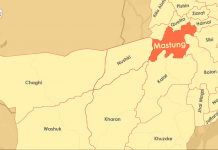
Achakzai also questioned how the government would assign responsibility if an untoward incident were to occur involving employees or civilians in sensitive areas such as Mach during the current period of heightened tension. He said statements of this nature amounted to adding fuel to an already volatile situation and called on the authorities to reassess both their language and their broader approach.
Emphasising the need for political engagement, the ANP Balochistan president urged the government to take genuine stakeholders into confidence and prioritise dialogue over the use of force. “Even now, the situation has not completely slipped out of hand,” he said, adding that this would require a responsible and serious attitude from those in authority.
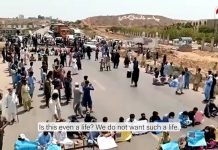
Achakzai further announced that protests would be held on the 8th across Balochistan and other parts of the country by various political parties and allied organisations. He said the demonstrations would be formally recorded to ensure that public demands were articulated in an organised and visible manner.
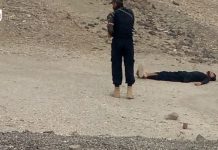
The chief minister’s remarks and the ANP’s response come at a time when the government and security forces are facing mounting criticism over their handling of the situation in Balochistan, particularly following a recent surge in violence linked to the Baloch “pro-independence” group Baloch Liberation Army.
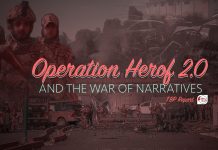
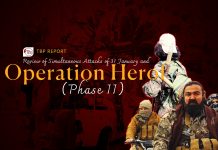
Previously, the former United States Special Representative for Afghanistan, Zalmay Khalilzad, had said that Pakistan’s strategy in Balochistan appears to be failing, citing the scale and coordination of recent attacks carried out under the Baloch Liberation Army’s “Operation Herof.” In comments shared publicly, Khalilzad argued that recent developments pointed to a deeper crisis in Pakistan’s approach to the region and suggested that the existing strategy required reassessment and change.
The Pakistani state has not publicly responded to Khalilzad’s or Achakzai’s comments. However, analysts say his remarks reflect growing international attention on the persistence of conflict in Balochistan. Some security observers argue that repeated large-scale, coordinated attacks raise questions about the effectiveness of security-centric policies alone, while others stress that enforcement measures need to be accompanied by political engagement to prevent further escalation.