


















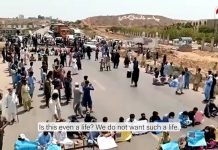





Protests by government employees in Balochistan, demanding the implementation of the Disparity Reduction Allowance (DRA), have intensified, leading to road blockages and arrests across Balochistan. The employees, primarily from various government departments, have been protesting for the past seven months, pushing for a 30% DRA to be granted in line with similar allowances in Punjab, Sindh, and the federal government.
The protests, led by the Balochistan Grand Alliance (BGA), have seen employees from multiple sectors united in their demands. They claim that employees in institutions such as the Governor’s House, Chief Minister’s Secretariat, and High Court are receiving higher salaries despite being in the same grade as workers in other government departments. The BGA has highlighted the urgent need to address this wage disparity, emphasizing that the committee set up by the Balochistan government has already recommended the DRA, but no action has been taken so far by the Chief Minister.
Despite several rounds of negotiations between the government and employees, no resolution has been reached. In retaliation, Balochistan government has reportedly launched a crackdown on the protest leaders, with over 50 employees arrested so far, including 15 who are currently incarcerated in Quetta Jail.
In response to the government’s actions, employees have escalated their protests, with strikes, road blockages, and mass demonstrations. On Monday, key highways linking Quetta to Karachi, Taftan, Gwadar, and Sindh were blocked in cities like Khuzdar, Lasbela, and Nasirabad, leading to long traffic jams and significant inconvenience for the public.
Balochistan government’s approach has been to enforce strict measures to curb the protests, with police raids and arrests of demonstrators taking place in various regions. Previously, 38 assistant professors and lecturers from government colleges were suspended for participating in the protest, as the Balochistan government argued that their actions violated the Essential Services Act, which restricts protests in educational institutions.
The BGA has announced its plans for a phased escalation of the protests. In the first phase, they will continue their road blockages until January 14, followed by a complete shutdown of government offices across Balochistan on January 15. The final stage of the protest will take place on January 20, with a sit-in planned near the Red Zone in Quetta. The employees have warned the government that if no action is taken, they will launch a “Jail Bharo” (Fill the Jails) movement.
In response, Balochistan’s Finance Minister, Shoaib Nosherwani, acknowledged the employees’ grievances but warned that implementing the DRA for over 350,000 government employees could add an additional financial burden of 16 to 20 billion rupees. He stated that the government is in consultation over the issue and urged employees to refrain from taking extreme actions until a decision is made.
Employees argue that while the DRA would cost approximately 17 billion rupees, it would only result in an increase of about 150 rupees per day or 4,000 to 4,500 rupees monthly for each employee. They insist that this modest increase is necessary to meet the rising cost of living and is a fundamental right of the workers.
Several political parties in Balochistan have also expressed their support for the employees’ demands, calling on the Balochistan government to resolve the issue in a fair and timely manner.