






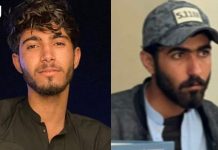
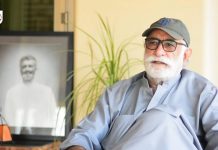




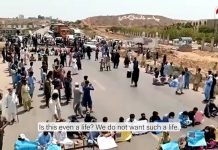
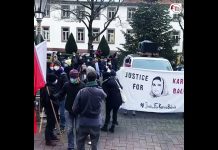
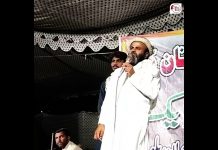



Funeral prayers for Zubair Baloch, the former chairman of the Baloch Students Organization (Pajjar), political activist and lawyer killed in Dalbandin on Wednesday, were held in Mastung on Thursday.
A large number of people, including leaders of student and political organisations, representatives of civil society, writers, intellectuals and community members, attended the prayers. Zubair Baloch was later laid to rest in his native area of Mastung.
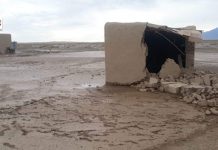
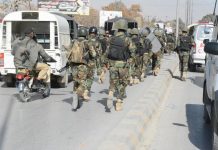
Zubair Baloch and his companion, Nisar Baloch, were killed during a raid by Pakistani security forces on a residential house in Dalbandin, Chagai district. His death has sparked widespread condemnation from political parties, student groups, rights organisations and legal bodies across Balochistan.
The Baloch Students Organization (Pajjar) described Zubair Baloch as a principled leader committed to “peaceful struggle, education, justice and human rights.” The group said his stance and dedication to public service had made him widely respected across the region.
In a statement, the organisation called his killing a “tragic attack” that had plunged his family, the organisation and people across Balochistan into grief. It described his death as “a great sacrifice made for conscience, peace and justice” and announced five days of mourning, during which all organisational activities would be suspended.
“We will never forget the sacrifice of Zubair Baloch and will carry forward his principles of peace, justice and service,” the statement said. “Following in his footsteps is the duty of every member, and this sacrifice inspires us to remain united.”
BYC calls it part of ‘genocide policy’
The Baloch Yakjehti Committee (BYC) condemned what it called the “extrajudicial killing” of Zubair Baloch, saying it was a continuation of the state’s “policy of Baloch genocide.”
The group’s spokesperson said the incident reflected the intensification of repression in Balochistan and an attempt to silence political voices through the use of force.
“In recent years, Balochistan has been turned into a slaughterhouse,” the statement said. “Enforced disappearances, fake cases, harassment and extrajudicial killings have become routine. Within one week, four individuals were killed in fake encounters, three were returned as mutilated bodies after enforced disappearance, and now the extrajudicial killing of Zubair Baloch is being concealed as another fake encounter.”
The BYC said Zubair Baloch was more than an individual leader, describing him as a lawyer, student leader and political activist who consistently opposed human rights violations and the denial of fundamental rights. “His killing is not only the loss of an individual but of the entire Baloch nation,” the statement added.
The group urged people not to remain silent, warning that “silence in the face of repression is equivalent to collective death.”
Condemnations from legal and political circles
The Baloch National Movement (BNM) accused the Pakistani army of deliberately targeting Zubair Baloch, calling his death “an open display of state terrorism.” It said he had been a strong voice against enforced disappearances, exploitation of resources and rights abuses, and his killing was part of an effort to suppress the Baloch national struggle.
The National Party described the incident as “tragic and alarming,” saying security forces had targeted not only a political worker but also a legal expert. It praised Zubair Baloch’s long democratic struggle for freedom of expression, student rights and the recovery of missing persons.
The Balochistan Bar Council expressed “deep concern” over the killing, calling it an attack on the legal community. It said Zubair Baloch had always worked for “the supremacy of the constitution and law” and was recognised as a peaceful lawyer and citizen.
The Bar Council demanded that those responsible be arrested and punished and announced a boycott of judicial proceedings across the Balochistan on Thursday, 25 September, in protest.
The central Baloch Students Organization (BSO) also strongly condemned the incident, calling it a “conspiracy to silence the Baloch student movement.” It described Zubair Baloch as a courageous leader who dedicated his life to education, justice and student rights, announcing three days of mourning in his memory.
“Leaders like Zubair Baloch may be physically killed but their ideas and sacrifices can never be erased,” the organisation said, adding that his death would strengthen the resolve of the student movement.