














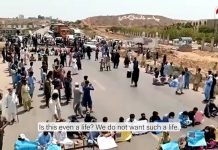
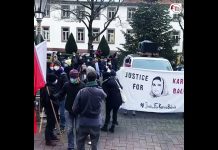
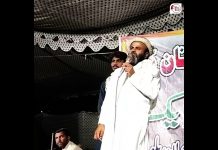



A long march by Shia pilgrims protesting against the federal government’s ban on overland travel to religious shrines in Iran and Iraq has been stopped by Balochistan police at the Hub River Bridge near the Sindh-Balochistan border. The group had set off on foot from Karachi, aiming to reach the Taftan border and eventually join the annual Arbaeen pilgrimage in Iraq.
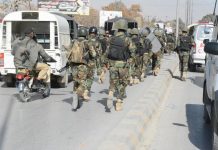
Security forces, including a large deployment of police and Anti-Terrorism Force (ATF) personnel, have blocked the main entry routes into Balochistan, citing precautionary security measures. Police officials confirmed that negotiations are underway with the protestors in an attempt to resolve the matter peacefully.
The march is being led by representatives of various Shia organisations, who have condemned the travel restrictions as a violation of basic constitutional and human rights. Participants include women, elderly individuals, children, and youth—many of whom have pledged to continue their journey and maintain a peaceful protest.
The protest stems from the federal government’s decision to prohibit overland pilgrimage routes to Iran and Iraq, reportedly due to security concerns during the upcoming Arbaeen observance. Arbaeen, which falls forty days after Ashura, commemorates the “martyrdom” of Imam Hussain ibn Ali, the grandson of Prophet Muhammad, in the Battle of Karbala in 680 CE.
It is one of the most significant religious events in the Shia Muslim calendar, and the pilgrimage to Imam Hussain’s shrine in Karbala, Iraq, draws millions of participants from around the world each year. Many pilgrims from Pakistan traditionally travel via the Taftan border in Balochistan to Iran, and onward to Iraq. The road journey, although long, is often undertaken as a spiritual commitment and a symbolic act of solidarity with Imam Hussain’s stand against “injustice”.
In a related statement, the Baloch Yakjehti Committee (BYC) also condemned the restriction, calling it a clear infringement on religious freedom. The organisation stated that the state has an obligation to ensure safe and secure access to religious observances rather than impose blanket bans.
BYC has announced its full support for the march, describing it as a legitimate constitutional and democratic expression. The group pledged solidarity with the pilgrims, stating it would stand “shoulder to shoulder” with their peaceful protest.
Pilgrims, meanwhile, have reaffirmed their resolve, stating that they will not forgo their religious obligations and will continue their protest through peaceful means.