

















The Baloch Raaji Aajoi Sangar (BRAS) claimed on Saturday that its fighters carried out 71 attacks across Balochistan between 10 and 15 August, killing 24 Pakistani soldiers and five “state-backed agents,” and injuring several others.
In a media statement, BRAS spokesperson Baloch Khan said the group targeted military camps, convoys, police stations, and so-called “death squad” operatives in a wave of coordinated operations spanning multiple districts.
According to the group, one of the largest attacks took place in Basima, where fighters stormed a military camp and ambushed a convoy, killing at least 13 soldiers including a captain. The group said it also briefly seized a Levies station, set fire to government offices, and destroyed vehicles during the same operation.
BRAS also claimed responsibility for an IED blast in Gwadar’s New Town area that targeted a military convoy, killing two soldiers, as well as a separate IED attack on the Jaffar Express in Mastung that derailed six coaches of the Quetta–Rawalpindi train.
The group said it carried out multiple attacks across Quetta, Kech, Panjgur, Awaran, Sibi, Dera Bugti, and Naseerabad, among other districts. It said fighters shelled army posts with rockets and grenade launchers, planted IEDs against convoys and camps, destroyed surveillance drones, government offices, Levies stations, and police checkpoints, and targeted alleged intelligence operatives.
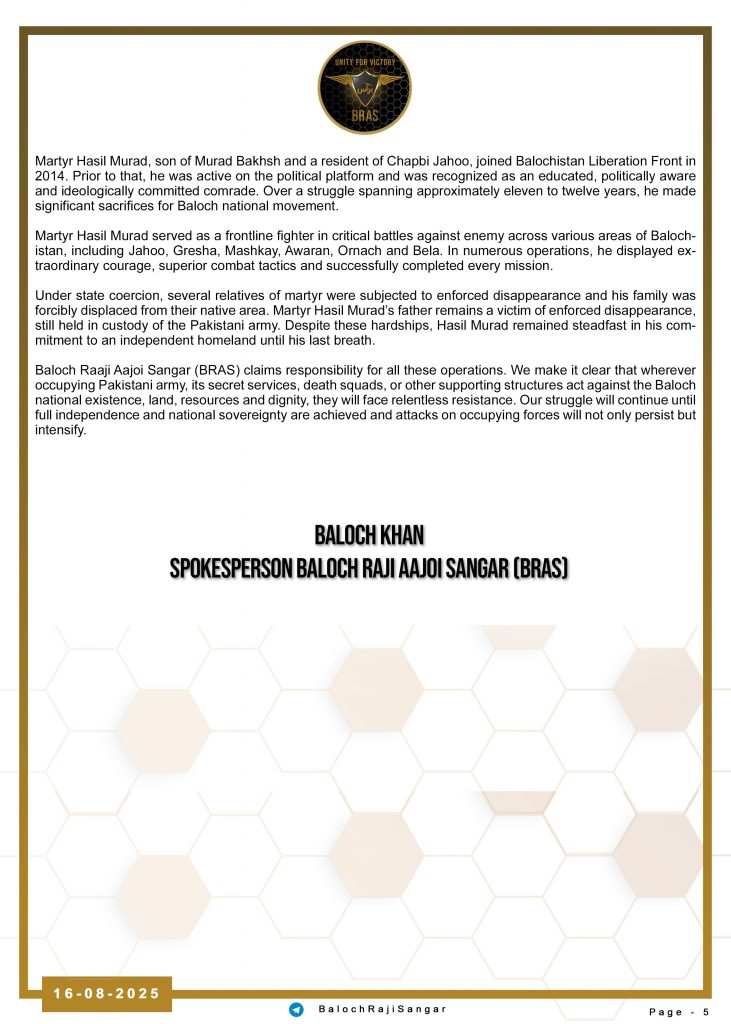
BRAS confirmed that one of its fighters, Hasil Murad alias Sarban Baloch, was killed in clashes with a pro-military armed group in Jhao. It described him as an “educated, politically aware and ideologically committed comrade” who joined the Balochistan Liberation Front in 2014 before becoming part of BRAS.
The statement reiterated BRAS’s vow to continue and intensify attacks against what it called the “occupying Pakistani army, its secret services, and supporting structures”, declaring that its struggle would continue “until full independence and national sovereignty are achieved”.