











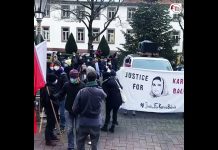



Pakistan’s military has accused Baloch rights activist Dr. Mahrang Baloch of acting as a proxy for terrorist groups, drawing sharp condemnation from human rights defenders and the Baloch Yakjehti Committee (BYC).
In a press conference on Friday, Director General Inter-Services Public Relations (DG ISPR) Lieutenant General Ahmed Sharif Chaudhry alleged that Dr. Baloch was linked to “terrorist networks” and called on media outlets to expose what he termed the “sinister face” of the BYC.
The BYC dismissed the allegations as “baseless and defamatory,” stating that the accusations were part of a broader effort to divert attention from grave human rights violations in the region.
“The BYC is a peaceful political and human rights organisation committed to nonviolent advocacy for the democratic and civil rights of the Baloch people,” the group said in a statement. “Dr Mahrang Baloch is a respected human rights defender with a well-documented record of peaceful activism.”
The group said both Dr Baloch and the BYC have consistently condemned all forms of violence and remain committed to lawful and democratic resistance.
“These recent statements are not only defamatory; they also reflect the growing legitimacy and influence of our peaceful movement,” the statement continued. “Rather than addressing well-documented abuses—enforced disappearances, extrajudicial killings—the state has chosen to intensify its campaign of disinformation.”
The group further said that it welcomes an independent investigation by international bodies. “If there is any evidence to support the military’s claims, we are fully prepared to be held accountable under international law,” the statement said. “But if the allegations are disproven, then Pakistan’s institutions must also be held accountable, including under the Geneva Conventions.”
Prominent human rights lawyer Imaan Mazari criticised the military’s comments, describing them as “venom, lies, and hatred” directed at a peaceful activist.
“No daughter wishes to see her father’s mutilated corpse,” she wrote on X. “Yet they made Dr Mahrang’s father disappear and later presented his disfigured body. Still, she chose peace—not violence.”
“Dr Mahrang Baloch is the true voice of Balochistan,” Mazari added. “She continues to demand peace and the protection of human rights. False propaganda cannot silence her.”
Dr Baloch’s family also issued a statement on Friday rejecting the DG ISPR’s accusations as “baseless, false, and motivated by political vengeance.”
The family said that despite the state’s access to extensive surveillance networks, no credible evidence had ever been presented linking Dr Baloch to violent activities.
“If Dr Mahrang Baloch were truly involved in violence, why has the state not produced evidence?” the statement said. “Why is a transparent legal process not pursued, rather than media trials and repression?”
The family also accused the military of misrepresenting Dr Baloch’s remarks during a press conference earlier this year, held after an armed attack that had been publicly claimed by a militant group.
According to the family, the group had identified twelve of its fighters involved in the incident. However, they said at least 23 bodies were brought to a local hospital afterwards, and many were buried overnight in Quetta’s Kasi Cemetery without any formal identification process.
“She never called for the return of militants’ bodies,” the family’s statement said. “She called for transparency—an identification process in a region plagued by enforced disappearances and extrajudicial killings.”
The family said Dr Baloch remains detained under Pakistan’s colonial-era Maintenance of Public Order (3MPO) law, which has been criticised by legal experts and courts for its susceptibility to state abuse. They added that they are considering legal action in response to the military’s public accusations.
“We are being denied justice, media access, and a transparent judicial process,” the family said. “We intend to raise our voice on the international stage.”
Dr Mahrang Baloch, a medical doctor and organiser with BYC, has become one of the most prominent voices highlighting human rights violations in Balochistan. She was detained in March 2025 under Pakistan’s colonial-era Maintenance of Public Order law.
The detentions of BYC leaders have been condemned by several human rights organisations, including Amnesty International, Human Rights Watch, and the Human Rights Commission of Pakistan. In April, over a dozen United Nations human rights experts expressed concern over Pakistan’s use of counter-terrorism laws to suppress peaceful dissent in Balochistan.
The UN experts warned that Pakistan was conflating legitimate human rights advocacy with terrorism. They urged the country to criminalise enforced disappearances, ratify international conventions, and allow independent investigations.
In late 2023, Dr Baloch led a nearly 1,000-mile march from Balochistan to Islamabad demanding justice for the victims of enforced disappearances. She was detained twice during the march.
Dr Baloch has been internationally recognized for her activism. She was named among BBC’s 100 most influential women and TIME magazine’s 100 emerging leaders in 2024, and has been nominated for the Nobel Peace Prize.