












By Yaran Diyar
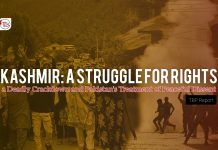
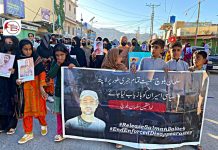
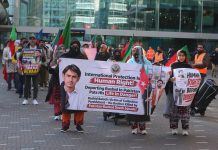
On November 9, Kashmiris gathered outside Pakistani diplomatic missions in London, Manchester, Bradford and Birmingham, protesting against the killing of demonstrators and demanding an end to security operations in Pakistan-administered Kashmir.
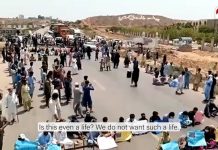
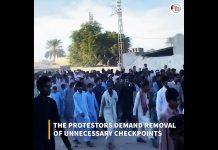
Thousands of miles away, markets and businesses remained closed in parts of Kashmir as a movement that began with demands for affordable electricity and subsidised flour, continued its confrontation with Pakistani authorities. The demonstrations followed a deadly operation on November 5 in Rawalakot, where Pakistani forces moved against a prolonged protest sit-in organised by the Jammu Kashmir Joint Awami Action Committee (JKJAAC, or JAAC). At least three deaths were reported, while allegations of further casualties emerged from the area, prompting renewed demands for an independent investigation, the release of detainees and an end to the use of force against protesters.
According to Kashmir Times, a partial shutdown was observed across six districts on November 9, including Muzaffarabad, Haveli, Neelum, Kotli, Mirpur and Bhimber. The protests also continued in Britain, where Kashmiri activists had been demonstrating outside Pakistani diplomatic missions for more than five months. On November 9, Mahmood Kashmiri, chairman of the Jammu-Kashmir National Independence Alliance (JKNIA), submitted a memorandum at the Pakistani Consulate in Bradford, expressing solidarity with the JAAC and demanding an end to alleged human rights violations and repression in the region.
He also called for the release of prominent JAAC leader Shaukat Nawaz Mir, or his production before a court, and demanded information about other Kashmiri youths reportedly detained or missing. Kashmiri accused Pakistani authorities of denying Mir’s arrest despite what he described as video evidence of his detention. The international campaign had also reached Brussels, where Kashmiri activists marched through the European Union quarter on October 4, calling for international attention to the deteriorating human rights situation.
The latest unrest has brought renewed scrutiny to a territory Pakistan officially calls Azad(Free) Jammu and Kashmir. For decades, Islamabad has presented itself internationally as a defender of Kashmiri self-determination, particularly in Indian-administered Kashmir. Yet within the territory it administers, a civilian movement demanding economic relief, political representation and accountability has been proscribed under anti-terrorism legislation, its activists have faced arrests, and demonstrations have repeatedly ended in deadly confrontations.
The developments have raised questions about the political freedoms available to Kashmiris under Pakistani administration and drawn comparisons with the treatment of peaceful rights movements in Balochistan and Pashtun-majority areas.
Kashmir’s Unresolved Political Question
The Kashmir dispute dates to the partition of India in 1947, when the princely state of Jammu and Kashmir became the subject of competing claims by India and Pakistan. Following an incursion by tribal fighters from Pakistan, the state’s ruler signed an Instrument of Accession to India, leading to Indian military intervention and the first war between the two countries. A UN-mediated ceasefire in 1949 left the territory divided between Indian and Pakistani administration. Although the United Nations proposed a plebiscite under specified conditions, disagreements over its implementation prevented the vote from taking place.
Pakistan administers Jammu and Kashmir, also known as Pakistan-administered Kashmir and Gilgit-Baltistan under separate arrangements. The territory has its own president, prime minister, legislative assembly and judiciary, but Islamabad retains significant authority over defence, foreign affairs and other matters.
The territory’s constitutional framework also restricts political activity challenging its accession-oriented relationship with Pakistan. These restrictions were documented by the United Nations human rights office in 2019, which raised concerns about freedom of expression, political association and the treatment of pro-independence activists. The report also identified restrictions on political rights as a longstanding issue in the territory administered by Pakistan.
From Economic Demands to a Deadly Confrontation
The JAAC movement gained momentum in 2023, bringing together traders, students, civil society representatives and residents demanding affordable electricity, subsidised flour and relief from rising living costs. As protests continued, the movement expanded its demands to include political accountability, governance reforms and changes to the representation of Kashmiri refugees in the Kashmir Legislative Assembly. One major dispute concerned 12 seats reserved for refugees from Indian-administered Kashmir living elsewhere in Pakistan, which the JAAC argued weakened the representation of residents within Pakistan-administered Kashmir.
The movement organised strikes, sit-ins and public gatherings, with its leaders repeatedly calling for peaceful participation and negotiations. Despite these appeals, the authorities increasingly characterised the protests as a threat to public order. On June 5, 2026, the Kashmir government proscribed the JAAC under anti-terrorism legislation. Two days later, deadly clashes erupted in Rawalakot, where at least 11 people were reported killed, including six protesters, four police officers and a passer-by. Pakistani authorities accused armed individuals of attacking police, while protest organisers alleged that forces opened fire on demonstrators. The allegations against protesters have not been independently verified.
The confrontation worsened during the July regional elections. On July 27, the JAAC alleged that 19 people were killed when Pakistani forces fired on protesters in Rawalakot. Amnesty International called for an independent investigation, warning that restrictions on communications were obstructing verification of the violence. By late July, media reports cited by Amnesty indicated that at least 40 people, including 34 protesters and six police and paramilitary personnel, had been killed during the wider unrest. The figures remained disputed, with subsequent reports suggesting higher casualties.
Amid the unrest, Pakistan’s Defence Minister Khawaja Asif publicly compared Kashmiri protesters with India, Pakistan’s principal regional adversary. He declared: “I put the protesters of Azad Kashmir in the same category as India and consider them also as enemies like India.” The remarks drew criticism at a time when Pakistani authorities were already facing allegations of lethal force against civilians. For a movement campaigning over economic hardship and political representation, the comparison illustrated how political demands were increasingly being framed as a national security threat.
Behind the Blackout
One of the most serious concerns surrounding the unrest has been the prolonged disruption of communications and independent reporting. From June onwards, mobile internet services remained suspended across affected areas, while restrictions on movement complicated the work of journalists and human rights observers.
By September 15, the partial shutdown had continued for more than 100 days, according to NetBlocks data reported by Al Jazeera. Families struggled to contact relatives, while reporters faced difficulties transmitting photographs, videos and casualty information from areas affected by military operations.
Amnesty International warned that the restrictions were obstructing independent verification of the violence. Reporters Without Borders also documented interference with journalists and restrictions on access, describing the measures as an attempt to impose a news blackout. In August, Reuters reported that Pakistan had expanded restrictions affecting foreign news organisations and their locally employed journalists, requiring additional permission for reporting outside major cities and limiting access to Pakistan-administered Kashmir.
These restrictions have made it difficult to independently establish the number of people killed or injured during the unrest. They also reflect wider concerns about media freedom in Pakistan, where Reporters Without Borders and the International Federation of Journalists have documented censorship, intimidation and pressure on journalists covering the military and politically sensitive issues. Although independent Pakistani journalists continue to challenge official accounts, restrictions on reporting from conflict-affected regions can leave state institutions with considerable influence over the information reaching the public.
Kashmir, Balochistan and the Treatment of Peaceful Movements
The treatment of the JAAC bears similarities to the experiences of peaceful political movements elsewhere in Pakistan, particularly the Baloch Yakjehti Committee (BYC) and the Pashtun Tahafuz Movement (PTM). Although these organisations have different histories and demands, they have faced restrictions while campaigning over political rights, enforced disappearances and alleged abuses by Pakistani forces.
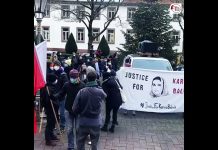
In Balochistan, the BYC has organised large demonstrations against enforced disappearances and extrajudicial killings, with women and relatives of missing persons playing a prominent role. In March 2025, Pakistani authorities launched a crackdown following demonstrations in Quetta, where three protesters were reportedly killed and several activists detained, including BYC leader Dr Mahrang Baloch. Amnesty International condemned the crackdown, raising concerns about unlawful force, arbitrary arrests and restrictions on peaceful assembly.
The treatment of JAAC leader Shaukat Nawaz Mir has drawn parallels with the detention and prosecution of prominent Baloch rights activists. Mir, a former traders’ association president in Muzaffarabad who became one of the leading figures of the Kashmiri protest movement, was arrested on June 30, 2026, according to an Associated Press report citing a government administrator. The authorities accused him of sedition and inciting violence, while the JAAC subsequently raised concerns about his whereabouts and alleged failure to produce him before a court.
His case bears similarities to that of BYC leader Dr Mahrang Baloch, who was arrested following demonstrations in Quetta in March 2025 and later prosecuted under anti-terrorism legislation. In June 2026, Amnesty International condemned the life sentences imposed on Mahrang Baloch and Sibghat Ullah Shah Jee, raising concerns over secret proceedings and the absence of direct evidence linking the activists to the alleged violence. Although the circumstances differ, the cases illustrate concerns about the use of criminal proceedings against prominent leaders of civilian rights movements in Kashmir and Balochistan.
A similar pattern has emerged in the treatment of the Pashtun Tahafuz Movement, which campaigns against enforced disappearances, extrajudicial killings, landmines and the effects of military operations on Pashtun communities. In October 2024, the Pakistani government proscribed the PTM under anti-terrorism legislation shortly before a planned gathering. Amnesty International condemned the ban, stating that the authorities had failed to provide concrete evidence justifying the designation.
On November 5, 2026, Amnesty issued an urgent appeal concerning Hanif Pashteen and Noor Ullah Tareen, two PTM activists reportedly forcibly disappeared after attending a gathering in Peshawar in November 2025. Nearly a year later, their whereabouts remained unknown.
The experiences these movements face, reveal a recurring reliance on anti-terrorism legislation, restrictions on public gatherings and the detention of activists in response to civilian political mobilisation. In each case, organisations demanding dialogue and accountability have faced measures justified by the authorities on security grounds, raising questions about the space available for peaceful dissent.
International Scrutiny
The crackdown in Kashmir has also attracted the attention of international human rights mechanisms. In September, six UN experts reportedly sent a communication to Pakistan raising concerns about the JAAC’s proscription, alleged unlawful killings, arbitrary arrests and restrictions on communications. According to a summary published by the JAAC, the communication referred to allegations that at least 96 protesters and six police and paramilitary personnel had been killed since June. These were allegations submitted to the experts rather than independently verified UN findings. The communication also reportedly raised concerns about restrictions affecting 205 individuals under anti-terrorism provisions.
Similar concerns have been raised by UN mechanisms regarding Baloch activists. In 2025, UN experts called for the release of Baloch human rights defenders and criticised arbitrary detention, enforced disappearances and restrictions on peaceful protests. These interventions reflect growing international concern over the use of coercive measures against civilian rights movements and the difficulties faced by affected communities in seeking accountability.
The Question
The latest unrest in Pakistan-administered Kashmir has exposed a contradiction between the territory’s official designation as Azad, meaning Free, and the restrictions faced by people demanding political and economic rights. The deaths reported during demonstrations, the ban on the JAAC and the prolonged communications blackout have raised serious concerns about the limits of peaceful dissent under Pakistani administration.
The experiences of the BYC and PTM suggest that these concerns extend beyond Kashmir. Across different regions, civilian movements have faced security legislation, arrests and restrictions while demanding accountability and fundamental rights. Their treatment raises a question that Pakistan’s institutions have yet to adequately answer: why are peaceful demands for justice and political accountability so frequently treated as threats to national security?
For Kashmiris, the question is no longer simply what Azad means in the territory’s name, but whether its people can exercise the freedoms that name promises.