













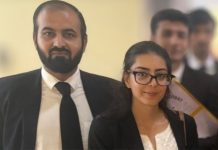


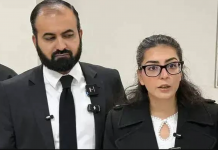










More than 20 international human rights and legal organisations, including Amnesty International, called on Pakistani authorities on Friday to “immediately and unconditionally” release lawyers Imaan Mazari-Hazir and Hadi Ali Chattha and take steps to have their convictions quashed.
In a joint statement, the 23 organisations described the couple’s sentencing as a “significant escalation in the extensive misuse of the criminal justice system” and raised concerns over the use of anti-terrorism legislation “to criminally punish and intimidate lawyers undertaking permissible human rights work”.
The signatories included the Alliance for Lawyers at Risk, Front Line Defenders, the International Commission of Jurists, the New York City Bar Association, Lawyers for Lawyers, PEN Norway and the Law Society of England and Wales.
An Islamabad anti-terrorism court sentenced the couple on October 29 over an October 2024 incident in which they allegedly removed security barriers on a road used by the visiting England cricket team. They received ten-year sentences under the Anti-Terrorism Act and prison terms totalling three years under the Pakistan Penal Code, to run concurrently, alongside fines totalling Rs200,000.
Read More | Imaan Mazari and Hadi Ali Chattha Sentenced to 10 Years in Prison
The organisations said the court delivered its verdict while a petition filed by the couple on October 26 remained unheard in the Supreme Court. The lawyers had challenged the Islamabad High Court’s refusal to halt the proceedings and sought the transfer of their case to another court.
“Proceedings in these circumstances raise concerns about respect for due process and the right to an effective judicial remedy,” the statement said.
The organisations also questioned the conduct of the trial inside Rawalpindi’s Adiala prison, where the couple were reportedly held in a “cage-like structure” throughout the hearings, preventing effective communication with their counsel and the court. Their lawyers complained that they had not been given sufficient access to prepare the defence.
“The prosecution relied primarily on police testimony to establish the offence, while the defence were denied adequate opportunity to reasonably challenge prosecutorial evidence,” the statement said, adding that both lawyers denied the charges and maintained that the case was fabricated to target their professional work and peaceful activism.
Applying anti-terrorism legislation to the alleged removal of security barriers raised “serious questions about the proportionality of the charges”, the organisations said.
“Anti-terrorism legislation must not be applied arbitrarily or disproportionately, nor used to intimidate individuals or punish permissible conduct or activities that do not meet the applicable threshold.”
‘Calculated to Make an Example’
The organisations said the convictions must be viewed alongside “successive, politically motivated, criminal proceedings” that appeared intended solely to punish the couple for their human rights work and deter them from continuing it.
On September 17, the Supreme Court granted them bail and suspended their 17-year sentences under the Prevention of Electronic Crimes Act over “anti-state” social media posts criticising the military and expressing solidarity with Baloch and Pashtun activists.
The authorities rearrested them the same day, without releasing them, in an anti-terrorism case concerning a protest in 2025. Their bail application was repeatedly delayed and was eventually granted on November 3, after their conviction in the road-barrier case, the statement said.
Read More | Rights Lawyers Mazari and Chattha Rearrested Hours After Pakistan’s Top Court Grants Bail
The successive proceedings and continued imprisonment despite the Supreme Court’s intervention reinforced concerns that the cases were “calculated to make an example of the two lawyers”, the organisations said, warning of a “chilling effect” on the independence of the legal profession and access to justice.
Mazari-Hazir and Chattha’s work had included representing victims of enforced disappearances, custodial abuse and misuse of blasphemy laws, the statement noted.
“The arrest, prosecution or prolonged detention of the lawyers because of their professional representation, human rights advocacy and exercise of their right to freedom of expression not only violates their personal human rights – it also sends a stark warning to other legal professionals and human rights defenders.”
The organisations cited Article 10A of Pakistan’s Constitution, which guarantees a fair trial and due process, and the country’s obligations under the International Covenant on Civil and Political Rights.
They also invoked UN principles requiring states to protect lawyers from intimidation and interference, and to ensure they are not identified with their clients or their clients’ causes.
“Anti-terrorism legislation must not be used to criminalise peaceful assembly, protected expression, freedom of association, or permissible professional activity,” they said.
Alongside the couple’s release and the quashing of their convictions, the signatories demanded an end to cases arising solely from their human rights work. They urged a review of the use of cybercrime and anti-terrorism laws against lawyers, journalists, human rights defenders and peaceful critics.
“Judicial remedies cannot be meaningful if a grant of liberty by one court is followed immediately by detention through another proceeding without sufficient credible evidence,” the statement said.