

























By Yaran Diyar
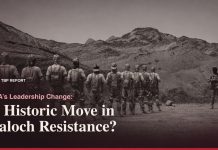
The Baloch Liberation Army (BLA) announced on November 3 that Bashir Zeb Baloch would no longer serve as its commander-in-chief following a unanimous decision by the Senior Command Council. The council will assume leadership responsibilities until a successor is appointed.
The group said the decision followed a meeting of its highest bodies on October 16 and was made under the constitutional framework introduced during its 2018 restructuring under Aslam Baloch, which abolished hereditary and lifelong leadership. Describing the transition as unprecedented in Baloch resistance history, the BLA claimed it had taken place peacefully, without internal divisions, and would not affect its organisational structure or chain of command.
If the BLA’s account is accurate, this could indeed be a historic and potentially revolutionary development in Baloch armed resistance. A look at the history of Baloch political and resistance movements shows that leadership has traditionally remained concentrated among influential tribal figures, with major decisions often resting with individual chiefs rather than collective organisational institutions.
Following British interference in Balochistan’s tribal system and the strengthening of individual tribal authority, the traditional structures became increasingly hierarchical. This influence was also reflected in Baloch politics and resistance movements. Although people participated collectively in political struggles and armed resistance, major decisions concerning whether to continue fighting, retreat or surrender often rested with tribal chiefs.
However, Baloch political and particularly armed movements gradually began moving towards a different organisational approach. An educated, middle-class generation increasingly challenged the concentration of authority in hereditary tribal leadership and called for collective decision-making, organisational authority and leadership positions based on merit rather than tribal or elite affiliation.
The emergence of Dr Allah Nazar Baloch, a physician from a non-tribal background, as the leader of the Balochistan Liberation Front (BLF) was one example of this change. Another prominent development was the emergence of Aslam Baloch as a leading figure within the BLA, replacing the leadership associated with tribal chief Hyrbyair Marri following the organisation’s division in 2018.
That transition, however, came at the cost of an organisational split, resulting in two factions. According to the BLA’s activities in following years and several analytical accounts, the faction led by Aslam Baloch subsequently became the most prominent Baloch armed organisation, introducing new tactics and, most importantly, developing a more organised institutional structure.
According to multiple accounts, Aslam Baloch sought to bring revolutionary changes within the organisation by promoting democratic values and institutional authority. He wanted leadership positions to be determined by abilities and merit rather than tribal affiliations, and advocated distributing power through organisational institutions instead of concentrating it in individual personalities. He eventually succeeded in establishing a structure under which the organisation continued to function after his death, with Bashir Zeb Baloch, a former student leader, assuming its leadership.
Following Aslam’s death, The Balochistan Post contacted Bashir Zeb Baloch and asked him why Aslam had acquired the reputation of a hero and almost mythological figure in Balochistan’s independence movement.
“He is a symbol of bravery and chivalry in Baloch society and the founder of modern Baloch guerrilla warfare. With the passage of time, new generations will rise and understand the changes he brought to the movement,” Bashir Zeb said.
Explaining how Aslam’s organisational structure helped the BLA maintain continuity after his death, Bashir Zeb added:
“BLA as an organisation is still intact because one of his greatest achievements was ensuring that, no matter how influential a personality might be, the organisation would not face a crisis after their death.”
A report by the US-based Jamestown Foundation attributed much of the BLA’s rise to its organisational restructuring and changing leadership model. It noted that following the 2018 split, leadership shifted from tribal elites towards middle-class figures such as Aslam Baloch and Bashir Zeb.
The report described this transition as having democratised the Baloch movement and widened its social reach. It also characterised the BLA’s leadership as semi-democratic and consultative, with decisions increasingly made through consensus rather than imposed through tribal authority. The shift, it argued, helped the organisation attract educated Baloch youth.
A Historic and Revolutionary Move
The BLA’s latest decision also has parallels with developments in other international liberation movements, where collective leadership structures and institutional authority played important roles during prolonged struggles.
During the Algerian independence struggle, the National Liberation Front (FLN) established the National Council of the Algerian Revolution (CNRA) as its governing body. On August 27, 1961, the FLN replaced Ferhat Abbas with Benyoucef Benkhedda as head of its provisional government while the war against French colonial rule was still underway.
Seven months later, in March 1962, the FLN concluded the Évian Accords with France. The agreement had been authorised by the CNRA through a vote of 45 to four, demonstrating the role of collective institutional decision-making in a major political development. Algeria achieved independence in July 1962.
Such examples show that collective leadership and institutional decision-making have played important roles in other revolutionary movements. The BLA’s announcement is significant in its own particular context: an armed organisation claiming to have changed its highest leadership through an established constitutional mechanism without an accompanying organisational split.
Academic research also highlights the importance of such arrangements. A 2021 study by Minnie M. Joo and Bumba Mukherjee, Rebel Command and Control, Time, and Rebel Group Splits, examined rebel organisations worldwide between 1980 and 2014. It found that around two-fifths of the organisations studied had experienced splits. The researchers concluded that highly concentrated leadership authority could increase fragmentation risks as organisations aged, while structures distributing decision-making authority were associated with fewer splits.
Another study by Mark Youngman and Cerwyn Moore, Replacing the Standard Bearer: Theorising Leadership Transition in Insurgencies (2024), examines leadership succession in armed movements. It explains that leadership transitions are important periods during which successors must establish authority, maintain internal relationships and demonstrate organisational continuity.
The research provides a useful perspective on the significance of the BLA’s announcement, particularly the importance of institutional mechanisms in maintaining organisational cohesion during leadership changes.
The BLA’s institutional approach can also be traced to statements and developments predating its 2018 restructuring.
In December 2017, the BLA spokesperson, Jeeyand Baloch, announced plans to establish a core committee supported by senior commanders to address organisational disputes, distribute authority and prevent authoritarian leadership practices.
On August 17, 2018, the faction led by Aslam Baloch announced that its members and commanders would report to the Senior Command Council and Operational Core Committee, according to a historical monitoring report by the Centre for Strategic and Contemporary Research.
On December 26, 2018, Aslam Baloch discussed the internal dispute that had divided the BLA in an interview with journalist Malik Siraj Akbar. He emphasised institutional procedures and called for an end to hereditary supremacy and individual domination.
Following his death, a December 29, 2018 BLA statement attributed the organisation’s continuity to the institutions developed under Aslam Baloch, rather than reliance on an individual personality.
These developments indicate that the idea of institutional leadership and the distribution of organisational authority had been part of the BLA’s publicly stated approach for years. The November 2026 announcement therefore appears to be a continuation of that process.
A New Chapter in Baloch Resistance?
If the BLA’s claims are accurate, its decision to change its commander-in-chief through a collective and constitutional process, without internal fragmentation, represents a major development in the history of Baloch armed resistance. The significance of this decision goes beyond the departure of Bashir Zeb Baloch. It reflects an organisational approach in which leadership is not treated as a lifelong position belonging to an individual but as a responsibility that can be transferred through institutional mechanisms.
The decision also appears to be a practical manifestation of the organisational principles Aslam Baloch advocated years ago: that institutions should be stronger than individuals and that an organisation should be able to continue functioning regardless of who occupies its highest position.
Such a development could have implications beyond the BLA. If institutional leadership, merit-based appointments and collective decision-making become established practices within Baloch political and resistance movements, they could help overcome some of the historical weaknesses associated with individual authority, internal rivalries and organisational fragmentation.
The real achievement of this move, therefore, would be the establishment of a lasting tradition in which leadership changes do not necessarily result in organisational crises or divisions. If the BLA succeeds in maintaining its unity and institutional structure through this transition, it could set an important precedent for the wider Baloch national movement.
In a movement where leadership has historically been closely associated with individual personalities and tribal authority, the principle that no individual is indispensable and that an organisation must remain stronger than its leader could prove to be a genuinely transformative development. The November 3 decision could, therefore, mark not merely a change of commander but the beginning of a new chapter in the organisational history of Baloch resistance.