






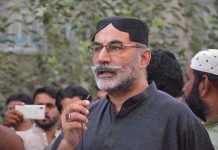







Imprisoned Baloch Yakjehti Committee (BYC) leader Dr Mahrang Baloch has issued a detailed statement from Hudda Jail describing veteran human rights defender Mama Qadeer Baloch as an “exemplary, steadfast and enduring asset of the Baloch national movement.”
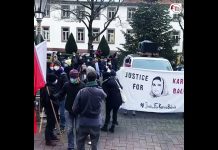
In the statement dated 22 December, Dr Baloch said news of Mama Qadeer’s death reached her inside prison on the same day she and fellow activists were marking the fifth anniversary of Baloch political worker Karima Baloch’s death.
She wrote that during the nine months she and others have spent in detention, they have repeatedly received reports of “ongoing enforced disappearances and extrajudicial killings” in Balochistan. “When people come to visit us,” she said, “my first question is often: Has another innocent person been killed today? And how many more young sons and daughters of my homeland have been disappeared by this ruthless state?”
She said Mama Qadeer’s own struggle began after the enforced disappearance and later killing of his son, Jalil Reki. “Mama did not sink into the grief of his son’s martyrdom,” she wrote. “Instead, he took upon his shoulders the responsibility of securing the recovery of his son’s companions.”
According to Dr Baloch, the Voice for Baloch Missing Persons (VBMP) camp led by Mama Qadeer served as a space where “every political activist in Balochistan received their early political education”.
She said the photographs displayed there for two decades “presented to the world the horrific picture of the Baloch genocide” at a time when Pakistani media “remained silent” and politicians “fabricated false narratives of so-called development”.
‘He never forgot the missing’
Dr Baloch wrote that even during periods when fear silenced many families in Balochistan, Mama Qadeer “did not forget the missing Baloch sons”. He gathered their names and photographs, displayed their details publicly, and challenged state claims denying enforced disappearances.
“As incidents of extrajudicial killings increased,” she said, “one wall of the camp replaced ‘Photographs of Missing Youth’ with ‘Photographs of Martyred Youth’. With the rapid escalation of the Baloch genocide, Mama Qadeer reduced the production of new posters and instead would simply write ‘Released’ or ‘Martyred’ alongside the photographs.”
Dr Baloch also recounted her father’s guidance to her during his own imprisonment. “My father used to say that whenever you felt disheartened by my imprisonment, you should look at the photographs displayed at Mama Qadeer’s camp,” she wrote. “These images testify that people have been missing for years.”
She said Mama Qadeer often carried profound emotional weight when speaking of his son Jalil. “His expression would change when he mentioned his martyred son,” she wrote. “Grief and anger would simultaneously appear in his eyes.”
Dr Baloch said he would tell her that he took Jalil’s son to his grave and told him “the state killed his father after brutal torture and the state is his father’s murderer”, so the child might one day become part of the national movement.
‘A guiding light for all activists’
In her concluding remarks, Dr Baloch said Mama Qadeer’s contributions would endure beyond his death.
“Mama Qadeer will always be remembered as an exemplary and eternal political figure of the Baloch national movement,” she wrote. “His sacrifice, courage and continuous struggle are a guiding light for all political activists associated with the Baloch national movement.”