












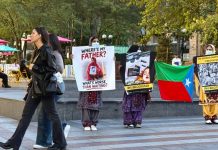
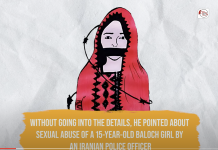
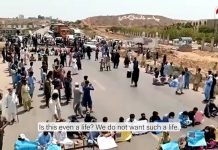
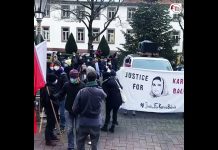



The Baloch Yakjehti Committee (BYC) has announced a five-day campaign beginning today (22 December) to raise national and international awareness about what it describes as a sharp escalation in the enforced disappearances of Baloch women by Pakistani armed forces.
In a statement, the group said the recent surge in enforced disappearances of women marks a “dangerous intensification” of a “systematic policy” targeting the Baloch population.
It warned that the practice is becoming “gradually normalized”, placing women at severe risk and inflicting deep social and psychological damage across Baloch society.
“The enforced disappearance of women is not only a gross violation of fundamental human rights; it is a direct attack on the dignity, survival and collective identity of the Baloch nation. This practice forms part of a broader pattern of repression aimed at silencing and erasing Baloch resistance,” the statement said.
The BYC said several Baloch women had been forcibly disappeared in recent months, including university student Mahjabeen Baloch in May, 15-year-old Nasreena Baloch from Hub Chowki on 22 November, Farzana Zehri from Khuzdar on 1 December, and Raheema Baloch from Dalbandin on 9 December.
The group said the trend has continued this month. On 18 December, Hazra Baloch and her two-year-old son, Brahmdag, were taken from the Daroo Hotel area of Hub Chowki. Two more women — Hani Dilwash and 17-year-old Hairnisa— were allegedly forcibly disappeared from the same area on 20 December.
“These incidents demonstrate that the enforced disappearance of Baloch women is no longer an exception but a systematic policy,” the BYC said. “Remaining silent in the face of this organized and continuous violence amounts to strengthening a policy of Baloch genocide.”
Five-Day Campaign
The BYC said its five-day campaign aims to document lived experiences, mobilize public resistance and draw global attention to what it calls “serious crimes committed by the Pakistani military.”
The campaign will begin on 22 December with the launch of an online petition calling for the recovery of all disappeared Baloch women and an end to the practice of enforced disappearances.
The second day will feature statements and video messages from families of victims, activists and writers, sharing personal testimonies and expressions of solidarity.
On 24 December, the campaign will focus on “art as resistance”, encouraging poetry, letters, visual art and short performances to highlight the human cost of the crisis.
Symbolic protests will be held on 25 December to remember disappeared Baloch women, stand in solidarity with their families and deliver what the BYC described as a “unified message of resistance.”
The campaign will conclude on 26 December with a webinar featuring activists and families of the disappeared. According to the BYC, the session will examine the rising number of cases, discuss on-the-ground realities and explore ways to strengthen advocacy and international engagement.