




















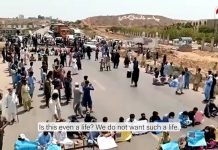




The peaceful sit-in by Baloch families outside the National Press Club in Islamabad entered its 17th consecutive day on Friday, as protesters continue to demand the immediate release of detained Baloch Yekjehti Committee (BYC) leaders and an end to enforced disappearances in Balochistan.
Dozens of protesters, many of them women and children, have been staging a vigil under the open sky in searing summer heat. They insist that missing persons must be produced in courts and granted access to justice as per Pakistan’s Constitution.
Despite the duration of the protest, demonstrators allege that Islamabad’s city administration has failed to grant them permission to install tents or basic shade to protect themselves from the scorching heat. “We’re sitting here in extreme heat without even the right to erect a shelter,” said one participant. “Instead of listening to our demands, we are being harassed and intimidated.”
According to the protesters, roads leading to the National Press Club remain blocked with buses and barbed wire, an apparent effort to shield the protest from public view and media coverage. They report being followed daily by intelligence operatives, filmed without consent, and racially profiled. “Some agents even pose as journalists to record us and intimidate the participants,” claimed one organizer.
The protest has gained support from human rights advocates and civil society actors who argue that the protestors’ core demands – justice, transparency, and due process – are constitutional in nature.
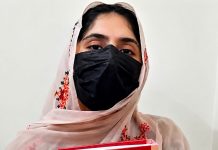
On Friday, speaking at an All Parties Conference organized by the Tehreek-e-Tahaffuz-e-Aaeen Pakistan (Movement for the Protection of Pakistan’s Constitution), Advocate Nadia Baloch reiterated the call for the release of BYC leaders and highlighted the worsening human rights situation in Balochistan.
“The Constitution was meant to protect citizens,” she said, “but now it is being weaponized to legitimize the state’s repression in Balochistan.”
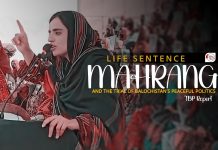
Nadia Baloch offered scathing criticism of Pakistan’s judicial system, describing it as compromised. She cited the case of her detained sister Dr. Mahrang Baloch, whose court hearing is scheduled for Saturday. “We already know she will be sent on remand again. The outcome is predetermined.”
Addressing the state’s accusations that BYC members are working as “proxies,” Nadia Baloch asked: “If the government believes these activists are involved in illegal activities, why has it kept them under MPO [Maintenance of Public Order] for over three months? Why hasn’t any evidence been presented in court?”
The protest in Islamabad is part of a larger wave of Baloch resistance against enforced disappearances, extrajudicial detentions, and shrinking democratic space in Balochistan. Families of the disappeared argue that their loved ones have not been charged, tried, or convicted, yet are being punished outside the legal framework.
As the sit-in enters its third week, protesters remain defiant in the face of state pressure. Their message is simple: release of “illegally detained” BYC leaders and Baloch missing persons, and an end to enforced disappearances in Balochistan.