












By Bahot Baloch
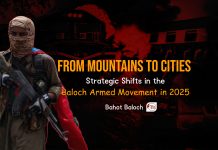
The conflict in Balochistan underwent a marked transformation in 2025, defined by a surge in high-impact attacks, expanding geographic reach and increasingly sophisticated tactics by Baloch armed groups. The year opened with a major assault in its first week and the cycle continued without interruption until December. Reported incidents ranged from Suicide operations, improvised explosive device (IED) attacks and ambushes to road blockades and the temporary seizure of towns and state installations. These operations stretched from the mountainous regions of Kech and Bolan to urban centres including Khuzdar, Mastung and Quetta, and extended into areas such as Jhal Magsi where such activity had rarely been documented before. Pro-independence Baloch groups also expanded operations into neighbouring Sindh and Punjab.
According to official data, Pakistan’s military conducted more than 78,000 operations across Balochistan in 2025, relying heavily on drone strikes, artillery and armoured vehicles. While the military claims successes from these operations, it has not publicly acknowledged the use of drone strikes in Balochistan. In several areas, attempts to advance ground operations reportedly resulted in significant troop and equipment losses.
Major Attacks of 2025
The Baloch Liberation Army (BLA), widely regarded as the most active of the armed groups seeking Baloch independence, launched its first major operation of the year on 4 January. In Turbat, the central city of Kech district, fighters of the group’s Majeed Brigade targeted a convoy of buses carrying Pakistani military personnel using an explosives-laden vehicle. One bus was completely destroyed, killing dozens of personnel on board.
Four days later, on 8 January, special units of the BLA, the Special Tactical Operations Squad (STOS) and the Fateh Squad, seized control of Zehri town in Khuzdar district. Fighters took over police stations, the municipal committee, banks and other government buildings, set up checkpoints and defensive positions, and addressed public gatherings. Control lasted for more than ten hours. When withdrawing, fighters left with seized weapons, ammunition and vehicles. According to the group, the operation formed part of its Operation Herof exercises.
In the final week of January, the BLA said its STOS unit targeted another bus carrying Pakistani troops about 40 kilometres from Khuzdar, using a remote-controlled IED fitted into an explosives-laden vehicle.
The year’s most significant operation occurred in March, when the BLA’s Majeed Brigade hijacked the Jaffar Express train in the Mashkaf area of Bolan. The train, reportedly transporting more than 200 Pakistani soldiers, was held for four days — an incident seen by observers as unprecedented in modern insurgent warfare.
The fighters released civilians, including women and children, at the outset, which observers said was intended to send a positive message internationally. The soldiers were taken into custody as the group presented its demands to the Pakistan Army. The military opted for force rather than negotiations, resulting in the deaths of detained soldiers and further casualties during ensuing clashes. The BLA said the operation was part of the second phase of its Operation Dara-e-Bolan, supported by STOS, the Fateh Squad and the group’s intelligence wing, Zirab.
Rail services across Balochistan were severely disrupted during the year. Following the hijacking of the Jaffar Express, the train and its tracks were targeted in more than 15 subsequent IED attacks, affecting services for months. Most were claimed by the Baloch Republican Guards (BRG).
Just four days after the train hijacking, another major attack took place in Nushki, where a convoy of buses carrying Pakistani military personnel was struck by the BLA’s Majeed Brigade and Fateh Squad. One bus was destroyed in a vehicle-borne explosive attack, while fighters from Fateh Squad opened fire on personnel travelling in another. The BLA claimed that approximately 90 soldiers were killed.
A third major Majeed Brigade operation took place in September in the Dasht area of Kech district, where another convoy travelling from Karachi via Gwadar towards Turbat was attacked. One bus was destroyed in an explosives-laden vehicle attack, while others came under fire from additional fidayeen fighters.
Toward the end of the year, in November, the Balochistan Liberation Front (BLF) carried out one of its largest operations to date. fidayeen from its newly formed Saddo Operational Battalion (SOB) stormed the main Pakistani military camp in Nokundi and maintained control of the installation for more than 24 hours.
Expanded Control and Disrupted Military Supply Lines
Throughout 2025, Baloch armed groups seized control of towns and key highways for varying periods. Military camps, police stations and security checkpoints were raided, with weapons and equipment confiscated. Around 200 explosions were reported across the region, and IED attacks led to the deaths of four Major-rank officers and several Captain-rank officers.
From Mastung to Zehri, the BLA established more than sixteen checkpoints on major and adjoining routes, effectively cutting off military supply lines for months. Similar disruptions were reported in Zamuran. In Kalat and Mastung, Pakistan’s military launched repeated operations to restore supply routes, but faced sustained resistance from Baloch fighters, leading to casualties among senior officers and Special Services Group personnel.
The Evolution of Strategy and Technology
Although the latest phase of the Baloch independence movement has continued for more than two decades, 2025 marked a distinct shift in tactics, organizational structure and long-term planning — a shift that may push the conflict toward a more decisive phase. Over the past eight years, fidayeen operations, temporary seizures of military installations, intelligence-led strikes, control of highways and towns, and the widespread use of IEDs have become defining features of this transformation.
Fidayeen operations have emerged as the most lethal component of the Baloch armed movement. The BLA’s Majeed Brigade has developed the capacity to conduct multiple high-impact attacks within short intervals. It operates with support from the organization’s intelligence wing, Zirab, which is believed to maintain detailed surveillance of Pakistani military movements and the locations of senior officers from Quetta to Gwadar and Karachi.
Attacks such as the Jaffar Express hijacking, the Turbat, Nushki and Dasht convoy operations, and the killings of senior officers in Mastung and Quetta were all attributed by the group to Zirab’s intelligence-gathering.
The BLF, the second major armed group in Balochistan, has also formed its own fidayeen unit — the “Saddo Operational Battalion (SOB)” — a development expected to further intensify the conflict. The creation of the battalion suggests that Baloch groups increasingly view high-intensity attacks as the only viable path for pushing the war toward a decisive phase.
The BLA has also placed increasing emphasis on IED warfare. The group claimed responsibility for more than fifty IED attacks in 2025. Videos released through its Hakkal media channel show blasts that the group says killed dozens of Pakistani soldiers.
Security analyst Iftikhar Firdous told the BBC that armed groups in Balochistan were now acquiring weapons and technologies previously uncommon in such conflicts.
“After 2021, we saw U.S. and NATO weapons fall into the hands of these groups. But now, systems and technologies are appearing that militants rarely possessed in the past,” he said.
He said that Baloch fighters were increasingly using IEDs capable of targeting the frequencies of military jammers, devices that have contributed to a rise in casualties among Pakistani forces. “These devices defeat conventional protective measures, which is why more officers and soldiers are being killed.”
Urban Expansion and Public Visibility
Baloch armed groups increasingly pushed the conflict toward urban centres. Throughout the year, the BLA temporarily seized towns such as Zehri, Manguchar, Surab, Mastung and Panjgur, directly challenging state authority. These operations increased public visibility and allowed fighters to acquire weapons and ammunition essential for guerrilla warfare.
In the Dasht area, roughly 40 kilometres from Quetta, fighters established roadblocks and carried out operations along major highways. Inside Quetta itself, at least three incidents were reported in which weapons were seized from police personnel.
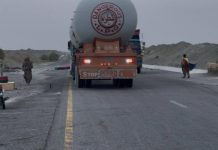
Control over key highways was reported to have significant consequences not only for military logistics but also for the transportation of minerals across Balochistan. In Mastung, several incidents were reported in which truck operators were warned by armed groups to halt movement. Vehicles belonging to those who reportedly failed to comply were later set on fire, according to local accounts.
A Conflict Entering a Decisive Phase
The influx of new recruits, including university-educated youth, has reshaped the Baloch armed movement, adding technical capacity, organizational discipline and a new generation of fighters who are altering the trajectory of the conflict. Armed groups appear to be strengthening their internal structures, forming specialized squads, and placing greater emphasis on coordination, intelligence and political education. These developments are reflected in increasingly coordinated nature of attacks and the adoption of more complex operational strategies.
Despite a long-running media blackout in Balochistan, armed actions were reported almost daily throughout 2025, including several large coordinated operations. The Pakistan Army, meanwhile, struggled to contain or obscure casualties and operational setbacks, even as it expanded its use of heavy artillery, armoured vehicles and drone strikes.
Baloch armed groups also suffered losses, and analysts expect casualties on all sides to rise as the conflict intensifies.
Pakistan’s Army Chief Asim Munir, echoing rhetoric previously used by General Pervez Musharraf, raised his fist and challenged the Baloch “for seven generations.” Yet developments over the past year indicated that the military is now confronting some of its most serious challenges in years. In Zehri, tanks and artillery were deployed; in Bolan, jet aircraft carried out strikes; and drone operations were reported throughout the region.
The shifts in strategy, geography, weaponry and state response indicate that the conflict in Balochistan has moved far beyond a low-intensity phase and is entering a more expansive, sustained and technically sophisticated stage. Developments throughout 2025 suggest that the coming years may bring an even deeper and more complex confrontation across the region.