






By: Zanish Baloch
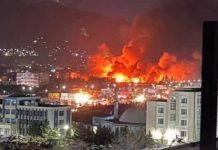
In central Balochistan, a remote inside town called Zehri has become a grim emblem of Pakistan’s longest-running counterinsurgency. Since early September 2025, Zehri, a tehsil in Balochistan’s Khuzdar district, has been under intense military siege, sealed off by checkpoints, surveillance drones, and artillery fire. This siege shows how the government doesn’t trust people in distant areas and tries to control them by suppressing them.
What Islamabad calls a “targeted operation” has, according to local accounts and human rights groups, turned into one of the worst instances of military repression in recent Balochistan history, leaving dozens dead, entire families buried, and locals living under curfew and fear. The phrase “targeted operation” hides the truth that it is actually collective punishment meant to instill obedience through fear, showing that the goal is control instead of real peace.
Counterinsurgency or Civilian Targeting?
The military claims its operations aim to suppress armed groups. Yet Zehri had been under control of the Baloch umbrella armed organization Baloch Raaji Aajao Sangar (BRAS) since August 11. Despite this, Pakistan declared its operation a success while the area remained under BRAS influence well into October. This shows that the government focuses more on claiming success than truly controlling the area, using propaganda and force to maintain a false image of power.
Pakistan’s counterinsurgency laws are meant to regulate military operations, safeguard civilians, and prevent abuse. In Zehri, however, these laws appear to have been selectively applied or ignored entirely. Security forces detained civilians arbitrarily, seized property, destroyed infrastructure, and carried out airstrikes on noncombatants under the pretext of targeting insurgents. Such selective use of law turns it into a tool of power instead of protection, letting the state justify its actions while blurring the line between justice and violence.
Zehri Under Siege
The siege began in early September after BRAS took control of Zehri in August. Residents recount that BRAS had been the main authority since August 11, yet military operations proceeded as if the town were fully under Pakistani control. Local life became a battlefield: checkpoints, drone patrols, and artillery disrupted daily routines while the state framed the operation as a counterinsurgency success. This twisting of ground realities shows that controlling the story is as important to the state as controlling the land itself.
Prior to the siege, Pakistani forces stopped a passenger van near Pir Umer, Khuzdar district, traveling from Hub Chowki to Zehri, and detained all the men on board. When families gathered to protest, security forces opened fire, injuring two. One resident told local media, “We tried to ask for our men back, but the soldiers started shooting; we were powerless to stop them.”
This deliberate mix-up destroys people’s freedom, making normal things like traveling, protesting, or speaking out seem like crimes, as if simply living is dangerous.
On September 15, the Human Rights Council of Balochistan reported that three civilians were killed in an airstrike and that thousands were trapped without food, water, or medicine due to the curfew. Two days later, a drone strike killed three more, including two women, and injured five others near Terasani. Those killed were Bibi Amna, Lal Bibi, and Muhammad Hassan, while one injured, Ali Akbar, was later detained. Frontier Corps personnel intercepted the injured en route to the hospital, further restricting civilian access to care and reinforcing a climate of fear. Denying medical care becomes another kind of violence, making basic health and survival something they can only get if they obey.
According to the HR Council of Balochistan, another strike on October 1 in Noorgama killed four civilians near cotton fields, followed by air raids in Moola Pass. The bombardments continued into October, with further strikes hitting civilian areas. The continued use of force, even after many civilians are killed, shows a military mindset that sees human lives as collateral, relying on the fact that few are watching.
Independent verification is nearly impossible, but local news outlets and human rights organizations suggest at least a dozen civilians were killed in the first month, underlining a systematic pattern of civilian targeting that stretches beyond conventional counterinsurgency operations.
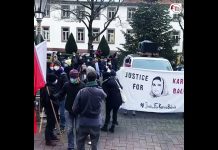
The Baloch Yakjehti Committee (BYC), one of the main organizations monitoring the situation, condemned the ongoing military siege, calling it a “severe violation of human rights and international laws,” and urged international communities and global media to take urgent notice and hold Pakistan accountable against collective punishment of the Baloch population. By calling these acts “collective punishment,” local activists and rights groups challenge the state’s narrative, standing up for what is right and sharing the truth.
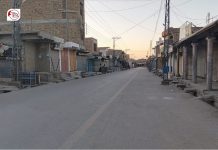
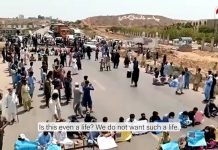
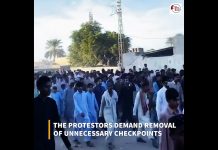
Civilians face more than bombs; the siege disrupts daily life, cuts off access to food and medicine, and imposes a curfew that isolates the population.
The Moola Pass Massacre
On October 5, jets, drones, and helicopters bombarded the Moola Pass area of Bel Chari, killing six civilians, including women and children, and injuring three others. Victims included Manzoor Ahmed, his two children, a nephew, and Bibi Raheema with her child. Survivors reported returning from a funeral only to be struck by military aircraft.
Times of grief turn into moments of massacre, showing a strategy that aims not just to kill people but to destroy the community rituals that help them stay strong and connected.
A day later, a young man in Noorgama was shot dead simply for stepping outside his home. Witnesses described soldiers firing without warning. These acts reveal how ordinary life, like funerals or daily routines, became lethal, instilling fear across the population.
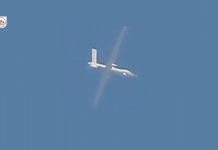
By October 18, residents described relentless drone activity, shelling, helicopter raids, and the movement of tanks. A local resident said, “It feels like living under permanent surveillance.” The communication blackout amplified this effect. Surveillance becomes both a weapon and a message, with the constant presence of the state showing control over both land and truth.
Ground Operations and Displacement
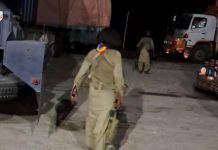
As airstrikes continued, ground troops advanced into Zehri’s villages. Residents said the army occupied the only civil hospital, turning it into a military camp. One pregnant woman allegedly died after being denied care. Soldiers seized farmland and coerced young men into labor on construction projects. Civilians were required to show identification at checkpoints and record their movements.
This militarization of civilian institutions blurs governance and warfare, showing how control of health, labor, and movement becomes part of counterinsurgency tactics.
Several families fled to other towns of Khuzdar and Hub Chowki. Cotton fields were destroyed, shops and hotels burned, and transport halted. One displaced shopkeeper said, “Daily life has become a nightmare. We cannot work, cannot leave, cannot even mourn.” The operation illustrates how military power extended beyond the battlefield to control social, economic, and civic life, dismantling local autonomy.
“Zehri, in Khuzdar district, remains under a severe military siege,” wrote BYC leader Dr. Sabiha Baloch on X (formerly Twitter) on October 15. “All roads are blocked, civilians are trapped, and communication is cut. Drone strikes and raids have killed children and destroyed homes.” Sharing stories online becomes the only way people can resist, letting the voices of those under siege reach beyond censorship and silence.
A Widening Pattern in Balochistan
The violence in Zehri is part of a broader pattern. According to Paank, the human rights wing of the Baloch National Movement, a similar strike took place on October 28 in the Chiltan Hills near Quetta, injuring nine unarmed teenagers who had gathered for a picnic. This shows these attacks are not occasional mistakes but part of a deliberate system, making civilian targeting a normal part of Pakistan’s approach to Baloch dissent.
BBC Urdu reported that authorities were reluctant to comment. The military’s media wing, ISPR, claimed it had targeted “fourteen Indian-sponsored terrorists,” but local sources later revealed all the victims were civilians.
Blaming “foreign sponsorship” shifts attention, making domestic repression seem like national defense while the state keeps control over dissenting people.
Paank documented 785 enforced disappearances and 121 extrajudicial killings in the first half of 2025 alone. Patterns of airstrikes, shootings, and abductions suggest a deliberate strategy of population control, with counterinsurgency laws manipulated to provide legal cover for civilian repression.
Political Outrage and Denial
Former Chief Minister Akhtar Mengal called the siege cruelty, noting, “For 2 months a road blockade has cut off food, medicine & livelihood. Children are suffering, the cotton crop is destroyed, & families are desperate. How long will innocent Baloch lives be held hostage to power politics?” His statement shows the gap between Baloch political voices and the federal government, where even showing concern is treated as opposition.
Baloch nationalist groups denounced “collective punishment” and demanded independent access for journalists and aid. Yet the military persisted in framing the operation as targeting insurgents, leaving civilians’ lived experiences invisible. By ignoring people’s suffering in official statements, the state protects itself from blame, because if the victims are denied, the crime is ignored too.
International Condemnation
Both Amnesty International and the Human Rights Commission of Pakistan (HRCP) condemned the civilian deaths. Amnesty urged the government to “end the use of indiscriminate force in populated areas,” while HRCP called for immediate restoration of essential services and the release of abducted civilians.
Human rights groups demand independent investigation, restoration of communications, and safe corridors for aid. For many in Zehri, justice feels distant. “We are not militants,” said one survivor from Moola Pass. “We are farmers. Yet our homes are rubble, our children gone, and no one outside knows.”
International attention, however, has been minimal. Unlike Gaza or Myanmar, Balochistan’s conflicts seldom make global headlines. Rights groups say this invisibility has emboldened the state to act with impunity. Silence in this case is a form of complicity, showing a global failure that lets oppression continue unchecked.
Beyond Zehri
The violence in Zehri reflects a deeper tension that has haunted Balochistan for decades: a struggle over identity, autonomy, and the state’s use of force. The region, rich in natural resources yet mired in suppression, has long been the site of separatist movements demanding independence from Pakistan. The state’s heavy militarization has only deepened alienation.
This repeated cycle of rebellion and repression shows the deeper roots of the conflict, where Pakistan’s federal system continues a colonial pattern, with resource extraction and political exclusion shaping the region. Analysts warn that the current operation, far from quelling unrest, may further radicalize local people. “When entire families are wiped out and labeled as terrorists, it destroys any possibility of reconciliation,” said a Karachi-based human rights lawyer.
Each violent attack gives more energy to the Baloch struggle, making the cost generational.
For now, Zehri remains cut off. As the curfew stretches into November, survivors struggle to reach hospitals, bury their dead, and rebuild. Human rights monitors continue to demand access, but few expect accountability.
Pakistan’s actions in Zehri go beyond military tactics, amounting to systematic repression of civilians, misuse of counterinsurgency laws, and a campaign increasingly described as a genocide of the Baloch people. The contrast between Pakistan’s claims of “success” and the reality of BRAS control highlights the deliberate targeting of civilians to conceal operational failure, reflecting decades of oppression and structural violence.
For the international community, Zehri is a reminder that crises in forgotten places often foretell the world’s next emergencies.
Disclaimer: The views and opinions expressed in this article are those of the author and do not necessarily reflect the official policy or position of The Balochistan Post or any of its editors.