












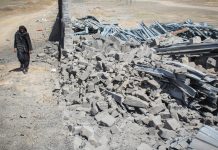
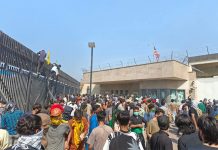




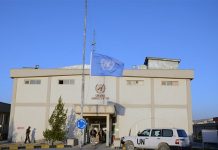


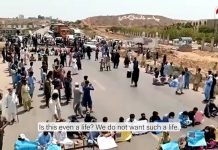





Israel and Iran continued to exchange missile and drone strikes late Saturday night into Sunday, raising fears of a broader regional war. Confirmed reports suggest Israel targeted Iran’s Ministry of Defense facilities and locations it claims are linked to Iran’s nuclear program, while Iranian strikes caused multiple fatalities and damage deep inside Israel, including in Tel Aviv and Haifa.
According to Israel’s Magen David Adom rescue service, at least 10 people were killed in Iranian strikes overnight, raising Israel’s total death toll to 13. Iranian state media and its UN mission said Saturday that 78 people had died in Israeli strikes on Iranian military and nuclear installations, including several high-ranking officials. There was no updated toll on Sunday, but new explosions were reported in Tehran.
Iran’s Islamic Revolutionary Guard Corps (IRGC) confirmed that Gen. Amir Ali Hajizadeh, head of its aerospace division, and seven of his senior deputies were killed in Friday’s Israeli airstrike. The Guard has not explained why all eight men were gathered at a single location.
In retaliation, Iran launched a new wave of missiles targeting Israeli civilian and energy infrastructure. Iranian strikes reportedly caused damage at an oil refinery in Haifa and killed at least six civilians in Tel Aviv suburb Bat Yam, including two children. A separate strike in Tamra killed four, including a 13-year-old, and injured 24 others.
Explosions were also heard across Jerusalem and Tel Aviv early Sunday morning. According to Israeli media, the country’s air defense system intercepted several incoming projectiles, though some missiles evaded defenses and struck residential buildings and infrastructure.
Iran’s government announced that metro stations and mosques would begin serving as bomb shelters from Sunday night, indicating Tehran expects further Israeli assaults. Meanwhile, Iranian media said Israel targeted Shahran oil depot in western Tehran. Videos posted by semi-official sources showed large fires at the site. The damage, officials claimed, was later contained.
Strategic and Diplomatic Fallout
The Israeli military issued a public warning in Persian, urging Iranian civilians to evacuate military production sites, signaling more strikes may be imminent. The military also claimed to have struck Iran’s South Pars gas field – the world’s largest – forcing Iran to partially halt operations. If verified, this marks a significant escalation with global economic implications, as oil prices jumped 9% on Friday due to fears of disrupted energy exports.
Iran’s Foreign Minister Abbas Araghchi repeated that Iran does not seek nuclear weapons but insisted the country would not relinquish its “nuclear rights.” He described Israeli strikes as being carried out with “direct support from Washington.” However, former U.S. President Donald Trump denied American involvement, though he warned Tehran that any attack on U.S. interests would provoke an overwhelming military response.
Planned nuclear negotiations between Iran and the U.S. were called off following the Israeli bombardment. Oman, a key mediator, confirmed the sixth round of indirect talks – scheduled for Sunday – had been cancelled. Oman’s Foreign Minister reiterated that diplomacy remains the only viable path to peace.
Regional Militias Threaten U.S. Forces
Amid rising tensions, Iran-aligned Iraqi militia Kataib Hezbollah issued a stark warning to the United States, threatening to attack American bases in the region if Washington becomes directly involved in the Iran-Israel confrontation.
A statement by the group said it is “closely monitoring U.S. military movements” and declared that “any U.S. interference in the Iran-Israel war” would result in strikes on American installations across the region.
This was the first direct threat against U.S. forces by the group since open hostilities between Israel and Iran erupted earlier this month. Although the militia did not claim responsibility, three drones were shot down on Friday near Ain al-Asad base housing U.S. troops in western Iraq.
Escalation Outlook
As of Sunday afternoon, Israel’s airspace and Ben Gurion International Airport remained closed for the third consecutive day. Ground crossings with Jordan and Egypt stayed open. Israeli authorities said repatriation of stranded citizens may take time, depending on the security situation.
Prime Minister Benjamin Netanyahu, in a video address, warned that Israel’s current response is “nothing compared to what will come.” Iran’s leadership, meanwhile, cautioned that any further Israeli aggression would provoke “more severe and expansive retaliations.”
Iran’s IRGC stated that it has already used missiles and drones to target Israel’s energy infrastructure and warned of even heavier strikes if attacks continue.
The situation remains volatile with no diplomatic breakthrough in sight. World leaders have urged restraint, but both sides appear committed to pursuing military options over dialogue.